
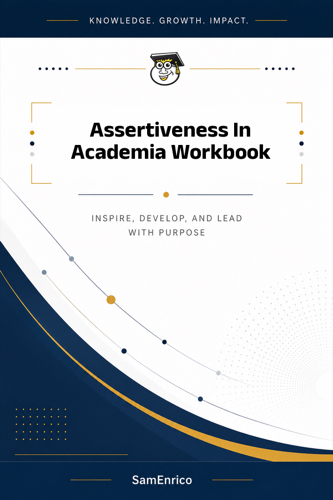
Non-FictionSelf-HelpAcademic Life
Assertiveness In Academia Workbook eBook
Navigates advisor relationships, publication credi
by Fort Nova
Navigates advisor relationships, publication credit, and department politics.
Formats
Free sample
Chapter 1: The CV Killer--–- The email arrived at 11:47 PM on a Tuesday. Your advisor had just finished reviewing the draft you submitted two weeks late because you were also teaching an extra section for a colleague who was “going through something.” The advisor’s feedback is three sentences long: “This needs more work. Let’s discuss Friday. Also, can you run the stats for my R01 grant by Thursday?” You type “Absolutely, thank you for the feedback” before you realize your fingers have moved without your permission. Then you close your laptop, stare at the ceiling, and feel something you cannot yet name.
It is not exhaustion. It is not resentment. It is the quiet, accumulating realization that you are working harder than everyone around you, but your CV does not show it.Welcome to the hidden curriculum of academia. No one taught you that saying “yes” to everything would cost you the one currency that actually matters: credit. This chapter is not about imposter syndrome as a feeling.
It is about imposter syndrome as a tax—a tax you pay every time you fail to claim what you have earned, every time you assume your work will speak for itself, every time you confuse “being helpful” with “building a career.” By the end of this chapter, you will have a name for that 11:47 PM feeling. You will have a self-assessment that quantifies your passivity. And you will have a roadmap to the rest of this book, because passivity is not a personality flaw. It is a set of behaviors, and behaviors can be unlearned.The Publish-or-Perish Machine: Why Your Silence Costs You Academia runs on a simple, brutal logic: publish or perish. But what no one tells you is that publishing is only half the equation.
The other half is crediting. You can do the work of three people, but if your name is not first author, if your contribution is buried in acknowledgments, if your idea ends up as a footnote in someone else’s paper—you have, for all practical purposes, not done the work. The tenure committee does not read your emails. They do not know you stayed up until 3 AM to fix a co-author’s analysis. They see author order, publication counts, and citation indices.
That is it.This creates a specific kind of stress that is unlike any other profession. A surgeon who saves a life gets credit in the medical record. A lawyer who wins a case gets their name on the filing. But in academia, credit is negotiated, contested, and frequently stolen. And the power imbalance is staggering.
A full professor can take your data, present it as their own, and suffer no consequences—because the department chair used to be their co-author. A graduate student who complains about unfair authorship is labeled “difficult” and “not a team player.” The system is not broken. It is working exactly as designed. The question is whether you will learn to navigate it or be crushed by it.The first step is understanding how passivity operates. Most academics do not think of themselves as passive.
They think of themselves as collaborative, diligent, humble. But in a system where no one hands out credit for free, humility is a liability. Consider the following scenarios. How many of them describe you?You complete a data analysis for a senior colleague. When the paper comes out, you are in the acknowledgments, not the author list.Your advisor suggests “adding their name” to your first-authored paper because “it will help with review.” They do not write a single sentence.At a conference, a fellow graduate student presents your research findings as their own.
You say nothing because “they probably just forgot to cite me.”A committee member asks you to serve on an extra working group. You say yes even though you are already behind on your dissertation.A journal reviewer demands you cite their own irrelevant papers. You add the citations because “it’s not worth the fight.”If you recognized even two of these, your passivity is already hurting your CV. And the damage is cumulative. Every time you accept unfair authorship, you lose a line on your CV.
Every time you say yes to uncompensated service, you lose hours you could have spent writing. Every time you stay silent when your work is stolen, you train everyone around you that you are an easy target. The good news is that passivity is not destiny. But you cannot fix what you cannot measure.Self-Assessment Quiz: Is Your Passivity Hurting Your CV?This assessment is designed to diagnose the specific ways passivity shows up in your academic life. Do not answer how you wish you would behave.
Answer how you actually behaved in the last twelve months. For each statement, rate yourself from 1 (never) to 5 (always).I have accepted an authorship position (e.g., third author instead of first) that did not reflect my actual contribution.I have said “yes” to a service request (committee, review, guest lecture) that I knew would delay my own research.I have stayed silent when a senior colleague presented my work without attribution.I have agreed to analyze data or write sections for a paper I was not listed as an author on.I have hesitated to submit a paper because I was afraid of rejection or critical feedback.I have allowed an advisor or co-author to make substantive changes to my writing without discussion.I have deleted an email draft that pushed back on authorship or credit because it felt “too aggressive.”I have worked on weekends or holidays to meet someone else’s deadline while my own projects slipped.I have been listed as “co-first author” when my contribution was clearly greater than the other co-first.I have told myself “it’s not worth the fight” about a credit dispute at least three times.Scoring:10-20: Low passivity. You are already asserting yourself reasonably well. Use this book to sharpen specific skills.21-35: Moderate passivity. You are losing credit in specific domains.
The following chapters will target those gaps.36-50: High passivity. You are systematically undervaluing your work. This book is your intervention.If you scored in the moderate or high range, take a breath. You are not weak. You are not foolish.
You were trained to be this way. The remainder of this chapter explains that training—and then gives you a roadmap out.The Systemic Origins of Academic Passivity: It Is Not Your Fault You did not arrive at graduate school as a blank slate. You arrived as a product of an educational system that rewarded obedience above all else. In undergraduate and early graduate coursework, the rules are clear. Professors set deadlines.
You meet them. Professors assign topics. You write about them. Professors evaluate your work. You accept their judgment.
This is not a conspiracy. It is an efficient way to train large numbers of students. But it is also a trap.The “good student” identity is built on three pillars. First, never refuse a task. Saying no to a professor feels like insubordination because, in coursework, it is.
Second, assume authority is benevolent. Your professors have earned their positions, so their demands must be reasonable. Third, avoid negotiation.…
This is the end of the free sample. Get the eBook to keep going. Buy now
About this book
Details
- Author
- Fort Nova
- Publisher
- SamEnrico
- Language
- English
- Genre
- Non-Fiction, Self-Help, Academic Life
- Released
- 2026-06-09
- Pages (approx.)
- 143
- Available as
- eBook, Audiobook

Read better in the ZLOADR app
Your eBooks on your phone or tablet. Sign in with your SamEnrico account and start reading.
More by Fort Nova
 Stress Hormones ExplainedFort Nova$11.99
 ABCDE for Tax PreparationFort Nova$11.99
 The Sustainable Emotion Regulation GuideFort Nova$11.99
 ABCDE For Car MaintenanceFort Nova$11.99
 Understanding Ringed Hair DiseaseFort Nova$17.99
 How to Start a Drawing Machinery for Textiles Business (Beginners Guide)Fort Nova$11.99
 International Student Support RwandaFort Nova$12.99
 VAT Deregistration GuideFort Nova$12.99
 Mixed ClimbingFort Nova$11.99
You may also like
 Hong Kong Handover 1997Dunn Johnnie$11.99
 Zumba For Postnatal Recovery CourseNeal Christian$11.99
 Zumba for BeginnersLadner Nikia$11.99
 YouTube Comment Mining GuideHumes Pandora$12.99
 Worry Box MeditationCarlin Rudy$11.99
 Workplace Stress MeditationNguyen Lynn$11.99
 Workplace Stress and Sleep RepairHawley Ivory$11.99
 Workplace Perfectionism CureDelaney Jeffry$11.99
 Workplace Injustice Anger GuideWallen Isabelle$11.99
 Work Addiction and Burnout LinkGreenwood Ester$11.99
 Women in Yoga and WellnessBeattie Galina$11.99
 Women in Stand Up ComedyChun Evangeline$11.99