
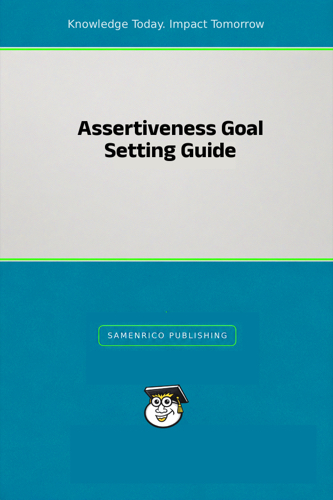
Non-FictionSelf-HelpGoal SettingAction
Assertiveness Goal Setting Guide Audiobook
Create specific, measurable assertive behavior goa
by Graff Kena
Create specific, measurable assertive behavior goals with action plans.
Formats
Free sample
Chapter 1: The Four Faces--–- You have been lied to about assertiveness. Not maliciously, but systematically. Nearly every book, seminar, and TED talk on the subject has presented assertiveness as a personality trait—something you either have or don’t have, like height or eye color. They tell you to “be more confident,” “find your voice,” or “stand up for yourself” as if these are light switches you can simply flip. They are not.
They are outcomes, not actions. And confusing the two has kept millions of otherwise capable people trapped in cycles of resentment, silence, and occasional explosions.This chapter dismantles that lie. You will learn that assertiveness is not a single thing. It is a set of observable, measurable behaviors that fall into four distinct patterns. By the end of this chapter, you will be able to look at any interpersonal interaction—your own or someone else’s—and name exactly which pattern is operating.
More importantly, you will take your first measurement. You will establish a baseline. Because you cannot improve what you have not counted.The Four Communication Styles: A Behavioral Field Guide Every time you interact with another human being, you are communicating in one of four ways. These are not personality types. They are behavioral choices, often automatic, but choices nonetheless.
The four styles are Passive, Aggressive, Passive-Aggressive, and Assertive. Each has a distinct set of observable behaviors that can be seen, heard, and measured.Let us be very clear about what we mean by “observable.” An observable behavior is something that another person could record with a camera and a stopwatch. Eye contact duration. Volume in decibels. Specific words spoken.
Posture. Timing. These are facts, not interpretations. You cannot observe “confidence” or “respect” or “anger.” You can observe a clenched fist, a raised voice, an apology, or a pause. This distinction is the entire foundation of this book.The Passive Pattern: The Invisible Exit Passive communication is the art of disappearing while remaining in the room.
The passive person speaks softly, often trailing off at the end of sentences. They avoid eye contact, looking at floors, phones, or anywhere except the other person’s eyes. Their vocabulary is rich with hedges: “maybe,” “sort of,” “I just think,” “this might be a bad idea but.” They apologize excessively, even when they have done nothing wrong. “Sorry, but could I ask a question?” “Sorry to bother…
This is the end of the free sample. Get the Audiobook to keep going. Buy now
About this book
Details
- Author
- Graff Kena
- Publisher
- SamEnrico
- Language
- English
- Genre
- Non-Fiction, Self-Help, Goal Setting, Action
- Released
- 2026-06-09
- Pages (approx.)
- 153
- Available as
- eBook, Audiobook

Listen in the VoxFlicks app
Audiobooks and audio dramas wherever you go. Sign in with your SamEnrico account and press play.
More by Graff Kena
 Recovery From Chronic Low Grade BurnoutGraff Kena$11.99
 Breaking the Humor Deflect HabitGraff Kena$11.99
 Anger After Partner's LyingGraff Kena$11.99
 Pre Talk Momentum CheckGraff Kena$11.99
 Shadows of the Warring States: Sun Tzu's Battles That Redefined WarGraff Kena$11.99
 EV Motorcycle Adoption GuideGraff Kena$12.99
 Data Presentation Q And PrepGraff Kena$12.99
 Lead ProgrammerGraff Kena$11.99
 Understanding Macrodactyly of The FootGraff Kena$17.99
 How to Become a Draw-bench OperatorGraff Kena$11.99
You may also like
 Hong Kong Handover 1997Dunn Johnnie$11.99
 Zumba For Postnatal Recovery CourseNeal Christian$11.99
 Zumba for BeginnersLadner Nikia$11.99
 YouTube Comment Mining GuideHumes Pandora$12.99
 Worry Box MeditationCarlin Rudy$11.99
 Workplace Stress MeditationNguyen Lynn$11.99
 Workplace Stress and Sleep RepairHawley Ivory$11.99
 Workplace Perfectionism CureDelaney Jeffry$11.99
 Workplace Injustice Anger GuideWallen Isabelle$11.99
 Work Addiction and Burnout LinkGreenwood Ester$11.99
 Women in Yoga and WellnessBeattie Galina$11.99
 Women in Stand Up ComedyChun Evangeline$11.99