
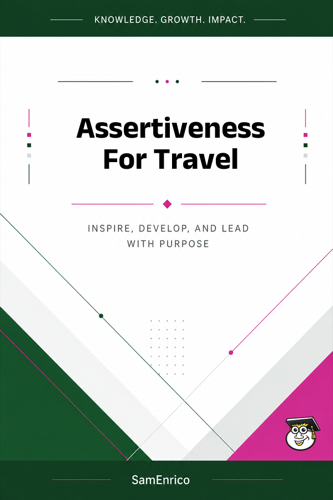
Assertiveness For Travel eBook
Handle flight changes, hotel issues, and rental ca
by Weber Viola
Handle flight changes, hotel issues, and rental car problems.
Formats
Free sample
Chapter 1: The Silence Tax--The first time Eleanor paid the Silence Tax, she didn’t even know she was doing it. She was standing at a rental car counter in Phoenix, exhausted after a three-hour flight delay. The agent slid a contract toward her and said, “Just initial here—there’s a small scratch on the rear bumper, but don’t worry about it.” Eleanor initialed. She didn’t look at the scratch. She didn’t ask to see it.
She didn’t write “pre-existing damage” on the contract. She just wanted to get to her hotel and sleep.Seventeen days later, her credit card was charged $419 for “collision damage.” The rental company sent photos of a dent Eleanor had never seen. She called customer service. She wrote emails. She disputed the charge.
She lost. “You initialed the contract,” the supervisor told her. “The damage was noted.” Except it wasn’t—not really. The agent had said “don’t worry about it,” but the fine print said otherwise. Eleanor paid $419 for the privilege of being polite.That is the Silence Tax.
It is the price you pay when you choose comfort over clarity, when you prioritize not being a bother over protecting your own interests. Most travelers pay this tax every single year. They pay it in rental car fees, in non-refundable hotel charges, in missed flight compensation, in upgraded seats they never received, in rooms that smelled like smoke but they were too tired to complain. The average American traveler loses an estimated $287 annually to the Silence Tax—not from fraud, not from bad luck, but from a simple, profound failure to speak up at the right moment, in the right way.But here is the paradox: the opposite of silence is not yelling. Most travelers believe there are only two options: shut up and take it, or blow up and demand a manager.
Both fail. Silence costs you money and dignity. Yelling costs you leverage and respect. Between them lies a third path—assertiveness—and it works because it is modeled not on street arguments or internet comment sections, but on the cockpit of a commercial airliner, where clear communication is literally a matter of life and death.This book is about that third path. It is about learning to say “I need” instead of “I want.” It is about documenting before disaster, escalating without anger, and walking away when walking away is the only power move left.
By the time you finish this chapter, you will understand why silence is not kindness, why yelling is not strength, and how a single sentence—“I need you to note that on the contract before I leave this counter”—could save you more money than this book costs.The Three Traveler Personas Every traveler falls into one of three behavioral categories. These are not personality types; they are situational responses. You might be assertive at work and submissive at a hotel desk. You might be aggressive in traffic and silent at an airport gate. But over time, most people develop a default.
Your default determines how much you pay.Persona One: The Submissive Traveler The submissive traveler confuses politeness with powerlessness. They believe that being nice means never causing inconvenience. They say “I’m sorry” before stating a problem. They accept the first offer. They avoid eye contact with gate agents during cancellations because they don’t want to be “that person.” They pay the Silence Tax every single time.Submissive script: “Oh, I guess it’s fine… I don’t want to be a bother… Is there any chance you could maybe help me whenever you have a moment?”The cost of submission: The submissive traveler is not seen as kind.
They are seen as easy. Agents process thousands of passengers; they do not reward the quiet ones. They reward the ones who speak clearly. Submission signals that your problem is optional. The agent moves on to the next person.Persona Two: The Aggressive Traveler The aggressive traveler confuses volume with victory.
They believe that the loudest person wins. They interrupt. They demand managers. They threaten bad reviews before the agent has finished speaking. They burn bridges so thoroughly that even when they get what they want, they leave a trail of resentment that ensures no one will go above and beyond for them next time.Aggressive script: “This is ridiculous!
I want a manager right now! Do you know how much I paid for this trip?!”The cost of aggression: Aggression triggers defensiveness. When an agent feels attacked, their brain shifts from problem-solving to self-protection. They will do the bare minimum required by policy—and nothing more. Worse, they will document your behavior in your file.
The next agent you speak to will see the note: “Customer was abusive.” That note follows you. Aggression is a short-term win that creates long-term losses.Persona Three: The Assertive Traveler The assertive traveler confuses neither politeness with weakness nor volume with power. They state facts. They name needs. They ask questions that invite solutions.
They understand that the person across the counter is not the enemy; the policy, the system, the breakdown—those are the obstacles. The agent is a potential ally. Assertiveness builds bridges that survive the crisis.Assertive script: “I have a confirmed reservation. The room I was given has a broken lock. I need a different room or a repair within fifteen minutes.
How would you like to handle this?”The benefit of assertiveness: The assertive traveler is taken seriously. They are not dismissed as a pushover or written off as a screamer. They are treated as a partner in problem-solving. Agents, who are screamed at dozens of times per day, will move mountains for a calm, clear, respectful customer. Not because they are nice—because it is easier.The Cirrus Crash: What Happens When You Are Too Polite In 2011, a 59-year-old pilot named Dianna St.
Clair flew her Cirrus SR22 into a thunderstorm near Ocala, Florida. She had filed a flight plan. She had checked the weather. But as she approached the storm, the air turned violent. Rain hammered the windscreen.
The plane began to buffet. Air Traffic Control radioed: “Say your intentions.”What Dianna should have said was: “Unable. Requesting immediate diversion to alternate airport.” That is the standard aviation phrase for “I cannot do what you are asking, and I need a different solution.” It is a phrase taught to every pilot. It is a phrase that saves lives.What Dianna actually said was: “I’ll try to make it through.”She crashed. She survived—miraculously—but the NTSB report was damning.
The probable cause, the investigators wrote, was “the pilot’s failure to declare an emergency and her continued flight into adverse weather conditions.” She knew the storm was dangerous. She knew she should divert. But she was too polite to tell Air Traffic Control “Unable.”The Cirrus crash is the Silence Tax in its most extreme form. Most of us will not crash a plane because we are too polite. But we will pay $419 for a scratch we didn’t cause.
We will sleep in a room that smells like smoke because we don’t want to complain. We will miss a…
This is the end of the free sample. Get the eBook to keep going. Buy now
About this book
Details
- Author
- Weber Viola
- Publisher
- SamEnrico
- Language
- English
- Genre
- Non-Fiction, Self-Help, Travel
- Released
- 2026-06-07
- Pages (approx.)
- 155
- Available as
- eBook, Audiobook

Read better in the ZLOADR app
Your eBooks on your phone or tablet. Sign in with your SamEnrico account and start reading.
More by Weber Viola
 Mentorship for Family Business SuccessionWeber Viola$11.99
 Creative Block FAQWeber Viola$11.99
 The MBSR for Dental AnxietyWeber Viola$11.99
 Spin Class Survival ManualWeber Viola$11.99
 Active Listening For DementiaWeber Viola$11.99
 Dance Injury Prevention GuideWeber Viola$11.99
 Snow Driving Anger GuideWeber Viola$11.99
 Sukha Tranquil Breath StateWeber Viola$11.99
 The Phantom Fleet: How a Secret Navy Changed the Course of WWIIWeber Viola$11.99
 The Old Trafford Divorce: How Manchester United and City's Feud Split a Football FamilyWeber Viola$11.99
 The House That Rothschild Built: A Financial Empire Across ContinentsWeber Viola$11.99
 The Mineral Guide to SchoepiteWeber Viola$11.99
You may also like
 Travel Conversation StartersBower Illa$11.99
 The Travel Comparison GuideNorfleet Tandy$11.99
 SMART For Travel GoalsGracia Li$11.99
 Boundary Setting for Vacation RentalsTibbs Lavern$11.99
 Hotel Memory PalaceFischer Matilde$11.99
 Cobblestone Village StrollHammer Darron$11.99
 The Airport Waiting CuesThornhill Kamala$11.99
 Senior Travel Self EsteemDrury Sharice$11.99
 Memory Palace For Passport InfoWingate Terisa$11.99
 International Travel Conversation TipsCosta Cristopher$11.99
 Airport Small Talk GuideHenson Kathie$11.99
 Vacation Comparison SyndromePederson Kirstie$11.99