
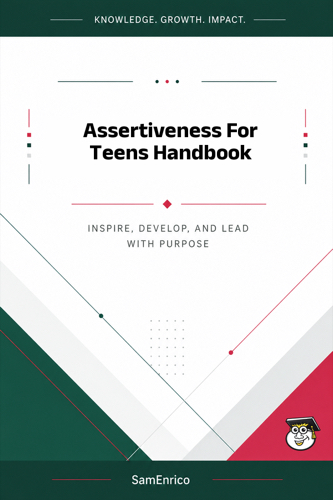
Non-FictionSelf-HelpTeen Skills
Assertiveness For Teens Handbook eBook
Teaches young people peer pressure resistance and
Teaches young people peer pressure resistance and adult communication.
Formats
Free sample
Chapter 1: The Approval Addiction--–- Maya had said yes three times before she realized she never actually wanted to say yes at all. The first yes was to her best friend Jordan, who asked if she could copy Maya's history homework. The second yes was to her mom, who asked her to babysit her little brother for the fourth night that week. The third yes was to a classmate she barely knew, who asked for her lunch money because he "forgot his wallet." Each yes felt like a small betrayal of herself, but each no felt like a potential disaster. What if Jordan got mad?
What if her mom thought she was selfish? What if the classmate spread a rumor that she was cheap? By Friday afternoon, Maya was exhausted, resentful, and confused. She had done everything everyone asked. She had been the "good kid." So why did she feel so terrible?This chapter dismantles the common belief that being a "good kid" means always saying yes, obeying without question, and never disappointing others.
It draws a clear line between compliance—acting out of fear of punishment or loss of approval—and assertiveness, which means choosing your actions based on your own values and rights. The chapter argues that chronic people-pleasing leads to internal resentment, poor decision-making, and eventual burnout. By the end of this chapter, you will understand why being "too nice" is actually a trap, and you will have taken the first step toward a different way of being: kind, cooperative, and completely impossible to manipulate.The Myth of the Good Kid Every culture celebrates the compliant child. Teachers give gold stars to the student who never talks back. Parents praise the teenager who follows rules without question.
Movies and TV shows reward the sidekick who is always helpful, always agreeable, never a problem. This constant reinforcement creates a powerful belief system: that your worth as a person is directly tied to how well you conform to what others want from you. But here is the problem that no one tells you about this arrangement. Compliance is not the same as kindness. Kindness is a choice.
It is the decision to help someone because you genuinely want to, because you have the capacity and the willingness to do so. Compliance, on the other hand, is a reflex. It is the automatic "yes" that comes not from generosity but from fear.When you comply out of fear, you are not being generous. You are being strategic. You are trying to avoid conflict, maintain approval, or prevent someone from being disappointed in you.
And while these are understandable motivations, they come at a steep cost. Every time you say yes when you mean no, you send a message to your own brain that your needs do not matter. Over time, this erodes your ability to know what you actually want. You become disconnected from your own preferences because you have spent so much time prioritizing the preferences of others. This is what psychologists call "self-abandonment," and it is the hidden engine of the Good Kid Trap.Consider the research.
Studies on adolescent development have consistently shown that teens who score high on measures of compliance—who describe themselves as "people-pleasers" and "conflict-avoidant"—also report higher rates of anxiety, depression, and resentment toward their peers and families. They are more likely to engage in risky behaviors when pressured by friends, not because they want to, but because they cannot tolerate the discomfort of saying no. They are also more likely to experience academic burnout, because they take on too many responsibilities and never ask for help. In other words, the Good Kid Trap does not produce happy, well-adjusted adults. It produces exhausted, resentful teenagers who have learned that their own needs are always secondary.Compliance vs.
Assertiveness: The Critical Distinction To escape this trap, you must first understand the three behavioral styles that shape every interaction you have. These styles exist on a spectrum, and most people move between them depending on the situation. However, most teens have a default style—a habitual way of responding to pressure, requests, and conflict. Identifying your default style is the first step toward change.The Passive Style: The Doormat The passive style is characterized by one core pattern: you prioritize others' needs over your own, even when it harms you. Passivity looks like agreeing to things you do not want to do, staying silent when you are treated unfairly, and apologizing for things that are not your fault.
Passive teens often describe themselves as "easygoing" or "low-maintenance," but beneath that surface lies a mountain of unexpressed frustration. The passive teen says yes to a party they do not want to attend, then spends the whole night miserable. The passive teen lets a friend borrow their phone charger, then goes without for a week. The passive teen watches someone cut in line and says nothing, then feels angry at themselves for hours afterward.The cost of passivity is not just external—it is internal. Research in social psychology has shown that suppressing your own preferences in favor of others leads to a phenomenon called "resentment accumulation." Each small yes that you did not mean adds a layer of frustration.
Over time, these layers build into a solid wall of bitterness. And here is the cruel irony: the people you are trying to please usually have no idea that you are resentful. They think you are fine because you never told them otherwise. So they keep asking. And you keep saying yes.
And the resentment keeps growing.The Aggressive Style: The Bulldozer On the opposite end of the spectrum is the aggressive style. Aggression prioritizes your own needs over others' needs, often at their expense. The aggressive teen interrupts, demands, and dismisses. They win arguments but lose relationships. They get what they want in the moment but find themselves isolated in the long run.
Aggression can look like yelling, name-calling, or physical intimidation. But it can also look more subtle: sarcasm, eye-rolling, or the silent treatment. Any behavior that aims to control another person by diminishing them is aggressive.While passivity hurts yourself, aggression hurts others. Neither is effective for building healthy relationships or protecting your own well-being. The aggressive teen might avoid being taken advantage of, but they also push away people who genuinely care about them.
They might get the last word, but they lose the connection. And like passivity, aggression is often driven by fear—not the fear of disappointing others, but the fear of being controlled, humiliated, or dismissed. The aggressive teen has learned that the best defense is a strong offense. But that offense comes at the cost of trust and intimacy.The Assertive Style: The Leader Assertiveness is the balance between these two extremes. The assertive style prioritizes your own needs without trampling on the needs of others.
It is the ability to say no clearly and calmly, to ask for what you want without demanding, and to express disagreement without attacking. Assertiveness is not about winning. It is about being honest. The assertive teen does not try to control others; they simply refuse to be controlled. They do not…
This is the end of the free sample. Get the eBook to keep going. Buy now
About this book
Details
- Author
- Duarte Felisa
- Publisher
- SamEnrico
- Language
- English
- Genre
- Non-Fiction, Self-Help, Teen Skills
- Released
- 2026-06-08
- Pages (approx.)
- 135
- Available as
- eBook, Audiobook

Read better in the ZLOADR app
Your eBooks on your phone or tablet. Sign in with your SamEnrico account and start reading.
More by Duarte Felisa
 Sacred Walking PracticesDuarte Felisa$11.99
 The Black Dahlia Leidner DisappearanceDuarte Felisa$11.99
 Ultrahuman Ring Sleep GuideDuarte Felisa$11.99
 ABCDE Procrastination CureDuarte Felisa$11.99
 The Midnight Ticket: The Untold Story of the Underground Railroad’s Secret StockbrokerDuarte Felisa$11.99
 Understanding Rheumatic FeverDuarte Felisa$17.99
 Make Up AdvisorDuarte Felisa$11.99
 Return on Investment Study TurkeyDuarte Felisa$12.99
 NDA Remote Hiring GuideDuarte Felisa$12.99
 How to Become a Lens InserterDuarte Felisa$11.99
You may also like
 Hong Kong Handover 1997Dunn Johnnie$11.99
 Zumba For Postnatal Recovery CourseNeal Christian$11.99
 Zumba for BeginnersLadner Nikia$11.99
 YouTube Comment Mining GuideHumes Pandora$12.99
 Worry Box MeditationCarlin Rudy$11.99
 Workplace Stress MeditationNguyen Lynn$11.99
 Workplace Stress and Sleep RepairHawley Ivory$11.99
 Workplace Perfectionism CureDelaney Jeffry$11.99
 Workplace Injustice Anger GuideWallen Isabelle$11.99
 Work Addiction and Burnout LinkGreenwood Ester$11.99
 Women in Yoga and WellnessBeattie Galina$11.99
 Women in Stand Up ComedyChun Evangeline$11.99