
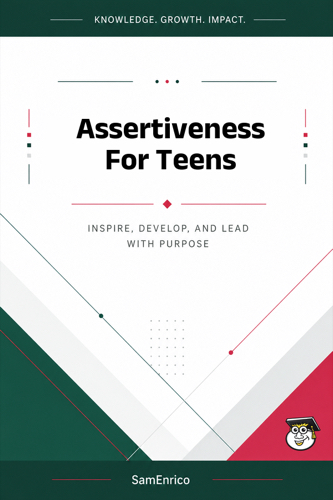
Assertiveness For Teens eBook
Help young people resist peer pressure and speak t
Help young people resist peer pressure and speak to adults respectfully.
Formats
Free sample
Chapter 1: The Volume Dial Lie--You’ve been taught a lie your entire life. It’s a lie whispered by well-meaning parents, repeated in school assemblies, and baked into every “just say no” poster that’s ever been taped to a classroom wall. The lie is this: saying no is simple. You just open your mouth, the word comes out, and everyone respects you for it. End of story.But you already know that’s not how it works.
You’ve felt the actual experience of wanting to say no—really wanting it—and then hearing yourself say something else entirely. Maybe you laughed when you weren’t amused. Maybe you nodded when every bone in your body wanted to shake your head. Maybe you said “yeah sure” to something that made your stomach drop, and then spent the next hour replaying the conversation in your head, hating yourself for folding.That’s not a character flaw. That’s not weakness.
That’s your brain and body reacting exactly the way millions of years of evolution programmed them to react. And the first step to changing your response isn’t memorizing scripts or practicing power poses—it’s understanding why saying no feels like standing at the edge of a cliff while someone gently pushes you toward the drop.This chapter is going to dismantle the three biggest myths about assertiveness, introduce you to the three personalities that show up when pressure arrives, and give you a completely new way to think about your own voice. By the time you finish these pages, you’ll never look at the word “no” the same way again.The Three Myths That Keep You Stuck Let’s start with the myths, because they’re the walls you’re going to have to break through before any of the tools in this book will work.Myth number one: being nice means always saying yes. This myth is everywhere. It lives in the voice of the friend who says “come on, don’t be like that.” It lives in the awkward silence after you decline an invitation.
It lives in the cultural message—especially for girls, but for everyone really—that your job is to make other people comfortable, even at your own expense. The myth says that a “no” is a small act of cruelty, a rejection of someone’s very being, a brick wall where there should be an open door. But here’s what the myth doesn’t tell you: people who demand constant yeses aren’t asking for kindness. They’re asking for compliance. And compliance isn’t the same as care.
You can be the kindest person in your school and still say no to things that hurt you, drain you, or simply don’t interest you. In fact, the kindest version of you is one who protects your own energy so you actually have something left to give when it matters.Myth number two: being strong means being loud or aggressive. This myth is the other side of the same coin. If niceness is passive silence, then strength must be the opposite—shouting, dominating, refusing to back down. Think about the cultural images of “strong” characters in movies and TV shows.
They’re rarely quiet. They rarely compromise. They bulldoze. But here’s the problem with that model: aggressive people don’t actually get what they want in the long run. They get short-term wins and long-term isolation.
People fear them, avoid them, or—worst of all—provoke them for entertainment. The kid who explodes when pressured becomes a target, not a leader. True strength isn’t about volume. It’s about clarity. And clarity doesn’t require shouting.Myth number three: assertiveness is a personality trait you either have or you don’t.
This is the most dangerous myth of all, because it convinces people who have folded under pressure that they’re just “not the type” to stand up for themselves. But assertiveness isn’t eye color. You aren’t born with a fixed amount of it. Assertiveness is a skill, exactly like learning to skateboard, play guitar, or cook eggs without burning them. The first time you try any of those things, you’re terrible.
You fall. You burn things. You sound like a dying animal. But no one says “well, I guess I’m just not a skateboarding person.” They understand that failure is part of learning. Assertiveness works the same way.
Every time you fold under pressure, you’re not revealing your true passive nature. You’re demonstrating that you haven’t practiced enough yet. And that’s fixable.The Three A’s: Passive, Aggressive, Assertive Now that we’ve cleared away the myths, let’s introduce the model that will serve as the backbone for everything else in this book. It’s called the Three A’s, and it’s the simplest way to understand what happens in your body, voice, and relationships when pressure arrives.Imagine three different teens facing the exact same situation. A friend leans over during a test and whispers, “Can I see your answers?
Just the last three.” Same pressure. Same moment. Three completely different responses.The first teen is Passive. This teen feels the question land like a stone in their stomach. They don’t want to share answers.
They know it’s wrong. They’re worried about getting caught. But when they open their mouth, what comes out isn’t a no. It’s a nervous laugh. It’s a shoulder shrug.
It’s a quiet “um, okay I guess” followed by sliding the paper slightly closer. After the test, the passive teen feels sick. They’re angry at themselves. They promise they’ll do better next time. But next time, the same thing happens, because passivity isn’t a choice they’re making—it’s a pattern their body has learned.
The passive teen’s internal monologue sounds something like this: “I don’t want to cause problems. What if they get mad at me? What if they stop being my friend? It’s easier to just say yes and deal with the consequences later.” The problem is, there are always consequences. And they always feel worse than a momentary awkwardness would have felt.The second teen is Aggressive.
This teen also doesn’t want to share answers. But instead of freezing or complying, they explode. “Are you serious? You want me to cheat for you? That’s so stupid.
Why would I risk getting detention for your grade? You’re such an idiot.” They might shove the paper away, turn their back, or make a loud comment that draws the teacher’s attention. The aggressive teen gets the immediate outcome they want—the friend backs off—but they’ve also created a new set of problems. The friend is humiliated. The relationship is damaged, maybe permanently.
Other classmates now see the aggressive teen as volatile, someone to walk on eggshells around. And worst of all, the aggressive teen often becomes a target for future pressure, because people enjoy provoking someone who reacts dramatically. It’s entertainment. The aggressive teen’s internal monologue sounds like this: “I have…
This is the end of the free sample. Get the eBook to keep going. Buy now
About this book
Details
- Author
- Lambert Joseph
- Publisher
- SamEnrico
- Language
- English
- Genre
- Non-Fiction, Self-Help, Teen
- Released
- 2026-06-05
- Pages (approx.)
- 126
- Available as
- eBook, Audiobook

Read better in the ZLOADR app
Your eBooks on your phone or tablet. Sign in with your SamEnrico account and start reading.
More by Lambert Joseph
 Immigrant Child Care Entrepreneur SuccessLambert Joseph$11.99
 ABCDE For One On One MeetingsLambert Joseph$11.99
 Metta For Grieving ParentsLambert Joseph$11.99
 Port Wine Stain Self-EsteemLambert Joseph$11.99
 Virtual Mentorship Best PracticesLambert Joseph$11.99
 The Cold ShoulderLambert Joseph$11.99
 Runner Knee Injury PreventionLambert Joseph$11.99
 Lotus Symbol RebellionLambert Joseph$11.99
 The Last Dance of the Red Baron: Aerial Duel That Shook the WorldLambert Joseph$11.99
 The Last Great Ascent: Reinhold Messner and the Conquest of K2Lambert Joseph$11.99
 Nefertiti’s Lost Voice: The Pharaoh Who Vanished from HistoryLambert Joseph$11.99
 Prompt Engineering for Property Market AnalysisLambert Joseph$11.99
You may also like
 Teen Growth Mindset WorkbookCleary Caroyln$11.99
 MBSR For Teen StressGilman Avis$11.99
 Teen Sleep MeditationBunnell Denita$11.99
 Teen Resilience GuideHam Cyrstal$11.99
 Teen Comparison Culture GuideBurton Dean$11.99
 Social Media Comparison for TeensCharlton Nova$11.99
 Breath for TeensGuzman Latoya$11.99
 Assertive Communication for TeensToliver Collin$11.99
 The Teen Parent Anger GuideMccool Farah$11.99
 The Teen Parent Loss GuideAbreu Maxie$11.99
 Teen Complicated Grief GuideWallen Mariah$11.99
 Habit Formation for TeensIrby Junita$11.99