
Non-FictionSelf-HelpNegotiation
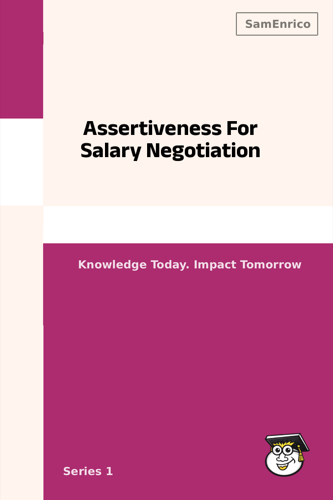
Assertiveness For Salary Negotiation eBook
Ask for what you're worth without apologizing or b
Ask for what you're worth without apologizing or backing down.
Formats
Free sample
Chapter 1: The Permission Trap--You are sitting across from your manager. The annual review is almost over. They have just said, "Overall, you're doing a great job. We're giving you a 3% increase, which is standard." You nod. You smile.
You say, "Thank you, I appreciate that."Inside, something is burning. You know you deserve more. You saved the company $40,000 last quarter. You took on the work of two people after your colleague left. You have not had a real raise in two years.
But the words will not come. Or if they do, they come out twisted: "I'm sorry to bring this up, but...", "I hate to ask, but...", "Maybe this is greedy, but..."Welcome to the Permission Trap.This chapter is about why you feel guilty asking for more, why you apologize for your own value, and why most people never negotiate at all – not because they lack the skills, but because they lack permission. By the end of this chapter, you will understand the psychological architecture of that guilt, and you will have taken the first step toward dismantling it.The Scene That Plays Out Millions of Times Every Day Let me describe a scene that is so common it has become invisible. A professional – let us call her Sarah – has been with her company for three years. She has exceeded every target.
Her boss has praised her publicly. She knows, because she has done the research, that she is underpaid by at least $15,000 compared to people in equivalent roles at similar companies.The annual review arrives. She has prepared. She has printed out her accomplishments. She has rehearsed what she wants to say.
The moment comes. Her manager says, "We're really happy with your work. We're offering you a 4% raise."Sarah opens her mouth. And what comes out is not what she rehearsed. What comes out is: "Thank you so much.
I really appreciate that."Later, she will lie in bed and replay the moment. She will feel ashamed of herself. She will promise that next time will be different. But next time, the same thing will happen. Not because Sarah is weak.
Not because she does not deserve more. But because she is waiting for permission that will never come.This is not a story about weakness. It is a story about conditioning.The Origins of the Permission Trap Where does this feeling come from? Why do so many of us – smart, capable, accomplished people – suddenly lose our voices when it is time to ask for money?The answer lies in a web of cultural, psychological, and evolutionary forces that have shaped you long before you ever sat across from a hiring manager.First, there is childhood conditioning. Most of us were raised with explicit or implicit rules about money.
"It is rude to talk about money." "Good people are grateful for what they get." "Don't be greedy." These messages may have come from well-meaning parents who wanted to raise humble, appreciative children. But they become invisible chains in adulthood. When you sit down to negotiate a salary, a child inside you still hears that voice saying, "Don't be greedy."Second, there is workplace power dynamics. The employer-employee relationship is not a relationship of equals. Even in the most progressive companies, there is an inherent power imbalance.
The person across the table can say yes or no. They control a budget. They have a title. You are asking. This imbalance triggers a primal fear response: if I push too hard, I might lose everything.Third, there is cultural and gender conditioning.
Research consistently shows that women are penalized more harshly than men for assertive negotiation. Women who ask for more are often labeled "aggressive," "difficult," or "entitled" – labels that men rarely receive for the same behavior. People of color face similar double binds. If you have witnessed or experienced backlash for self-advocacy, your brain has learned a painful lesson: asking is dangerous.Fourth, there is the fear of being perceived as "difficult." In many workplaces, the unspoken rule is that harmony is more valuable than fairness. The person who rocks the boat is the problem, regardless of whether the boat needed rocking.
This fear is not irrational. Some managers do retaliate, subtly or overtly, against employees who negotiate. But here is the truth this chapter will teach you: those managers are not the ones you want to work for anyway. The permission trap convinces you that every manager is a potential threat. Most are not.The Separation Principle: Your Worth Is Not Your Value Let me introduce a concept that will underpin everything else in this book.
I call it the Separation Principle.Your worth as a human being is infinite, sacred, and completely irrelevant to this conversation.Your value as an employee is finite, measurable, and based entirely on market data.These two things are not the same. But the permission trap exists precisely because we mix them up. When a company offers you a salary, they are not valuing your soul. They are pricing a set of skills, hours, and deliverables. When you ask for more, you are not demanding that they acknowledge your inherent dignity.
You are asking them to adjust a number based on objective factors.The moment you separate these two things, the emotional weight of the conversation changes dramatically.Let me give you an example. Imagine you are selling a used car. The car is worth $10,000 based on market data. A buyer offers you $8,000. You would not say, "I'm sorry to bother you, but I feel like this car deserves more." You would say, "Based on comparable sales, this car is worth $10,000." You would not take it personally.
You would not apologize. You would simply state the data.Your labor is no different. You are not your labor. You are the person who performs the labor. The labor itself has a market price.
Negotiating that price is not a conversation about your worth. It is a conversation about the labor.This sounds simple. It is not easy. The permission trap has wired your emotional brain to treat a salary negotiation as a personal referendum on your value as a human. This chapter will begin the process of rewiring that response.The Myth of Automatic Reward One of the most destructive beliefs in the professional world is the Myth of Automatic Reward.
This is the idea that if you work hard, do good work, and stay loyal, the company will automatically recognize your value and pay you accordingly.Let me be very clear: this is a lie.Companies are not designed to maximize your salary. They are designed to minimize costs while retaining necessary talent. Your manager is not sitting in their office thinking, "How can I proactively give Sarah more money?" Your manager is thinking about their own deadlines, their own pressures, and their own budget constraints. Paying you more is not their priority. Paying you as little as possible while keeping you productive is their priority.This is not evil.
It is just the structure of capitalism. Labor is a cost. Costs are managed. If you do not ask for more, the system will assume you are satisfied. It will…
This is the end of the free sample. Get the eBook to keep going. Buy now
About this book
Details
- Author
- Silverman Johnny
- Publisher
- SamEnrico
- Language
- English
- Genre
- Non-Fiction, Self-Help, Negotiation
- Released
- 2026-06-07
- Pages (approx.)
- 141
- Available as
- eBook, Audiobook

Read better in the ZLOADR app
Your eBooks on your phone or tablet. Sign in with your SamEnrico account and start reading.
More by Silverman Johnny
 Growth Capital Allocation Forecast GuideSilverman Johnny$11.99
 Self Esteem for Project LeadersSilverman Johnny$11.99
 Immigrant Salon Chain Success GuideSilverman Johnny$11.99
 TikTok Affiliate MarketingSilverman Johnny$11.99
 Wholesaling with No Money GuideSilverman Johnny$11.99
 Spin Bike Setup PerfectedSilverman Johnny$11.99
 Dispassion Through Breath WatchingSilverman Johnny$11.99
 Wholesaling Goal Setting GuideSilverman Johnny$11.99
 Aggressive Driver AvoidanceSilverman Johnny$11.99
 The Vanishing of Flight 1956: The Cold War’s Forgotten DisappearanceSilverman Johnny$11.99
 The Star Forts of Ceuta: Gibraltar's Forgotten TwinSilverman Johnny$11.99
 The Great TikTok Heist: How a Viral Trend Exposed a $10 Million ScamSilverman Johnny$11.99
You may also like
 Hong Kong Handover 1997Dunn Johnnie$11.99
 Zumba For Postnatal Recovery CourseNeal Christian$11.99
 Zumba for BeginnersLadner Nikia$11.99
 YouTube Comment Mining GuideHumes Pandora$12.99
 Worry Box MeditationCarlin Rudy$11.99
 Workplace Stress MeditationNguyen Lynn$11.99
 Workplace Stress and Sleep RepairHawley Ivory$11.99
 Workplace Perfectionism CureDelaney Jeffry$11.99
 Workplace Injustice Anger GuideWallen Isabelle$11.99
 Work Addiction and Burnout LinkGreenwood Ester$11.99
 Women in Yoga and WellnessBeattie Galina$11.99
 Women in Stand Up ComedyChun Evangeline$11.99