
Non-FictionSelf-HelpLaw Enforcement
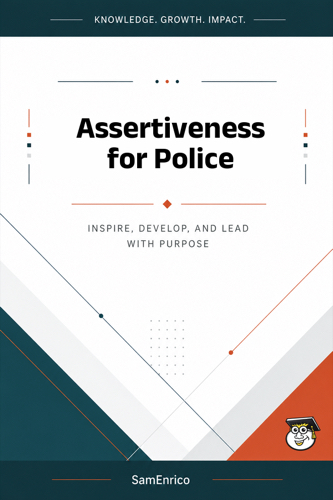
Assertiveness for Police eBook
De-escalate with authority that doesn't provoke.
De-escalate with authority that doesn't provoke.
Formats
Free sample
Chapter 1: The Authority Paradox--–- The training video had been viewed over two million times on law enforcement forums before it was quietly removed. It showed a traffic stop in a Midwestern suburb, filmed from three angles: the patrol car dashboard, the officer's body-worn camera, and a bystander's cell phone. The officer, a ten-year veteran with an unblemished record, had pulled over a sedan for rolling through a stop sign. What happened next lasted ninety seconds.The officer approached the driver's side window and asked for license and registration. The driver—a middle-aged man with no criminal record, no warrants, no outstanding tickets—began rummaging through his glove compartment.
The officer asked again. The driver muttered something inaudible. The officer's voice rose: "I said, get your license out!" The driver's hands began to shake. He dropped his registration. The officer opened the door and ordered him out of the car.
The driver refused. The officer reached for the driver's arm. The driver pulled away. Within thirty seconds, the officer had deployed his taser. The driver fell to the ground, hit his head on the curb, and suffered a traumatic brain injury that would end his career as a high school math teacher.The officer was exonerated by internal affairs.
The driver was charged with resisting arrest. The department released a statement praising the officer's "quick decision-making under pressure."But here is what the statement did not say: the driver had a mild stutter that worsened under stress. When he muttered inaudibly, he was trying to say "I have it, give me a second." He was not refusing. He was struggling. And the officer's escalating aggression—louder voice, open door, reaching into the car—turned a traffic violation into a life-altering injury.The officer did not lose his cool because he was a bad person.
He lost his cool because he believed a myth that has infected police training for generations: the myth that loud, aggressive commands equal authority. He believed that if he did not dominate the encounter immediately, the driver would perceive him as weak. He believed that the louder he shouted, the more likely the driver would comply. He believed, in short, that force invites compliance.The opposite is true. Force invites force.
Aggression invites resistance. Shouting invites shouting. And until police officers understand the biological reality of how the human brain responds to perceived threats, encounters like the one in that Midwestern suburb will continue to happen—not because officers are malicious, but because they are misinformed.This chapter dismantles the most dangerous myth in modern policing: that command presence is measured in decibels. You will learn about a psychological phenomenon called reactance that explains why aggressive commands trigger resistance rather than compliance. You will learn the difference between non-compliance and inability to comply.
And you will learn the single most important verbal tool in the assertive de-escalation toolkit: the dignity-preserving directive.By the end of this chapter, you will understand that your authority does not come from how loudly you speak. It comes from how calmly you listen.THE MYTH OF THE COMMAND VOICEEvery police academy in America teaches some version of "command presence." The term means different things to different instructors, but it almost always includes the same elements: a straight spine, a level gaze, a voice that carries. The implication is that authority is performed through the body and the voice, and that the louder and more certain you sound, the more likely people are to obey.There is a grain of truth here. Humans do respond to nonverbal cues of dominance. An officer who slouches, mumbles, and avoids eye contact will struggle to gain compliance.
But the academy version of command presence confuses dominance with aggression. It conflates the ability to be heard with the decision to shout. And it completely ignores the overwhelming body of research on how the human brain processes social threat.When a person perceives an authority figure as threatening—raised voice, aggressive posture, finger pointing—their nervous system does not say "I should comply." It says "I should defend myself." The body releases cortisol and adrenaline. Blood flow shifts from the prefrontal cortex, which handles rational decision-making, to the limbic system, which handles survival instincts. The subject stops hearing your words and starts reading only your threat level.This is not a character flaw.
It is not a sign of disrespect or criminal intent. It is biology, honed over millions of years of evolution. Your ancestors who complied with a threatening dominant individual did not survive as often as your ancestors who fought back or ran away. The human brain is wired to resist perceived coercion, not to welcome it.A 2022 meta-analysis of body-worn camera footage from twelve law enforcement agencies examined 847 encounters that began as low-level offenses—traffic violations, noise complaints, disorderly conduct. In encounters where the officer used a raised voice or shouted within the first thirty seconds, the likelihood of physical resistance increased by 47 percent.
In encounters where the officer used a normal or lowered speaking voice, the likelihood of physical resistance was 12 percent. The study controlled for subject demographics, time of day, location, and offense severity. The only variable that predicted resistance was the officer's vocal delivery.The implications are staggering. Officers who believe they are projecting strength by shouting are actually making resistance more likely. They are creating the very outcome they are trying to prevent.This is not to say that volume has no place in policing.
There are moments—active shooter responses, imminent threat of death or serious injury, a subject actively attacking someone—where a shouted command is not only appropriate but necessary. In those moments, the goal is not de-escalation. The goal is immediate interruption of a lethal threat.But those moments represent less than one percent of police-citizen encounters. The other ninety-nine percent require a different tool: the ability to assert authority without triggering the biological resistance response. That tool is assertive de-escalation, and it begins with understanding reactance.WHAT IS REACTANCE?Psychologist Jack Brehm first described reactance in his 1966 book "A Theory of Psychological Reactance." The concept has been validated across hundreds of studies in social psychology, neuroscience, and behavioral economics.
Reactance is the motivational state that occurs when a person perceives that their behavioral freedoms are being threatened or eliminated. The person becomes motivated to restore those freedoms—often by doing the very thing they have been told not to do.Here is what makes reactance dangerous for police officers: it operates below conscious awareness. A subject does not think to themselves, "I feel my freedom being threatened, so I will strategically resist to restore my autonomy." They simply feel an urgent, almost physical need to push back. When asked later why they resisted, they might say "he got in my face" or "she disrespected me" or "I just snapped." What they are describing, in biological terms, is reactance.The triggers for reactance are predictable and have been replicated across dozens of studies:Commands that feel arbitrary or unexplained. When a person cannot see the reason for a directive, their brain assumes the directive is about power rather than safety.
This triggers reactance.Commands delivered with anger or contempt. Facial expressions of anger, even without raised voices, activate the amygdala and…
This is the end of the free sample. Get the eBook to keep going. Buy now
About this book
Details
- Author
- Stuckey Romelia
- Publisher
- SamEnrico
- Language
- English
- Genre
- Non-Fiction, Self-Help, Law Enforcement
- Released
- 2026-06-07
- Pages (approx.)
- 134
- Available as
- eBook, Audiobook

Read better in the ZLOADR app
Your eBooks on your phone or tablet. Sign in with your SamEnrico account and start reading.
More by Stuckey Romelia
 United Premier Status ComparisonStuckey Romelia$11.99
 Jeannie C Riley Harper ValleyStuckey Romelia$11.99
 The Confidence Affirmation HandbookStuckey Romelia$11.99
 Paiute Golf Course EmpireStuckey Romelia$11.99
 The Healing Hands of Ancient Britain: The Lost Medical Art of the Celtic HealersStuckey Romelia$11.99
 Understanding Short Stature Webbed Neck Heart DiseaseStuckey Romelia$17.99
 SBA Loan Rate ComparisonStuckey Romelia$12.99
 CMMC Certification MinorityStuckey Romelia$12.99
 Software DeveloperStuckey Romelia$11.99
 How to Become a Pole-peeling-machine-operator HelperStuckey Romelia$11.99
You may also like
 Hong Kong Handover 1997Dunn Johnnie$11.99
 Zumba For Postnatal Recovery CourseNeal Christian$11.99
 Zumba for BeginnersLadner Nikia$11.99
 YouTube Comment Mining GuideHumes Pandora$12.99
 Worry Box MeditationCarlin Rudy$11.99
 Workplace Stress MeditationNguyen Lynn$11.99
 Workplace Stress and Sleep RepairHawley Ivory$11.99
 Workplace Perfectionism CureDelaney Jeffry$11.99
 Workplace Injustice Anger GuideWallen Isabelle$11.99
 Work Addiction and Burnout LinkGreenwood Ester$11.99
 Women in Yoga and WellnessBeattie Galina$11.99
 Women in Stand Up ComedyChun Evangeline$11.99