
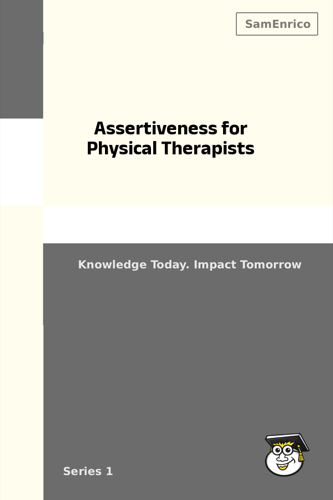
Assertiveness for Physical Therapists eBook
Motivate patients, handle insurance, and set treat
Motivate patients, handle insurance, and set treatment boundaries professionally.
Formats
Free sample
Chapter 1: The Kindness Kryptonite--–- Sarah had been a physical therapist for eight years when she found herself hiding in a supply closet, fighting back tears. Her schedule was overbooked. Her last patient had called her "useless" because she refused to write another week of light-duty notes for a minor ankle sprain. Her documentation was three days behind. And she had just learned that her clinic manager expected her to see four patients per hour starting next month."I thought I was being compassionate," she told me during a peer consultation session.
"I stayed late. I never said no. I gave extra time to anyone who asked. And now I can't remember why I became a PT in the first place."Sarah is not broken. She is not weak.
She is not a bad therapist. She is a classic example of what happens when genuine compassion meets no boundaries. She had been taught that being a good PT meant being a nice PT. And that belief was destroying her.This chapter is about why niceness is not a clinical strategy, why your empathy might be hurting your patients, and how the first step toward assertiveness is understanding the difference between pity, compassion, and the rescuer mindset that burns out even the best clinicians.The Seduction of the Helper Identity Physical therapy attracts a specific personality profile. You are, by nature and by training, a problem-solver who derives deep satisfaction from reducing suffering and restoring function.
You chose this profession because you wanted to witness the moment a patient takes their first unassisted step after months of rehabilitation, or returns to the sport they love after a devastating injury. That calling is noble. It is also, without the right interpersonal skills, a pathway to professional collapse.The problem is not the calling. The problem is that most PTs enter the field with what psychologists call an unexamined "helper identity." You believe, often unconsciously, that your value as a clinician is measured by how much you give, how available you are, and how rarely you say no. You mistake accessibility for excellence.
You mistake accommodation for alliance.Here is the hard truth that no one told you in PT school: Your patients do not need you to be nice. They need you to be effective. And effectiveness sometimes looks like the opposite of niceness. Effectiveness looks like saying, "No, I will not see you as an add-on today because I have three other patients who scheduled in advance." Effectiveness looks like, "Your insurance denied your claim, and I will help you appeal, but you need to make the first call yourself." Effectiveness looks like, "If you miss one more appointment without notice, I will discharge you from my care."These statements are not unkind. They are clear.
And clarity is the foundation of every therapeutic alliance worth having.The Empathy Trap: Why Feeling Too Much Undermines Recovery Empathy is supposed to be a superpower in healthcare. And it is—but only one specific type of empathy. Most people, including most PTs, do not realize that empathy comes in two distinct forms, and one of them is clinically dangerous.Affective empathy is the capacity to feel what another person feels. When your patient describes their crushing low back pain, your own nervous system activates. You wince when they wince.
You feel their frustration, their fear, their hopelessness, as if it were your own. Affective empathy is the basis of emotional contagion. It is why you feel exhausted after a day of listening to suffering. It is why you take work home with you, not just in your bag but in your chest.Cognitive empathy is the capacity to understand what another person feels without necessarily sharing the emotion. You recognize that your patient is afraid.
You understand the source of that fear. But you do not become afraid yourself. Cognitive empathy allows you to stand in the fire with your patient without catching flame. It is the empathy of the trauma surgeon, the firefighter, the combat medic. They understand suffering deeply.
They do not absorb it.Most PTs operate from affective empathy because it feels more authentic. You think, "If I don't feel their pain, I must not care." This is wrong. Affective empathy is not a measure of your caring. It is a measure of your emotional boundaries—or lack thereof.Here is the radical claim of this chapter: Affective empathy has no place in the clinical setting. It is not a virtue.
It is a cognitive bias that leads to poor clinical decisions, patient dependency, and therapist burnout. Cognitive empathy, on the other hand, is essential. It allows you to see clearly, act decisively, and maintain the emotional energy to help the next patient, and the next, and the next.The Rescuer Mindset: How Good Intentions Create Bad Outcomes When affective empathy goes unchecked, it produces what social psychologists call the rescuer mindset. This is the internal voice that whispers: "If I don't do it, no one will." "The patient is suffering; I can't add to that by holding them accountable." "I'll just stay late and catch up later." "One more accommodation won't hurt."The rescuer mindset is seductive because it feels like virtue. You are the good one, the dedicated one, the one who goes above and beyond.
But in practice, the rescuer mindset is a form of clinical negligence dressed up in a white coat. Here is what actually happens when you operate from a rescuer mindset:You reduce the difficulty of a home exercise program because the patient says it "hurts too much." The patient does not progress. Their fear of movement is reinforced. They learn that reporting pain leads to reduced expectations. You have just conditioned dependency.
The patient is now weaker, not stronger, because of your "kindness."You absorb repeated late cancellations without consequence. Your schedule becomes chaotic. The patient who arrives on time gets a shortened session because you are still catching up from the late patient before. You resent the late patient. The punctual patient suffers silently.
Both receive worse care because you could not enforce a simple boundary.You document vaguely because you feel bad about discharging a non-compliant patient. The insurance reviewer denies the claim. The patient blames you. Your license is at risk. The referring physician stops sending referrals.
You were trying to be nice, and now your career is in jeopardy.The rescuer mindset is not compassion. It is a failure of clinical leadership. And it is epidemic in our profession because no one has ever told you that there is another way.Pity Versus Compassion: The Distinction That Changes Everything Let us be precise about language, because imprecision here is what keeps good therapists trapped.Pity is the feeling that someone else's suffering is unfortunate, and you wish it were not happening. Pity leads to doing things for the patient. Pity gives the patient a pass on their responsibilities.
Pity feels warm in the moment but leaves the patient weaker, more dependent, and less capable. Pity is what you feel for a stray kitten. It is not a clinical stance.Compassion, in the clinical sense, is the recognition of suffering…
This is the end of the free sample. Get the eBook to keep going. Buy now
About this book
Details
- Author
- Wingfield Roseanna
- Publisher
- SamEnrico
- Language
- English
- Genre
- Non-Fiction, Self-Help, PT
- Released
- 2026-06-06
- Pages (approx.)
- 135
- Available as
- eBook, Audiobook

Read better in the ZLOADR app
Your eBooks on your phone or tablet. Sign in with your SamEnrico account and start reading.
More by Wingfield Roseanna
 Road Rage And Performance CarsWingfield Roseanna$11.99
 Spinning Top MeditationWingfield Roseanna$11.99
 The Catholic Pulpit Counter AttackWingfield Roseanna$11.99
 Journaling Through DivorceWingfield Roseanna$11.99
 The Whispering Coach: How a Maori Warrior Shaped Pacific Rowing (1789)Wingfield Roseanna$11.99
 Understanding Pili CanulatiWingfield Roseanna$17.99
 ArchitectureWingfield Roseanna$11.99
 JEE Stress and Anxiety ManagementWingfield Roseanna$12.99
 VA English Assessment GuideWingfield Roseanna$12.99
 How to Start a Optical Positioning Equipment Business (Beginners Guide)Wingfield Roseanna$11.99
You may also like
 Hong Kong Handover 1997Dunn Johnnie$11.99
 Zumba For Postnatal Recovery CourseNeal Christian$11.99
 Zumba for BeginnersLadner Nikia$11.99
 YouTube Comment Mining GuideHumes Pandora$12.99
 Worry Box MeditationCarlin Rudy$11.99
 Workplace Stress MeditationNguyen Lynn$11.99
 Workplace Stress and Sleep RepairHawley Ivory$11.99
 Workplace Perfectionism CureDelaney Jeffry$11.99
 Workplace Injustice Anger GuideWallen Isabelle$11.99
 Work Addiction and Burnout LinkGreenwood Ester$11.99
 Women in Yoga and WellnessBeattie Galina$11.99
 Women in Stand Up ComedyChun Evangeline$11.99