
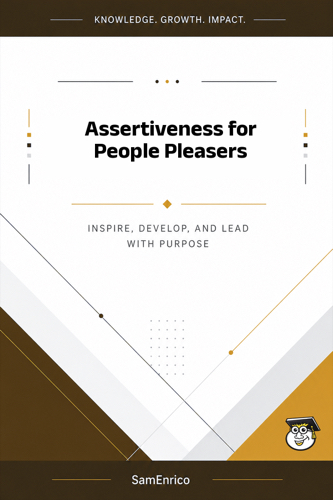
Non-FictionSelf-HelpPeople Pleasing
Assertiveness for People Pleasers eBook
Breaks the habit of always saying yes.
Breaks the habit of always saying yes.
Formats
Free sample
Chapter 1: The Silent Ledger--–- Sarah had not had a single hour to herself in eleven days. She knew this because she had started counting—not the hours, but the weight. Sunday evening found her sitting in her parked car in the garage, engine off, hands still on the wheel, staring at the concrete wall in front of her. Upstairs, her husband was waiting to discuss weekend plans. Her phone showed fourteen unread text messages.
Her email inbox glowed with the particular urgency of Monday morning arriving eighteen hours early. And somewhere in the back of her mind, a small, exhausted voice whispered something she had been trained never to say aloud: I cannot do one more thing for one more person.She was thirty-four years old, a marketing manager at a mid-sized tech firm, and she was known as the office glue. Colleagues came to her when they needed coverage. Her boss assigned her the projects no one else wanted because he knew she would not say no. Friends called her the reliable one, the listener, the fixer.
Her mother described her as "the daughter who never complains." All of this was true. All of this was also killing her slowly.The chapter you are about to read is not a gentle exploration of self-care. It is not a collection of platitudes about putting on your own oxygen mask first. It is an autopsy of a very specific, very costly survival strategy—one that you may have been running for so long that you no longer recognize it as a strategy at all. You likely believe that your constant yes-ing is a sign of your goodness, your generosity, your love.
You believe that saying no would make you selfish, cold, unloving, or unlovable. You believe that the exhaustion you feel is simply the price of being a good person.Everything you believe about your people-pleasing is wrong.The Generosity Trap Let us begin with a distinction that will save your life. There are two kinds of niceness in this world, and they share only a surface resemblance. The first is authentic kindness. Authentic kindness flows from a full cup.
It is given freely, without expectation, without resentment, and without self-abandonment. When you are authentically kind, you help because you choose to help, not because you fear the consequences of refusing. You can say yes with enthusiasm and no with equal clarity. Your generosity does not come with a hidden invoice marked "payable in exhaustion."The second kind of niceness is fawning. Fawning is a survival response.
It is the fourth F in the trauma response family—alongside fight, flight, and freeze—first identified by trauma therapist Pete Walker. When fawning, your nervous system detects a threat (disapproval, disappointment, anger, abandonment) and responds by appeasing the threat. You say yes not because you want to, but because your body has learned that compliance equals safety. Your yes is not a gift; it is a shield.Here is the brutal truth that most self-help books will not tell you: fawning works. In the short term, it works beautifully.
When you say yes to your boss, the immediate tension dissolves. When you agree to host the family holiday, the silence that follows is a relief. When you suppress your own needs to keep the peace, you are rewarded with the absence of conflict. Every yes delivers a small hit of relief, and that hit reinforces the habit. You are not weak; you are chemically conditioned.
Your brain has learned a simple equation: Yes = Safe. No = Danger.The problem, of course, is what happens after the relief fades.The Hidden Payoff Cycle To understand why you cannot stop saying yes, you must understand the cycle that keeps you trapped. It looks like this:Step One: The Request. Someone asks something of you. It might be a favor, a task, an invitation, an expectation.
Your nervous system registers the request as a demand.Step Two: The Spike. Immediately, your body responds. Heart rate increases. Muscles tense. Your mind races through the possible consequences of refusal: They will be angry.
They will be disappointed. They will think I am selfish. They will leave. This is not imagination; it is a conditioned fear response, rooted in whatever environment taught you that your safety depended on compliance.Step Three: The Yes. You say yes.
Almost immediately, the spike subsides. The threat recedes. Relief floods your system. You have successfully neutralized the danger. This relief is your reward.Step Four: The Resentment.
Hours later, or sometimes days, a different feeling arrives. You are tired. You have overcommitted again. You realize you did not want to do the thing you agreed to do. You feel taken advantage of, even though you know you volunteered.
This resentment is the true cost of your yes, but it arrives too late to change the decision.Step Five: The Reinforcement. Despite the resentment, the immediate relief of saying yes was more powerful than the delayed cost. Your brain remembers the relief more vividly than the resentment. Next time a request comes, the cycle repeats.This is not a personality flaw. This is operant conditioning, the same mechanism that trains any behavior through reward.
The only difference is that the reward is the absence of punishment—relief from fear. And because the fear is real (even if the threat is not), the cycle is extraordinarily difficult to break without understanding how it works.The Long-Term Ledger What does this cycle cost you over years? Let us examine the ledger.The Obvious Costs: Exhaustion, overcommitment, chronic stress, tension headaches, insomnia, weakened immune function, digestive issues. Your body keeps score. Every yes you did not want to say leaves a mark.The Emotional Costs: Resentment—toward the people you help, toward yourself for being unable to stop, toward a world that seems to take and take.
Loss of identity: when you are always responding to others' needs, you lose the ability to know what you want. You may find yourself staring at a restaurant menu unable to choose, deferring to everyone else's preferences because your own have atrophied. Anxiety: the constant anticipation of the next request, the next demand, the next opportunity to fail at saying no. Depression: the quiet recognition that your life is not your own.The Relational Costs: Ironically, chronic people-pleasing damages the very relationships you are trying to protect. Resentment leaks out in small ways—a sharp tone, a withdrawal of warmth, a passive-aggressive comment.
Or it builds until you explode or ghost someone entirely. Worse, people-pleasing attracts people who will take advantage of it. The healthier people in your life may respect your boundaries; the unhealthy ones will exploit your lack of them. You end up surrounded by takers, exhausted and wondering why no one gives back.The Existential Cost: This is the heaviest one. Somewhere inside you, there is a life you want to live.
Dreams you have deferred. Hobbies you have abandoned. Rest you have not taken. Love you have not given because you had nothing left. The years pass, and you wake up one day realizing you have spent your limited time on earth doing things you did…
This is the end of the free sample. Get the eBook to keep going. Buy now
About this book
Details
- Author
- Large Janessa
- Publisher
- SamEnrico
- Language
- English
- Genre
- Non-Fiction, Self-Help, People Pleasing
- Released
- 2026-06-07
- Pages (approx.)
- 138
- Available as
- eBook, Audiobook

Read better in the ZLOADR app
Your eBooks on your phone or tablet. Sign in with your SamEnrico account and start reading.
More by Large Janessa
 Financial Services MappingLarge Janessa$11.99
 Electroconvulsive Therapy BipolarLarge Janessa$11.99
 The Fitness Tracker MetabolicLarge Janessa$11.99
 Sibling Fights Parent AngerLarge Janessa$11.99
 Returns Forecasting AILarge Janessa$11.99
 Caregiver Anticipatory GriefLarge Janessa$11.99
 Improv for Project ManagersLarge Janessa$11.99
 Rana Pratap's Last Stand: The Chittorgarh Siege That Defied the Mughals (1567-1568)Large Janessa$11.99
 Harmony of the Ancestors: The Forgotten Maestros of the African DiasporaLarge Janessa$11.99
 EU VAT Sector Specific GuideLarge Janessa$12.99
 Wage Theft Acts and Personal LiabilityLarge Janessa$12.99
 How to Produce Outdoor Umbrella CoversLarge Janessa$11.99
You may also like
 Hong Kong Handover 1997Dunn Johnnie$11.99
 Zumba For Postnatal Recovery CourseNeal Christian$11.99
 Zumba for BeginnersLadner Nikia$11.99
 YouTube Comment Mining GuideHumes Pandora$12.99
 Worry Box MeditationCarlin Rudy$11.99
 Workplace Stress MeditationNguyen Lynn$11.99
 Workplace Stress and Sleep RepairHawley Ivory$11.99
 Workplace Perfectionism CureDelaney Jeffry$11.99
 Workplace Injustice Anger GuideWallen Isabelle$11.99
 Work Addiction and Burnout LinkGreenwood Ester$11.99
 Women in Yoga and WellnessBeattie Galina$11.99
 Women in Stand Up ComedyChun Evangeline$11.99