
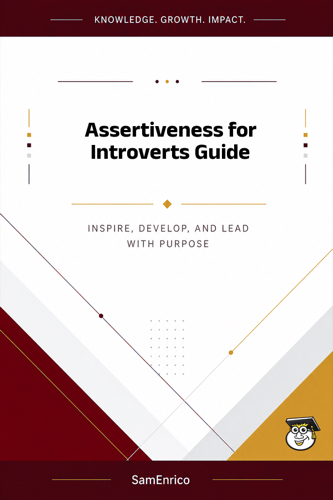
Assertiveness for Introverts Guide eBook
Adapts assertiveness skills for quiet, reflective
by Osorio Darci
Adapts assertiveness skills for quiet, reflective personalities.
Formats
Free sample
Chapter 1: The Invisible Cage--Most introverts do not wake up one morning and decide to become doormats.The erosion happens slowly, quietly, invisibly—like water wearing down stone. A missed opportunity to speak up here. A swallowed objection there. A “yes” offered when every fiber of your being wanted to say “no.” And because introverts process internally, because we feel the weight of social interactions long after they have ended, each small surrender leaves a residue. Not dramatic enough to call trauma.
Just heavy enough to notice. A low-grade exhaustion that becomes, over time, indistinguishable from normal.This chapter is not about teaching you how to be louder. It is about helping you see the cage you did not know you were living in—and realizing that the door was never locked.The Myth That Keeps You Quiet Let us name the enemy directly. The most destructive piece of advice ever given to introverts is this: Fake it till you make it.On its surface, the phrase sounds almost noble. Pretend to be confident.
Mimic the extroverts who seem to glide through meetings, negotiations, and social gatherings without a second thought. Eventually, the performance becomes reality. This is the promise.It is also a lie.For the introvert, “faking it” is not a bridge to authenticity. It is a fast track to burnout. When you force yourself to speak quickly, interrupt gracefully, dominate a conversation, or fill every silence with words, you are not learning assertiveness.
You are learning to ignore your own operating system. You are running extroverted software on introverted hardware, and the system crashes every time.Research in social psychology supports what introverts have always known intuitively: behavioral mimicry works only when the modeled behavior aligns with one’s core temperament. When it does not, the result is not integration but dissociation. You do not become more assertive. You become more exhausted.
And because the exhaustion sets in hours or days after the performance—not during it—you may not even connect the two. You just know that social interactions leave you depleted in ways that seem to baffle everyone else.Consider a typical scenario. A meeting at work. You have prepared extensively. You have data, insights, a well-reasoned alternative to the team’s current direction.
But the extroverts around you are talking fast, finishing each other’s sentences, pivoting from topic to topic. By the time you find a gap in the conversation, the moment has passed. So you wait. The gap never comes. Or when it does, someone interrupts you after six words.
You smile, nod, and retreat into silence. Later, driving home, you run the conversation through your mind again and again. Why didn’t I just say it? You rehearse the perfect line. Too late.This is not a failure of courage.
It is a mismatch of environments. You were playing a game whose rules were written by and for people who think out loud. You think in quiet. And there is nothing wrong with that.Redefining Assertiveness for the Quiet Psyche Before we go any further, we must scrap the conventional definition of assertiveness. Most self-help books define assertiveness as standing up for your rights while respecting the rights of others.
That is not wrong. But it is incomplete for the introvert.The conventional model assumes that assertiveness is about presence—taking up space, using a firm voice, maintaining eye contact, speaking without hesitation. These are behavioral markers of extroverted assertiveness. They work beautifully for people who gain energy from social interaction. For introverts, they are a recipe for performance anxiety.Let us propose a different definition, one that will anchor every chapter of this book:Assertiveness for the introvert is the ability to communicate your needs, boundaries, and values with surgical precision, using the least amount of energy required to achieve clarity.Notice what this definition does not require.
It does not require volume. It does not require speed. It does not require spontaneous speech. It does not require dominating a conversation. It does not require you to become someone else.What it does require is clarity.
And clarity, unlike charisma, can be learned, practiced, and deployed strategically without depleting your reserves.Think of assertiveness not as a volume knob that you must turn up, but as a scalpel that you learn to wield. The extrovert’s assertiveness is a broadsword—impressive, energetic, and exhausting to swing. The introvert’s assertiveness is a scalpel. Precise. Minimal.
Devastatingly effective when used correctly. You are not trying to take up more space. You are trying to make the space you already occupy count.The Three Communication Styles—Through an Introvert’s Eyes Every assertiveness guide introduces the classic triad: passive, assertive, aggressive. But almost none of them translate these styles into the internal experience of an introvert. Let us correct that now.Passive Communication (The Introvert’s Default Trap)Passive behavior looks like quiet compliance.
You say “it’s fine” when it isn’t. You agree to tasks you do not have time for. You laugh at jokes that bother you. You avoid asking for what you need because the anticipation of conflict feels worse than the deprivation of going without.Here is what most books miss: introverts do not become passive because we are weak. We become passive because it is energy efficient in the moment.
Saying “yes” takes two seconds. Saying “no” might require a ten-minute conversation, followed by thirty minutes of post-interaction rumination. In the short term, compliance is cheaper. The problem is not the short term. The problem is that short-term savings accumulate into long-term debt—debt paid in resentment, burnout, and the slow death of self-trust.The introvert’s passivity is not a character flaw.
It is a miscalculated energy economy. You have been unconsciously asking the wrong question: What is the easiest thing to do right now? The correct question is: What is the cost of this choice over the next week, month, and year?Aggressive Communication (Why It Feels Wrong)Most introverts have tried aggression at some point. Perhaps after months of silent frustration, you finally exploded at a colleague or family member. For a split second, it felt good.
Then came the shame. The crash. The certainty that you had betrayed yourself.Aggressive communication—raising your voice, interrupting, making demands, using dominance to get your way—is not just unnatural for introverts. It is metabolically expensive. An aggressive outburst burns through your social battery like a match through paper.
And the recovery period is brutal. You replay the scene for days. You apologize excessively. You vow never to do it again.Here is the liberating truth: you do not need to be aggressive to be assertive. Aggression is not a more intense version of assertiveness.
It is a completely different category—one that violates the introvert’s need for internal harmony and respectful exchange. If assertiveness has never felt right to you, it may be because you have been confusing it with aggression. Put that confusion aside. They are not on the same spectrum.Assertive Communication (Redefined for You)Assertive communication, in the model we will build throughout this book, has five signature characteristics that align with the introvert’s nature:Calm…
This is the end of the free sample. Get the eBook to keep going. Buy now
About this book
Details
- Author
- Osorio Darci
- Publisher
- SamEnrico
- Language
- English
- Genre
- Non-Fiction, Self-Help, Introvert Skills
- Released
- 2026-06-05
- Pages (approx.)
- 141
- Available as
- eBook, Audiobook

Read better in the ZLOADR app
Your eBooks on your phone or tablet. Sign in with your SamEnrico account and start reading.
More by Osorio Darci
 Mindful Running Transition GuideOsorio Darci$11.99
 Cooperative By Laws Drafting GuideOsorio Darci$11.99
 Holiday Family Anger Triggers WorkbookOsorio Darci$11.99
 Walking Meditation for AddictionOsorio Darci$11.99
 The Diamond Heist of Hong Kong: A Billion-Dollar BetrayalOsorio Darci$11.99
 Understanding OnchocerciasisOsorio Darci$17.99
 A Beginners Guide to Flutterguts (Volume 1)Osorio Darci$11.99
 DoorDash Remote Internship GuideOsorio Darci$12.99
 Value Based Pricing in High InflationOsorio Darci$12.99
 Functional TesterOsorio Darci$11.99
You may also like
 Introvert Networking Success GuideBush Jeff$11.99
 Body Language For Introverts CourseSelf Aiko$11.99
 Small Talk For Introverts GuidePartridge Ludie$11.99
 Social Assertiveness for IntrovertsRush Clemmie$11.99
 Creative Collaboration For IntrovertsBrownlee Dorthey$11.99
 Burnout Recovery Social WithdrawalCanada Reuben$11.99
 The Quiet Employee Voice GuideMontalvo Beverlee$11.99
 Small Talk for Deep IntrovertsGould Thanh$11.99
 Introverted Teen ConfidenceCheek Alaina$11.99
 Conversation Starters for Quiet PeopleGrubbs Barney$11.99
 The Quiet Professional Confidence CourseMackey Tillie$11.99
 Small Talk for Introverts HandbookBarham Stephaine$11.99