
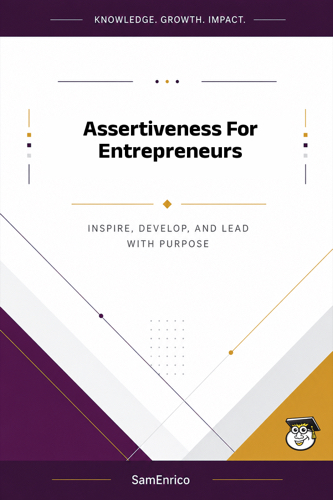
Non-FictionSelf-HelpEntrepreneurship
Assertiveness For Entrepreneurs eBook
Pitch investors, negotiate deals, and lead your st
Pitch investors, negotiate deals, and lead your startup.
Formats
Free sample
Chapter 1: The Certainty Trap--–- Most entrepreneurs walk into a pitch room believing they are playing a game of chess. They have studied the board. They know their numbers cold. They have rehearsed every possible objection. They have modeled the TAM, mapped the competitive landscape, and polished their deck until the fonts align perfectly.
And then they sit down across from the investor, open their mouths, and lose.They lose not because their product is flawed. Not because their market is too small. Not because their traction is weak. They lose because they misunderstand the fundamental nature of the game they are playing. They think the game is about being right.
It is not. The game is about being certain.This distinction sounds subtle, but it is the difference between walking out with a term sheet and walking out with a polite "we'll keep in touch." Investors do not buy logic. Logic is abundant. Every founder with a spreadsheet can produce logic. What investors buy is the feeling of certainty emanating from the person across the table.
Certainty is contagious. Doubt is louder than any number you will ever put on a slide.I learned this lesson the hard way, sitting in a Sand Hill Road boardroom with a term sheet that had just been pulled off the table. I had the data. I had the traction. I had a better product than any competitor in the space.
And I had spent forty-five minutes proving all of it, point by point, slide by slide, argument by argument. When I finished, the lead partner looked at me and said something I have never forgotten: "You've convinced me you're smart. You haven't convinced me you're in charge."That sentence changed everything. It forced me to confront a truth that most entrepreneurship books dance around but never name: in high-stakes conversations, being right is a secondary concern. Being certain is the primary currency.
And certainty does not come from having better data. It comes from understanding and controlling something far more fundamental than any number on a spreadsheet.That something is called the Frame.The Invisible Architecture of Power Every conversation takes place inside an invisible structure of assumptions, status, and unspoken rules. That structure determines who leads and who follows, who asks and who answers, who judges and who is judged. It determines, long before a single word about valuation or equity is spoken, who holds the power in the room. That invisible structure is the Frame.Here is what most founders never realize: the Frame is always there.
You do not get to opt out of it. You are either consciously building your own Frame, or you are unconsciously operating inside someone else's. And if you are operating inside an investor's Frame, you have already lost. You just do not know it yet.Think about the typical pitch meeting. The founder arrives early.
They wait in the lobby. They are ushered into a conference room where the investors are already seated at the head of the table. The founder sits where they are told. The investors ask questions. The founder answers.
The investors look at their watches. The founder thanks them for their time. The investors say they will be in touch. The founder walks to their car, replays every answer, and wonders why they feel so small.That founder never lost on the numbers. They lost on the Frame.
From the moment they walked into the room, they accepted a Frame in which the investors were the judges and they were the supplicant. In that Frame, no amount of data can save you. Because in that Frame, you have already agreed that your role is to perform and their role is to evaluate. And once you accept that, you are begging, not pitching.The good news is that Frames are not fixed. They are not walls.
They are agreements—unspoken, often unconscious, but agreements nonetheless. And what has been agreed can be reset. The question is whether you know how.The Four Investor Frames Designed to Destabilize You Over years of studying thousands of pitch meetings and term sheet negotiations, I have identified four specific Frames that investors use to destabilize founders. These Frames are not usually deployed with conscious malice. Many investors have used them so long they do not even notice they are doing it.
But the effect is the same: you walk in confident and walk out small.The Bargain Hunter Frame This Frame activates the moment an investor says something like, "Everyone is cutting valuations right now" or "The market has shifted—deals are happening at half what they were last year." On the surface, this sounds like market commentary. It is not. It is a Frame designed to make you feel that your ask is out of step with reality, that you are the unreasonable one, that you should be grateful for whatever you get.The Bargain Hunter Frame works because it taps into every founder's deepest fear: that they are overvaluing themselves, that their pride is clouding their judgment, that the market has passed them by. Once you feel that fear, you start negotiating against yourself. You lower your ask before they have even made an offer.
You start justifying your valuation instead of asserting it. You become a supplicant.The Institutional Investor Frame This Frame appears when an investor says, "We have a process you must follow" or "Our partnership meetings are every other Tuesday" or "We need you to fill out these thirty-seven pages of due diligence before we can schedule a follow-up." This Frame is designed to do one thing: make you wait. And waiting is a form of power.When you accept the Institutional Investor Frame, you agree that their timeline is the only timeline that matters. You agree that their process is legitimate and yours is not. You agree to dance when they call the tune.
And while you are waiting, they are evaluating other deals, your leverage is evaporating, and your desperation is growing.The White Knight Frame This Frame is the most insidious because it feels like kindness. An investor says, "You're lucky we're even talking to you" or "We don't usually look at companies at your stage" or "I had to really push the partners to take this meeting." On the surface, they are doing you a favor. Beneath the surface, they are establishing a Frame in which you owe them something before the conversation has even begun.The White Knight Frame puts you in debt. Once you feel grateful, you stop negotiating. You accept terms you would otherwise reject because "they took a chance on you." You give away equity because "they believed in you when no one else did." This is not charity.
It is leverage dressed up as generosity.The Time Crunch Frame This Frame appears when an investor says, "We have a partner meeting in forty-five minutes" or "I have another call at the top of the hour" or "Let's make this quick—I'm triple-booked today." The message is clear: their time is valuable. Your time is not. They are doing you the favor of squeezing you into their crowded schedule.The Time Crunch Frame…
This is the end of the free sample. Get the eBook to keep going. Buy now
About this book
Details
- Author
- Fleming Wilma
- Publisher
- SamEnrico
- Language
- English
- Genre
- Non-Fiction, Self-Help, Entrepreneurship
- Released
- 2026-06-07
- Pages (approx.)
- 124
- Available as
- eBook, Audiobook

Read better in the ZLOADR app
Your eBooks on your phone or tablet. Sign in with your SamEnrico account and start reading.
More by Fleming Wilma
 Thaler Nudge SummaryFleming Wilma$11.99
 German Bundeskartellamt CasesFleming Wilma$11.99
 Mentorship for Technical ProfessionalsFleming Wilma$11.99
 Overcoming Imposter Syndrome GuideFleming Wilma$11.99
 Clavicle Fracture RecoveryFleming Wilma$11.99
 Anger Is a LeashFleming Wilma$11.99
 Immigrant Digital Agency Success StoriesFleming Wilma$11.99
 Forensic Animal Hair GuideFleming Wilma$11.99
 The Icebound Chronicles: Viking Explorers and the Lost Arctic OutpostsFleming Wilma$11.99
 Neutrino Whispers: The Ghost Particles That Almost Solved the SunFleming Wilma$11.99
 The Mineral Guide to RiebeckiteFleming Wilma$11.99
 Growing Lychnis (Campion)Fleming Wilma$11.99
You may also like
 Hong Kong Handover 1997Dunn Johnnie$11.99
 Zumba For Postnatal Recovery CourseNeal Christian$11.99
 Zumba for BeginnersLadner Nikia$11.99
 YouTube Comment Mining GuideHumes Pandora$12.99
 Worry Box MeditationCarlin Rudy$11.99
 Workplace Stress MeditationNguyen Lynn$11.99
 Workplace Stress and Sleep RepairHawley Ivory$11.99
 Workplace Perfectionism CureDelaney Jeffry$11.99
 Workplace Injustice Anger GuideWallen Isabelle$11.99
 Work Addiction and Burnout LinkGreenwood Ester$11.99
 Women in Yoga and WellnessBeattie Galina$11.99
 Women in Stand Up ComedyChun Evangeline$11.99