
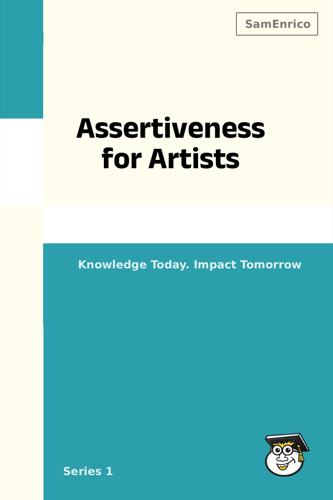
Assertiveness for Artists eBook
Set prices, handle commissions, and promote your w
by Link Ines
Set prices, handle commissions, and promote your work without self doubt.
Formats
Free sample
Chapter 1: The Starving Lie--The first time someone called me a “starving artist,” I felt a strange sense of pride. I was twenty-two years old, living in a converted storage closet that I called a studio, eating instant noodles for the fifth night in a row. The phrase felt like a badge of honor—proof that I was serious, committed, willing to suffer for my craft. I wore my poverty like a medal, believing that financial struggle was the entrance fee to authentic artistry.It took me twelve years to realize that I had been sold a lie. Not just a harmless myth, but a destructive, career-killing narrative that had been passed down through generations of artists like a hereditary disease.
The starving artist is not a hero. The starving artist is a warning sign. And the moment I stopped romanticizing my own scarcity was the moment my career finally began.This chapter dismantles the most destructive cultural narrative in the artistic world: that financial struggle is a badge of authenticity. You will learn where this myth came from, why it persists, and how it silently sabotages your ability to charge fairly, say no to bad projects, and build a sustainable career. You will identify the personal “money stories” you absorbed from family, school, and media—and see exactly how those stories are influencing your pricing today.
And you will begin the work of replacing the starving artist lie with a new, more truthful foundation: assertiveness as a skill, financial success as integrity, and charging fairly as an act of respect for your work and your community.Where the Myth Came From: A Short History of Romantic Suffering The starving artist myth did not exist for most of human history. Before the Romantic era of the late eighteenth and early nineteenth centuries, artists were generally understood as skilled craftspeople. They ran workshops, took apprentices, fulfilled commissions, and expected to be paid like any other tradesperson. Michelangelo negotiated contracts like a modern CEO. Rembrandt went bankrupt not because he was too pure for commerce but because he speculated badly in the art market.
These artists suffered, yes, but their suffering was not the point of their work.The Romantic movement changed everything. Poets, painters, and composers began to be portrayed as tortured geniuses—too sensitive for the vulgar world of commerce, too pure to manage money, too focused on transcendent beauty to bother with mundane things like rent. Lord Byron, the original celebrity suffering artist, cultivated an image of tragic nobility. Edgar Allan Poe died in poverty, and his death was retroactively framed as the inevitable end of a true artist. Van Gogh sold almost nothing in his lifetime, and his posthumous fame cemented the idea that great art and commercial success are opposites.This narrative was seductive.
It flattered artists by suggesting that their poverty was a sign of depth. It excused them from learning business skills by framing commerce as vulgar. And it gave audiences a romantic story to consume alongside the art itself. The problem is that the narrative is not only false but actively harmful. Most of the artists we revere as starving geniuses did not choose poverty.
They were failed by the systems of their time, or they made genuine mistakes, or they simply lived in eras before artists had any leverage. Their suffering was not the source of their art. It was an obstacle they overcame despite, not because of, the circumstances.The Four Ways the Starving Artist Myth Destroys Your Career Let me be specific about the damage this narrative causes. I have seen it play out in my own life and in the lives of hundreds of artists I have coached. The starving artist lie sabotages you in four distinct ways.First, it trains you to expect poverty.
If you believe that real artists struggle financially, you will unconsciously arrange your life to fulfill that expectation. You will underprice your work because charging fairly feels wrong. You will avoid asking for payment because it feels uncomfortable. You will accept bad deals because you believe you do not deserve better. The expectation becomes a self-fulfilling prophecy.
I have watched brilliant painters charge forty dollars for work that took twenty hours, then wonder why they cannot pay their rent. They were not bad at math. They were faithful to a story that required them to be broke.Second, it makes you feel guilty about earning well. The flip side of expecting poverty is feeling shame about success. When an artist lands a big commission or raises their rates significantly, the starving artist narrative whispers: “Who do you think you are?
Real artists don't care about money. You have sold out.” I have seen artists turn down lucrative opportunities because they felt “dirty” accepting them. I have seen artists apologize for their own success, diminishing their achievements before anyone else could. The guilt is not a sign of humility. It is a symptom of internalized poison.Third, it prevents you from learning business skills.
If commerce is vulgar, then learning to price, negotiate, contract, and promote yourself is not just unnecessary—it is actively dishonorable. The starving artist myth gives you permission to remain ignorant about the financial side of your career. You tell yourself that you are “focusing on the art” while secretly hoping that someone else will handle the money. No one else is coming. The galleries, agents, and collectors who could help you are not charities.
They are businesses, and they will not save you from your own financial illiteracy.Fourth, it damages the entire artistic community. When you undercharge, you do not just hurt yourself. You lower the market standard for every other artist working in your medium and region. A client who buys a $50 painting from you will expect to pay $50 for the next painting they buy, regardless of the artist's skill or effort. You have trained them to undervalue art.
I am not saying you should raise your prices overnight to match an established professional. I am saying that every time you accept less than you need to sustain yourself, you make it harder for every other artist to earn a living wage. The starving artist myth turns us against each other, competing to see who can survive on the least.Your Money Stories: Where Your Pricing Anxiety Really Comes From Here is a truth that may surprise you: most artists already know what they should charge. They have a number in their head. They have calculated their materials, their hours, their overhead.
The problem is not that they do not know the right price. The problem is that they cannot say it without apologizing, justifying, or negotiating against themselves.The root of this problem is not in your pricing spreadsheet. It is in your money stories—the unconscious narratives about money that you absorbed from your family, your school, your peers, and the media before you ever sold your first piece of art.Let me give you examples of common money stories I have heard from artists I have worked with:“Money is the root of all evil.” (From a religious or spiritually-minded family)“Rich people are greedy and corrupt.” (From a family that struggled…
This is the end of the free sample. Get the eBook to keep going. Buy now
About this book
Details
- Author
- Link Ines
- Publisher
- SamEnrico
- Language
- English
- Genre
- Non-Fiction, Self-Help, Art
- Released
- 2026-06-08
- Pages (approx.)
- 102
- Available as
- eBook, Audiobook

Read better in the ZLOADR app
Your eBooks on your phone or tablet. Sign in with your SamEnrico account and start reading.
More by Link Ines
 Metta For LGBTQ CommunityLink Ines$11.99
 The Calm Copilot WorkbookLink Ines$11.99
 The Diet of Worms Standoff GuideLink Ines$11.99
 Bully Boss Anger ControlLink Ines$11.99
 The Last Telegram: The Untold Story of the 1917 Halifax ExplosionLink Ines$11.99
 Advance Directive CounselingLink Ines$11.99
 Understanding Phosphoglycerate Kinase 1 DeficiencyLink Ines$17.99
 Cloud Database MapLink Ines$12.99
 OnlineJobs.ph Platform GuideLink Ines$12.99
 How to Start a Hobby in Vehicle restorationLink Ines$11.99
You may also like
 Purpose for ArtistsParrott Jame$11.99
 Mindfulness for Artists GuideHarwell Becki$11.99
 Growth Mindset In ArtGilbert Sam$11.99
 The Museum Viewing CuesNorris Lloyd$11.99
 Dream Journal For ArtistsChilds September$11.99
 Dream Arts IntegrationOwens Nettie$11.99
 The Teen Self Esteem Coloring BookLeighton Lenna$11.99
 The Museum Walking MeditationBlackman Ambrose$11.99
 NVC for ArtistsOtto Lacie$11.99
 Constraints for ArtistsAguilera Rickie$11.99
 Mindfulness for ArtistsMullis Larraine$11.99
 Goal Setting for ArtPuckett Amalia$11.99