
Non-FictionSelf-HelpCrisisEmergency
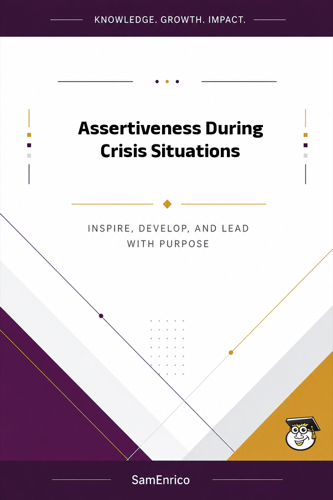
Assertiveness During Crisis Situations eBook
Advocate for yourself or loved ones during medical
by Wilke Otha
Advocate for yourself or loved ones during medical emergencies or disasters.
Formats
Free sample
Chapter 1: The Silence Trap--–- The heart monitor beeps in steady rhythm. Your mother lies in the hospital bed, her eyes closed, her chest rising and falling with the help of oxygen tubing that snakes across her pillow. The night shift nurse just came in, glanced at the screen, made a note, and walked out. You noticed something. The heart rate is 112.
Four hours ago, it was 88. You have been sitting here for hours, watching that number climb. You know, in your gut, that something is wrong. But you say nothing. The nurse is busy.
You don’t want to be a bother. You’re not a doctor. What do you really know?This is the Silence Trap. It catches smart, capable, caring people every single day. It catches them in emergency rooms and ICU waiting areas, in disaster shelters and ambulance bays, in the quiet moments before a small problem becomes a catastrophe.
And it catches them not because they don’t care, but because their own brains have been wired to prioritize politeness over safety, hierarchy over evidence, and fear over action.This chapter exists to spring that trap. By the time you finish reading these pages, you will understand exactly why silence feels so natural in a crisis, why staying quiet is almost always the wrong choice, and how to break the grip of paralysis in the seconds that separate recognition from action.THE COST OF A SINGLE UNASKED QUESTIONLet me tell you about a man named Daniel. He was a retired firefighter, sixty-three years old, admitted to a suburban hospital for what doctors thought was a mild case of pneumonia. His daughter, Elena, stayed with him around the clock. On the third day, Daniel complained of new pain in his left calf.
Elena noticed that the calf looked red and felt warm to the touch. She had read somewhere that leg pain and redness could be a blood clot. She opened her mouth to call the nurse.And then she stopped. The nurse had just been in the room. The nurse had said Daniel was doing great.
Elena didn't want to be the family member who cried wolf over nothing. She told herself she would mention it in the morning.By morning, Daniel had suffered a massive pulmonary embolism. The blood clot had traveled from his leg to his lungs. He survived, but he spent two weeks on a ventilator and lost forty percent of his lung function. He can no longer walk to his mailbox without stopping to catch his breath.
The pulmonologist told Elena that if the clot had been caught the night before, a simple blood thinner could have dissolved it. One question. One unasked question.Elena’s story is not unusual. It is not even extreme. Every day in hospitals across the world, patients die or suffer permanent harm because someone—a family member, a patient, sometimes even a nurse—noticed something wrong and said nothing.
The Joint Commission, which accredits healthcare organizations in the United States, has identified communication failures as a root cause in over seventy percent of serious adverse events. That number should terrify you. It should also empower you, because it means you have the power to change the outcome.WHY SMART PEOPLE FALL INTO THE TRAPIf silence is so dangerous, why do intelligent, articulate people fall into the trap again and again? The answer lies in three psychological mechanisms that operate below the level of conscious awareness. Understanding them is the first step to defeating them.Mechanism One: The White Coat Effect In the 1960s, psychologist Stanley Milgram conducted a series of experiments that shocked the world.
He asked ordinary people to administer electric shocks to a stranger in another room. The shocks were fake, but the participants did not know that. When a man in a white lab coat told them to continue, sixty-five percent of participants delivered what they believed to be lethal shocks. The white coat, all by itself, was enough to override their moral compass.Medical settings weaponize the white coat effect. Doctors wear white coats.
Nurses wear scrubs. The physical environment—the beeping monitors, the antiseptic smell, the gurneys—all of it signals to your brain that you are in a place where someone else is in charge. Your brain, evolved to defer to authority in unfamiliar situations, obediently steps aside. You become passive. You wait to be told what to do.The white coat effect is so powerful that it persists even when you know it exists.
Even when you have read this chapter. Even when you have sworn to yourself that you will speak up. The white coat triggers an automatic deference response that bypasses your rational brain. That is why you need tools, not just good intentions.Mechanism Two: The Asymmetric Risk Calculation Your brain is terrible at calculating risk in a crisis. Specifically, your brain systematically overestimates the social risks of speaking up and systematically underestimates the medical risks of staying silent.Consider two scenarios.
Scenario A: You speak up and you are wrong. What happens? A moment of embarrassment. A nurse might sigh. A doctor might give you a condescending look.
You might feel foolish for five or ten minutes. Scenario B: You stay silent and you are right. What happens? Your loved one could suffer permanent injury or die.From a purely logical standpoint, the choice is obvious. The potential harm of silence dwarfs the potential harm of speaking up.
But your brain does not process these risks logically. Social pain—embarrassment, rejection, looking foolish—activates the same neural circuits as physical pain. Your brain treats the possibility of a nurse’s sigh as a genuine threat. The distant possibility of a medical catastrophe, abstract and future-oriented, feels less urgent.This is the Asymmetric Risk Calculation, and it kills people. The only way to defeat it is to recognize it in the moment and consciously override it.
You must learn to say to yourself: I would rather be embarrassed for five minutes than carry guilt for the rest of my life.Mechanism Three: The Script of the Good Patient We are all raised on a cultural script about how to behave in a medical setting. The Good Patient is quiet, compliant, and grateful. The Good Patient does not ask too many questions. The Good Patient trusts the doctor implicitly. The Good Patient’s family member sits in the plastic chair, drinks bad coffee, and waits without complaint.This script is not neutral.
It was written by and for a medical system that prioritizes efficiency over partnership. A quiet patient is an easy patient. A family member who does not ask questions is a family member who does not slow things down. The script serves the system, not the patient.But you are not a character in someone else’s script. You are a human being with knowledge, observations, and a stake in the outcome.
The person who knows your mother’s baseline energy level is you. The person who knows your child’s normal cough is you. The person who knows your spouse’s medication allergies is you. That knowledge is not optional. It is essential.
And the system will not ask for it. You must volunteer it.THE ANATOMY OF A FREEZENow let us look under…
This is the end of the free sample. Get the eBook to keep going. Buy now
About this book
Details
- Author
- Wilke Otha
- Publisher
- SamEnrico
- Language
- English
- Genre
- Non-Fiction, Self-Help, Crisis, Emergency
- Released
- 2026-06-08
- Pages (approx.)
- 125
- Available as
- eBook, Audiobook

Read better in the ZLOADR app
Your eBooks on your phone or tablet. Sign in with your SamEnrico account and start reading.
More by Wilke Otha
 Depreciation for Medical EquipmentWilke Otha$11.99
 Bathroom Phobia Public Restroom PlanWilke Otha$11.99
 The EQ for Military Spouses GuideWilke Otha$11.99
 Crooked Teeth AcceptanceWilke Otha$11.99
 The Lazarus Protocol: How the CIA Turned Sleep into a WeaponWilke Otha$11.99
 Czech EV Battery Supply Chain GuideWilke Otha$12.99
 Strategy Meeting Emergency KitWilke Otha$12.99
 How to Become a Nurse AssistantWilke Otha$11.99
 Understanding Marburg FeverWilke Otha$17.99
 Mental Health WorkerWilke Otha$11.99
You may also like
 Hong Kong Handover 1997Dunn Johnnie$11.99
 Zumba For Postnatal Recovery CourseNeal Christian$11.99
 Zumba for BeginnersLadner Nikia$11.99
 YouTube Comment Mining GuideHumes Pandora$12.99
 Worry Box MeditationCarlin Rudy$11.99
 Workplace Stress MeditationNguyen Lynn$11.99
 Workplace Stress and Sleep RepairHawley Ivory$11.99
 Workplace Perfectionism CureDelaney Jeffry$11.99
 Workplace Injustice Anger GuideWallen Isabelle$11.99
 Work Addiction and Burnout LinkGreenwood Ester$11.99
 Women in Yoga and WellnessBeattie Galina$11.99
 Women in Stand Up ComedyChun Evangeline$11.99