
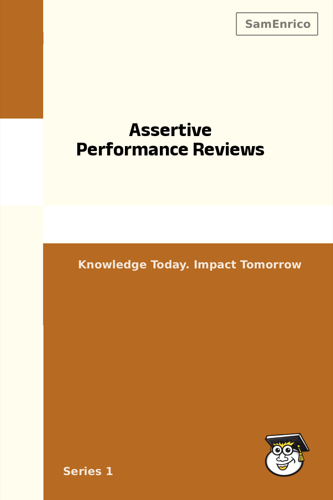
Non-FictionSelf-HelpPerformance Reviews
Assertive Performance Reviews eBook
Advocate for your accomplishments without bragging
by Vines Roxann
Advocate for your accomplishments without bragging using this guide.
Formats
Free sample
Chapter 1: The Humility Trap--–- Margaret is a senior product manager at a mid-sized tech company. She has led three successful product launches this year, increased customer retention by 15 percent, and personally mentored two junior PMs who were later promoted. When her annual performance review arrives, she walks into her manager’s office with a folder of metrics—and then proceeds to say the following: “I think things went pretty well. I had some help from the team. The retention numbers were okay, but there’s a lot more we could have done.”Her manager nods, writes down “meets expectations,” and moves on to the next topic.
Margaret leaves the room feeling vaguely cheated but unsure why. She worked hard. She has the data. Yet somehow, she just told her boss that her performance was merely adequate.This is the Humility Trap.The Quiet Crisis of Underselling Every day in offices around the world, capable, high-performing professionals walk into performance reviews and systematically undermine their own accomplishments. They use words like “we” when they mean “I.” They hedge their achievements with phrases like “it was nothing” or “anyone could have done it.” They focus on what went wrong rather than what went right.
And they walk out with ratings and raises that reflect neither their actual contribution nor their potential.The cost of this behavior is staggering. Research consistently shows that self-promotion—when done effectively—is correlated with higher performance ratings, faster promotions, and significantly higher lifetime earnings. A landmark study by the National Bureau of Economic Research found that employees who advocated for themselves during reviews received compensation increases up to 50 percent higher than equally qualified peers who remained silent. Another study published in the Journal of Applied Psychology demonstrated that self-advocacy was a stronger predictor of career advancement than actual performance metrics.Let that sink in. Your ability to communicate your value can matter more than the value itself.But here is the paradox: the same professionals who would never hesitate to advocate for a project, a budget, or a team member freeze when it comes to advocating for themselves.
They will write a five-page business case for a new software license but cannot write five sentences about their own accomplishments without feeling like a fraud.This chapter is about understanding why that happens—and why the standard advice to “just be more confident” fails spectacularly.Who Falls into the Trap The Humility Trap does not discriminate equally. It disproportionately affects certain groups, and understanding this is the first step toward escaping it.Women. Decades of research, including the seminal work by the Clayman Institute for Gender Research at Stanford, have documented the “likability penalty” faced by women who self-promote. When a man says “I closed the deal,” he is perceived as competent and assertive. When a woman says the exact same words, she is perceived as aggressive, unlikeable, and “difficult.” This double bind forces many women into a painful choice: advocate and risk social rejection, or stay silent and risk career stagnation.
Most choose silence.People of color. Research from Harvard Business Review shows that professionals from underrepresented racial and ethnic groups face a similar penalty, often amplified by stereotypes about “arrogance” or “not knowing one’s place.” The same assertive behavior that is rewarded in majority groups is punished in minority groups.Introverts and highly conscientious professionals. For those who derive energy from solitary work and value modesty as a moral virtue, self-promotion feels not just difficult but wrong. It violates an internal code of conduct that says good work speaks for itself. The problem is that good work does not speak.
It sits quietly in a database, waiting to be noticed by an overloaded manager who has fifteen other direct reports and two hundred unread emails.People from modest cultures. In many cultures—including East Asian, Scandinavian, and some Latin American traditions—self-promotion is considered shameful. Professionals who were raised with these values often experience physical discomfort when asked to highlight their own achievements. They are not being timid; they are being culturally loyal.If you see yourself in any of these descriptions, you are not broken. You are responding rationally to a set of social incentives that have punished self-advocacy in the past.
But those incentives change when you change how you advocate—which is why this book exists.Why the Standard Advice Fails If you have ever googled “how to be more confident in performance reviews,” you have encountered the same useless suggestions: “Believe in yourself!” “Fake it till you make it!” “Just be more assertive!”This advice fails because it ignores the actual barrier. Most high-performing professionals do not lack confidence. Margaret, our product manager from the opening, is plenty confident when she is leading a product launch or negotiating with engineering. She does not lack the skill to present data. She presents data every day.What she lacks is permission—permission to apply the same evidence-based, factual reporting to her own work that she applies to everything else.The standard advice also fails because it confuses two very different behaviors: bragging and assertive advocacy.
Let us distinguish them clearly, because this distinction is the foundation of everything that follows.Bragging is subjective, comparative, and emotion-based. It sounds like this:“I am the best salesperson on the team.”“Nobody else could have closed that deal.”“I work harder than anyone else here.”Bragging invites comparison. It invites pushback. It triggers the likability penalty. And it is almost always unnecessary.Assertive advocacy is factual, value-driven, and evidence-based.
It sounds like this:“I closed $500,000 in Q3, which was 120 percent of quota.”“The deal required six months of follow-up and three rounds of legal review, all of which I managed.”“I worked 45 hours per week on average and completed 12 of 13 quarterly objectives.”Assertive advocacy does not invite comparison. It invites verification. It says: “Here is the data. Check it if you want. The numbers speak for themselves.”The difference is not in the level of confidence.
It is in the level of evidence.The Non-Horn-Tooter Identity If you are someone who finds self-promotion morally uncomfortable, I want to offer you a different identity. You are not a braggart. You are not a self-promoter. You are a data provider.Here is the reframe: Your manager has between five and fifteen direct reports. They are not watching you work.
They are attending meetings, answering emails, putting out fires, and—if you are lucky—spending thirty minutes a week thinking about your career. They cannot see everything you do. It is literally impossible.If you do not tell your manager what you accomplished, they will do one of two things:Guess (which is dangerous, because they will almost certainly guess low).Assume you did nothing notable (which is common, because silence is read as absence).Neither outcome serves you. Neither outcome serves your manager, who needs accurate information to advocate for you in the compensation and promotion calibration meetings that happen behind closed doors.When you provide a factual account of your accomplishments, you are not “tooting your own horn.” You are giving your manager the ammunition they need to fight for you. You are making their job easier.…
This is the end of the free sample. Get the eBook to keep going. Buy now
About this book
Details
- Author
- Vines Roxann
- Publisher
- SamEnrico
- Language
- English
- Genre
- Non-Fiction, Self-Help, Performance Reviews
- Released
- 2026-06-11
- Pages (approx.)
- 137
- Available as
- eBook, Audiobook

Read better in the ZLOADR app
Your eBooks on your phone or tablet. Sign in with your SamEnrico account and start reading.
More by Vines Roxann
 Paraben Free Cosmetics ListVines Roxann$11.99
 The Retirement Housing Bridge Loan GuideVines Roxann$11.99
 Remote Work Manager GuideVines Roxann$11.99
 The Foster Sibling BondVines Roxann$11.99
 Parent Loss Therapy OptionsVines Roxann$11.99
 Success Without Burnout for TeachersVines Roxann$11.99
 Quanah Parker ComancheVines Roxann$11.99
 The Raid of the Sea Wolves: Viking Mercenaries in the American RevolutionVines Roxann$11.99
 The Corsair of the Black Sea: Amiral Mikhail Lazarev and the Charge of the Russian FleetVines Roxann$11.99
 How to Produce LipstickVines Roxann$11.99
 A Collector's Handbook to the Metropolitan 1500Vines Roxann$11.99
 Opening Hook That Grabs ReadersVines Roxann$12.99
You may also like
 Hong Kong Handover 1997Dunn Johnnie$11.99
 Zumba For Postnatal Recovery CourseNeal Christian$11.99
 Zumba for BeginnersLadner Nikia$11.99
 YouTube Comment Mining GuideHumes Pandora$12.99
 Worry Box MeditationCarlin Rudy$11.99
 Workplace Stress MeditationNguyen Lynn$11.99
 Workplace Stress and Sleep RepairHawley Ivory$11.99
 Workplace Perfectionism CureDelaney Jeffry$11.99
 Workplace Injustice Anger GuideWallen Isabelle$11.99
 Work Addiction and Burnout LinkGreenwood Ester$11.99
 Women in Yoga and WellnessBeattie Galina$11.99
 Women in Stand Up ComedyChun Evangeline$11.99