
Non-FictionSelf-HelpNegotiation
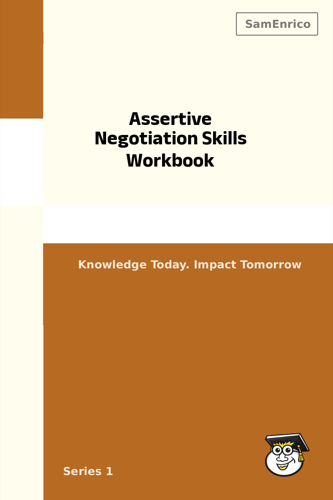
Assertive Negotiation Skills Workbook eBook
Balances own needs with others' interests in profe
Balances own needs with others' interests in professional negotiations.
Formats
Free sample
Chapter 1: The Balance Myth--–- Most professionals enter their first negotiation training convinced they face a simple choice: be tough and win, or be nice and lose. This either-or thinking is the most expensive mistake in business communication. It costs billions in lost value annually, destroys relationships, and leaves high-achieving people feeling like either bullies or doormats. The truth is that neither aggression nor passivity works reliably. Aggressive negotiators win short-term battles but poison long-term partnerships.
Passive negotiators preserve relationships but leave value on the table until resentment builds and collaboration collapses. The alternative that top performers use is neither a compromise between these extremes nor a blend of both. It is an entirely different category of behavior: assertive negotiation. And it begins with rejecting the false choice between self-interest and other-interest.The Cost of the Either-Or Trap Imagine a senior marketing director named Priya. She needs a 15 percent budget increase to launch a campaign that could define her career.
Her counterpart, the CFO, needs to cut department spending by 8 percent across the board. Priya has two voices in her head. The passive voice whispers: “Don’t push too hard. You need a good relationship with Finance for future projects. Ask nicely and accept whatever they offer.” The aggressive voice counters: “Demand the full 15 percent.
Show them your data. If they say no, threaten to escalate to the CEO.” Most training tells Priya to find a middle ground—maybe ask for 7 percent and hope. But middle ground is not assertiveness. It is just timid aggression wrapped in polite language.Priya’s real problem is not her asking style. It is her assumption that her needs and the CFO’s interests are opposites.
That assumption is the Balance Myth—the belief that every negotiation requires you to choose between getting what you want and keeping the other person happy. This myth persists because most negotiations are taught through a lens of scarcity. One pie. Two people. Whoever gets more leaves the other with less.
But professional negotiations rarely involve a fixed pie. They involve multiple variables: timing, risk, reputation, workload, future opportunities, and relationships. Assertive negotiation expands the pie before dividing it, then protects your slice without stealing theirs.The data on this is clear. Research from over 10,000 business negotiations shows that negotiators trained in assertive, interest-based models achieve 42 percent better outcomes on average than those trained in competitive bargaining, while maintaining relationship satisfaction scores that are 37 percent higher. More tellingly, the same study found that self-identified “nice” negotiators left an average of 18 percent of potential value on the table, while self-identified “tough” negotiators had a 53 percent higher rate of deal failure after the first signed agreement due to implementation sabotage or relationship breakdown.
The assertive middle does not exist. It is not a midpoint on a line between passive and aggressive. It is a different dimension entirely.Redefining Assertiveness: The Two-Pillar Model Assertive negotiation rests on two pillars that must stand simultaneously. Pillar one is unwavering respect for your own needs, interests, and limits. Pillar two is genuine respect for the other party’s needs, interests, and limits.
Remove either pillar, and the structure collapses into aggression (pillar one without pillar two) or passivity (pillar two without pillar one). The word “assertive” comes from the Latin assertus, meaning “to claim or defend.” But in modern negotiation science, assertiveness means claiming your position while defending the other person’s right to theirs. It is not domination. It is not submission. It is declaration with invitation.To make this concrete, consider three versions of the same statement delivered by a project manager whose team is overloaded:Passive: “I’m really sorry to bother you, but if it’s not too much trouble, could we maybe push the deadline by a few days?
Only if that works for you, of course.”Aggressive: “You need to give us another week. Your last request already put us behind. That’s non-negotiable.”Assertive: “I cannot meet the Friday deadline with the current workload. I can deliver on Tuesday, or we can discuss which tasks to deprioritize to keep Friday. Which works better for your team?”The assertive version does three things that the others do not.
First, it states a clear boundary without apology (“I cannot meet the Friday deadline”). Second, it offers alternatives that respect the other party’s needs (“deliver Tuesday” or “deprioritize tasks”). Third, it invites collaboration without surrendering agency (“Which works better for your team?”). Notice what is missing: justification, blame, hedging, and false harmony.This is the operational definition of assertive negotiation used throughout this workbook: the ability to state your needs clearly and calmly, set boundaries without hostility, and pursue your interests while actively preserving the other party’s ability to pursue theirs. Note that this definition does not require mutual satisfaction.
It requires mutual respect. You can assertively say no to a request that harms your interests, even if the other party is disappointed. Disappointment is not a sign of failure. Resentment is.Why “Win-Win” Became a Trap In the 1980s, the Harvard Negotiation Project popularized “win-win” as an alternative to positional bargaining. The idea was elegant: instead of fighting over positions, uncover underlying interests and create solutions that satisfy both parties.
This framework produced brilliant results in countless contexts. But over time, win-win was corrupted. Well-meaning professionals began to treat it as a moral obligation rather than a strategic tool. They believed that every negotiation must end with both parties happy. When that proved impossible, they either forced false agreements (sacrificing their own needs) or blamed themselves for failing to find a creative solution that did not exist.The problem is not win-win as a concept.
The problem is win-win as a requirement. Some negotiations involve genuinely opposing interests. You and a vendor both want the same limited supply of rare materials. You and another department head both want the same high-performing employee assigned to your team. You and a client both have fixed budgets that do not overlap.
In these cases, forcing a win-win outcome is like forcing a square peg into a round hole. It breaks the peg.Assertive negotiation parts ways with mandatory win-win at exactly this point. When interests genuinely conflict, the assertive negotiator does the following: (1) acknowledges the conflict openly, (2) protects their own interests without demonizing the other party, (3) seeks fair process even if fair outcome is impossible, and (4) walks away when no acceptable agreement exists. This is not win-win. It is win-respect.
And it is far more sustainable than pretending that every dispute has a hidden solution where everyone gets everything they want.Consider a real example from a technology company. Two senior engineers both wanted the same promotion to lead architect. The position could not be split. There was no creative solution that would give both the title and compensation. A win-win consultant might suggest co-lead roles, but the company’s structure did not allow it.
An assertive approach did something different. The two engineers, guided by a trained manager, acknowledged the conflict directly. Each stated their interests. One wanted the title for career mobility; the other wanted the compensation to support a growing family. They could not both get the…
This is the end of the free sample. Get the eBook to keep going. Buy now
About this book
Details
- Author
- Bellamy Earle
- Publisher
- SamEnrico
- Language
- English
- Genre
- Non-Fiction, Self-Help, Negotiation
- Released
- 2026-06-10
- Pages (approx.)
- 160
- Available as
- eBook, Audiobook

Read better in the ZLOADR app
Your eBooks on your phone or tablet. Sign in with your SamEnrico account and start reading.
More by Bellamy Earle
 Endometriosis after MenopauseBellamy Earle$11.99
 Coros Wearable Sleep GuideBellamy Earle$11.99
 The German Tuition Free Master GuideBellamy Earle$11.99
 Brazil Green Tax CreditsBellamy Earle$11.99
 The Silk Road of the Sahel: The Merchant Kings of TimbuktuBellamy Earle$11.99
 Understanding Retinal DegenerationBellamy Earle$17.99
 Developer Hiring Guide PhilippinesBellamy Earle$12.99
 Student PR Timeline PlannerBellamy Earle$12.99
 Lead AccountantBellamy Earle$11.99
 How to Start a Bandage Cloth Weaving Business (Beginners Guide)Bellamy Earle$11.99
You may also like
 Hong Kong Handover 1997Dunn Johnnie$11.99
 Zumba For Postnatal Recovery CourseNeal Christian$11.99
 Zumba for BeginnersLadner Nikia$11.99
 YouTube Comment Mining GuideHumes Pandora$12.99
 Worry Box MeditationCarlin Rudy$11.99
 Workplace Stress MeditationNguyen Lynn$11.99
 Workplace Stress and Sleep RepairHawley Ivory$11.99
 Workplace Perfectionism CureDelaney Jeffry$11.99
 Workplace Injustice Anger GuideWallen Isabelle$11.99
 Work Addiction and Burnout LinkGreenwood Ester$11.99
 Women in Yoga and WellnessBeattie Galina$11.99
 Women in Stand Up ComedyChun Evangeline$11.99