
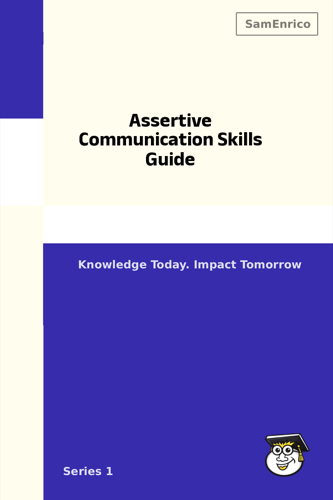
Assertive Communication Skills Guide eBook
Stand up for yourself while respecting others usin
Stand up for yourself while respecting others using 'I' statements and calm tone.
Formats
Free sample
Chapter 1: The Ghost, The Tank, and The Anchor--Most people believe they know how they come across to others. They are almost always wrong.Take a moment to recall the last time you felt truly frustrated in a conversation—maybe with a partner who wasn't listening, a colleague who took credit for your work, or a parent who dismissed your feelings. What did you do? If you are like the majority of people who walk into my workshops or pick up books like this one, you did one of two things. Either you swallowed your words, smiled, and said nothing—then fumed about it for three days.
Or you snapped, said something sharper than intended, and spent the next hour replaying the exchange with a knot in your stomach.Neither path leads anywhere good. The first path—silence—builds a slow, suffocating resentment. The second path—explosion—burns trust and leaves you feeling guilty or misunderstood. And here is the cruel irony: most people cycle between these two extremes their entire lives, believing they have only two options: be nice or be tough. Be quiet or be loud.
Lose or win.This chapter exists to show you a third option—one that most people have never seen modeled, let alone practiced. It is called assertiveness, and it has nothing to do with winning arguments or dominating conversations. Assertiveness is the quiet, grounded ability to stand up for your own needs while leaving room for someone else's. It is not a personality trait you are born with. It is a skill you build, like a muscle.
And the first step to building it is recognizing which of three communication "selves" currently shows up when you are under pressure.We will call them the Ghost, the Tank, and the Anchor.By the end of this chapter, you will not only know which one you default to—you will understand why you default to it, what it costs you, and how to begin shifting toward the Anchor. This is not about judging yourself. Most people are some blend of all three, depending on the situation and who they are talking to. But there is almost always a dominant pattern, a familiar shape that your voice takes when the stakes rise. Finding that shape is the first real step toward changing it.The Ghost: The High Cost of Vanishing The Ghost is the part of you that learned, somewhere along the way, that keeping the peace is more important than being heard.
Ghosts do not start fights. Ghosts do not make demands. Ghosts apologize for things that are not their fault. Ghosts say "I don't mind" when they absolutely mind. Ghosts laugh off insults.
Ghosts over-explain their simplest needs. Ghosts will drive twenty minutes out of their way because they could not bring themselves to say "that doesn't work for me."On the surface, being a Ghost feels safe. Conflict avoided. Voices never raised. Relationships preserved.
But beneath that calm surface, something corrosive is happening. Every swallowed opinion, every forced smile, every "it's fine" that is not fine—these are not harmless sacrifices. They are small betrayals of yourself. And they accumulate.One client I worked with, let us call her Priya, came to coaching because she was exhausted all the time. She managed a team of eight, had two young children, and was the designated family peacekeeper for her extended relatives.
She described herself as "patient" and "easygoing." But when we dug deeper, a different picture emerged. Priya never said no. She never asked for help. She answered emails at 11 PM because she could not bring herself to set an out-of-office boundary. When her husband forgot their anniversary, she said "it's okay, you've been busy." When her boss added a fifth project to her plate, she said "I'll figure it out."Priya was not patient.
Priya was invisible.Here is what the Ghost does not see in the moment: the long-term cost of chronic passivity is not just burnout. It is resentment. And resentment is insidious because it does not feel like anger at first. It feels like fatigue. Like low-grade depression.
Like waking up and not wanting to talk to anyone. But underneath that fatigue is a quiet fury—at yourself for not speaking up, and at others for not noticing your sacrifice.The physical toll is real. Chronic passivity has been linked to elevated cortisol levels, weakened immune function, and higher rates of anxiety disorders. Your body knows when you have betrayed your own needs, even if your mouth says "I'm fine." The Ghost's signature move—avoidance—may dodge a momentary conflict, but it mortgages your long-term well-being.Beyond the personal cost, the Ghost damages relationships in a way that feels invisible. Partners of Ghosts often report feeling confused and frustrated.
They say things like "I wish she would just tell me what she wants" or "I feel like I'm walking on eggshells, but I don't know why." Because the Ghost does not express needs directly, the other person is left guessing—and usually guessing wrong. Then the Ghost feels unseen. Then the resentment grows. It is a loop that benefits no one.Common Ghost phrases include:"It's really not a big deal." (When it is.)"Oh, don't worry about me." (When you desperately want someone to worry.)"I just want everyone to be happy." (Except yourself.)"Sorry, sorry, sorry." (For existing.)"No, you go ahead." (When you were there first.)"I don't need anything." (When you are drowning.)If any of these sound familiar, you have a Ghost inside you. And that Ghost is not your enemy—it is your protector.
It kept you safe in environments where speaking up was punished, ignored, or dangerous. But what worked then may be crippling you now.The Tank: Winning the Battle, Losing the War If the Ghost disappears, the Tank attacks. The Tank is the part of you that learned that the only way to be heard is to be louder, sharper, or more forceful than the other person. Tanks interrupt. Tanks raise their voices.
Tanks use "you" statements that land like accusations: "You never listen," "You always do this," "You are so selfish." Tanks might not yell—some Tanks are masters of the cold, cutting comment delivered at a whisper. But the effect is the same: the other person feels run over.On the surface, the Tank appears to win. They get the last word. They make their point. They do not leave a conversation feeling walked on.
But beneath that surface, the Tank is losing something more valuable than any argument: connection.I worked with a senior executive named Marcus who could not understand why his team had stopped bringing him problems. His numbers were good. His decisions were correct. But turnover was high, and his direct reports gave vague, evasive answers in meetings. Marcus was a classic Tank.
He did not yell—he prided himself on being "direct." But his directness sounded like this: "That idea won't work." "You missed the obvious problem." "Here's what you should have done." Every sentence was a correction. Every interaction was a performance review.Marcus was not trying to be cruel. He genuinely believed he was…
This is the end of the free sample. Get the eBook to keep going. Buy now
About this book
Details
- Author
- Bunch Shirely
- Publisher
- SamEnrico
- Language
- English
- Genre
- Non-Fiction, Self-Help, Communication
- Released
- 2026-06-09
- Pages (approx.)
- 129
- Available as
- eBook, Audiobook

Read better in the ZLOADR app
Your eBooks on your phone or tablet. Sign in with your SamEnrico account and start reading.
More by Bunch Shirely
 Gratitude for FailureBunch Shirely$11.99
 Senior Regret Acceptance GuideBunch Shirely$11.99
 Working Poor Car RepairBunch Shirely$11.99
 Beginner Loving Kindness MeditationBunch Shirely$11.99
 Tamerlane's Blood Moon: The Conqueror Who Shattered Empires (1389)Bunch Shirely$11.99
 Understanding Myoclonic EpilepsyBunch Shirely$17.99
 Variance Analysis Formula GuideBunch Shirely$12.99
 Tesla SWOT Analysis Library GuideBunch Shirely$12.99
 Battery Jump-start Service (Mall/garage)Bunch Shirely$11.99
 How to Become a Documentation SupervisorBunch Shirely$11.99
You may also like
 NVC Four Step FrameworkRountree Jude$11.99
 I Statements Practice GuideChan Erlene$11.99
 The Small Talk TransformationBittner Bart$11.99
 The Assertive Communication GuideSumpter Chantal$11.99
 Stress Induced Nagging CycleNix Lavada$11.99
 Social Intelligence WorkbookCochrane Cythia$11.99
 Mindful Listening CommunicationCleary Dian$11.99
 Improv Yes And HandbookRees Cheyenne$11.99
 Honking Anger Reduction GuideGurley Irmgard$11.99
 Difficult Conversation ResetRenner Jonah$11.99
 Breaking Yelling Cycles HandbookMclendon Latrice$11.99
 The Coworker Interruption ScriptWyman Nicolasa$11.99