
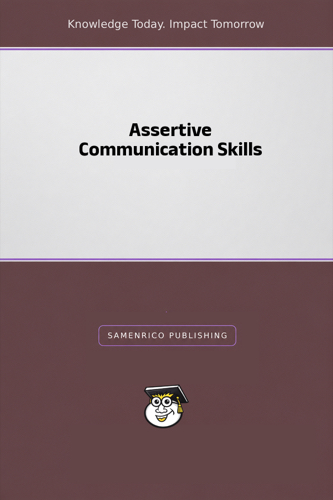
Assertive Communication Skills eBook
Teaches I-statements, eye contact, and body langua
Teaches I-statements, eye contact, and body language for confident delivery.
Formats
Free sample
Chapter 1: The Third Door--–- You are about to make a decision that will determine everything. Not a decision about a job, a relationship, or a major life purchase. A decision smaller than that, faster than that, and more powerful than that. The decision happens in less than one second. It happens when someone asks you for something you do not want to give, when someone interrupts you in a meeting, when someone makes a comment that lands like a small punch to the chest.
In that half-second window, your brain chooses one of two paths: fight or flight. And here is the problem those two paths have created for you. Neither one works.The fight path looks like aggression. You raise your voice. You interrupt back.
You make a cutting remark that lands harder than you intended. For about three seconds, it feels good. Then the other person’s face changes. They shut down, or they fire back, or they quietly begin planning their exit from the conversation and from you. You win the battle.
You lose the bridge.The flight path looks like silence. You nod. You say “sure” when you mean “no.” You laugh at a joke that stung. You tell yourself it’s not worth it. For about three seconds, you feel safe.
Then the resentment begins to grow, quietly at first, then louder, until you find yourself lying awake at two in the morning rehearsing everything you should have said. You keep the peace. You lose yourself.There is a third path. Almost no one takes it. Not because it is difficult to learn, but because no one ever showed them the door.
This book is that door.The third path is assertiveness. It is not aggression dressed in nicer clothes. It is not passive silence with a smile. It is a completely different operating system for human interaction, one based on a radical idea that most people have never heard stated aloud. Here it is.
You matter. And so do they. At the exact same time.Most people live their entire lives believing that conversation is a zero-sum game. If I get what I want, you lose. If you get what you want, I lose.
Assertiveness rejects this completely. Assertiveness says: we can both walk away from this conversation with our dignity intact, our needs partially met, and our relationship still standing. That is not a fantasy. That is a skill. And like any skill, it can be learned, practiced, and mastered.But before we teach you the techniques, before we give you the scripts, the body language drills, the eye contact exercises, we have to show you something uncomfortable about where you are standing right now.
Because most people who pick up this book do not realize that they have already chosen a default path. They have been choosing it for years. And that default path is slowly, quietly, costing them everything.THE FOUR COMMUNICATION STYLESLet us name the four ways human beings talk to each other when the stakes are high. You will recognize yourself in at least one of these. Most people recognize themselves in two.
The goal of this chapter is not to shame you for your default style. The goal is to help you see it clearly for the first time, because you cannot walk through a door you do not know exists.Style One: Passive Communication The passive communicator has forgotten that their own needs exist. When asked for an opinion, they say “I don’t know” even when they do know. When asked for a favor, they say “sure” even when every cell in their body is screaming no. When treated poorly, they say “it’s fine” while their jaw is clenched so tight their teeth ache.The passive communicator operates on a single, unspoken rule.
Other people’s feelings matter. Mine do not. Or more accurately, mine matter less. Much less. Almost not at all.This is not a character flaw.
It is a survival strategy that was learned somewhere along the way, probably in childhood, probably from a caregiver who punished self-expression or a peer group that rewarded compliance. The strategy worked then. It kept you safe. But strategies that keep a child safe in a chaotic environment become prisons for an adult who wants to thrive.The passive communicator pays a steep price for their silence. The body keeps score.
Cortisol, the stress hormone, floods their system during every suppressed conflict. Over months and years, this leads to headaches, digestive issues, insomnia, and a persistent low-grade depression that they cannot quite name. They are exhausted not because they do too much, but because they carry too much unsaid.Worse, the passive communicator eventually explodes. Not always, not everyone, but the pattern is so common it has a name. The door-mat syndrome.
You say yes so many times that you become a door-mat. People wipe their feet on you not because they are monsters, but because you have taught them that you will not complain. Then one day, without warning, the door-mat flips over and becomes a bomb. You scream. You cry.
You say things you cannot take back. And then you apologize for exploding, which puts you right back on the floor as a door-mat, and the cycle begins again.If this sounds familiar, take a breath. You are not broken. You are trained. And training can be replaced.Style Two: Aggressive Communication The aggressive communicator has the opposite problem.
They have forgotten that other people’s needs exist. When asked for an opinion, they state it as fact. When asked for a favor they cannot give, they say no in a way that feels like a slap. When treated poorly, they attack back immediately, twice as hard, with interest.The aggressive communicator operates on a single, unspoken rule. My feelings matter.
Yours do not.This strategy also worked somewhere along the way. Perhaps it was modeled at home by a parent who shouted to win. Perhaps it was rewarded in sports or business or male socialization. Perhaps it is the only way they learned to feel safe, by making everyone else feel smaller.But the aggressive communicator pays a different price. They win arguments and lose relationships.
The boomerang effect describes what happens when aggression is used repeatedly. At first, people comply. They are afraid, and fear produces short-term obedience. But over time, the same people begin to avoid the aggressive communicator. They stop sharing bad news.
They stop offering creative ideas. They stop caring about the aggressive person’s success. And eventually, they leave. The aggressive person is left standing in a room that is emptying out, wondering why no one respects them, not realizing that fear and respect are not the same thing.The aggressive communicator also pays a physical price, though it looks different than the passive communicator’s price. Chronic aggression raises blood pressure, increases risk of heart disease, and correlates with shorter lifespans.
The body was not designed to live in a state of constant fight. The fight response is for emergencies, not for Tuesday morning staff meetings.If this sounds familiar, take a breath. You are not a…
This is the end of the free sample. Get the eBook to keep going. Buy now
About this book
Details
- Author
- Worth Willena
- Publisher
- SamEnrico
- Language
- English
- Genre
- Non-Fiction, Self-Help / Communication
- Released
- 2026-06-06
- Pages (approx.)
- 140
- Available as
- eBook, Audiobook

Read better in the ZLOADR app
Your eBooks on your phone or tablet. Sign in with your SamEnrico account and start reading.
More by Worth Willena
 Parentified Child Self EsteemWorth Willena$11.99
 Healthcare Persuasion TacticsWorth Willena$11.99
 Elderly Nightmare ProcessingWorth Willena$11.99
 Bipolar and Gambling DisorderWorth Willena$11.99
 Low Carb Work Lunch SolutionsWorth Willena$11.99
 Boulder Fields Danger ZonesWorth Willena$11.99
 Law Degrees In DubaiWorth Willena$11.99
 Angels of the Eastern Front: The Forgotten Medics of Khalkhin GolWorth Willena$11.99
 The Undisputed: How Australia and New Zealand Forged Boxing LegendsWorth Willena$11.99
 How to Produce Speed and Agility Ladders and HurdlesWorth Willena$11.99
 How to Produce Golf BagsWorth Willena$11.99
 How to Become a Prize CoordinatorWorth Willena$11.99
You may also like
 Stress Communication for CouplesRose Luis$11.99
 Anticipatory Grief and Final ConversationsValentine Dani$11.99
 Stress and Stonewalling RecoveryBarden Lennie$11.99
 I Statement TechniqueTillery Carlita$11.99
 Assertiveness Boundary Setting GuidePoindexter Donette$11.99
 Transforming Parental Anger Into ConnectionFaison Lino$11.99
 Body Language Decoder HandbookIvey Darlena$11.99
 Verbal De escalation HandbookAltman Briana$11.99
 Public Speaking Confidence GuideSilva Kari$11.99
 Phone Call DistractionCausey Odessa$11.99
 Meeting Participation ConfidenceMattox Lakita$11.99
 Difficult Conversations GuideBarraza Adrianne$11.99