
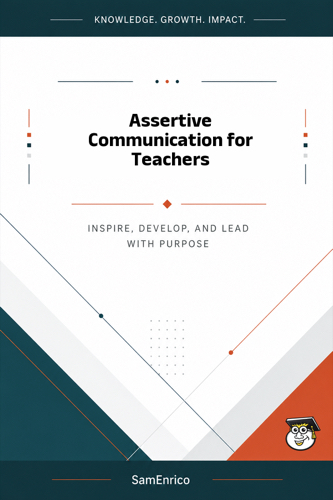
Assertive Communication for Teachers eBook
Manage classrooms and parents with authority and w
Manage classrooms and parents with authority and warmth.
Formats
Free sample
Chapter 1: The Agreeableness Trap--–- Megan had been a teacher for exactly four months, and she was already crying in her car again. It was a Thursday, 6:47 PM, and the February rain streaked down her windshield like tears she refused to shed. Her third-period class had devolved into chaos that afternoon—two students openly on their phones, three others talking over her instruction, and one student who had simply put his head down and refused to work. Megan had done what she always did: she raised her voice slightly, asked nicely again, and then, when that failed, she let it go. She let it all go.
She finished the lesson to the four students who were still listening while the other twenty-six did whatever they wanted.She had spent the next two hours grading papers that should have taken forty-five minutes, interrupted constantly by her own wandering mind replaying every moment of failure. On the drive home, she calculated the hours she had worked that week: fifty-three so far, with Friday still to come. She had skipped lunch three days in a row. Her fiancé had texted her twice, and she hadn't responded. She was exhausted, resentful, and utterly convinced that she was a bad teacher.The most painful part was that Megan was not a bad teacher.
She was brilliant with curriculum design. Her students genuinely liked her. She had received glowing reviews from her supervising teacher during student teaching. But she had one fatal flaw that her training had never addressed: she could not say no. She could not hold a boundary.
She could not be anything other than nice.Megan was trapped in what this book calls the Agreeableness Trap.The Teaching Profession’s Hidden Vulnerability Let us name something uncomfortable but true: the teaching profession selects for people who are agreeable, compassionate, and self-sacrificing. These are beautiful qualities. They are also, without the counterbalancing force of assertiveness, a direct pipeline to professional burnout.Think about the language we use to describe great teachers. "She would do anything for her students." "He stays until 8 PM every night." "She never complains." "He took on that committee, the after-school tutoring, and the mentoring program all in the same year." We celebrate martyrdom as if it were pedagogy. We confuse presence with effectiveness.
We have built a professional culture where saying "yes" is a virtue and saying "no" is a weakness.This is not sustainable. And it is not kind.Research on teacher burnout consistently identifies a cluster of personality traits that predict exhaustion, depersonalization, and eventual departure from the profession. At the top of that list is high agreeableness combined with low assertiveness. In plain English: teachers who are nice but cannot set boundaries burn out faster than any other group in education.The Agreeableness Trap Defined The Agreeableness Trap is the tendency to say "yes" to every request, demand, or implied expectation in order to avoid conflict, disapproval, or the discomfort of disappointing others. It is the reflexive shrinking of your own needs in service of everyone else's.
It is the belief that your worth as a teacher is measured by how much you give, how much you tolerate, and how little you ask for in return.This trap has three interlocking components.First, there is the fear of conflict. The agreeable teacher anticipates that any boundary, any "no," any consequence will trigger an argument, a complaint, or a negative evaluation. Rather than risk that conflict, she simply lets the behavior slide, answers the email at 10 PM, or takes on the extra duty without protest.Second, there is the overvaluation of being liked. Many teachers enter the profession because they want to be loved by children. This is understandable and even admirable.
But when the need to be liked overrides the responsibility to lead, the classroom becomes a democracy of chaos. Students do not need another friend. They need a warm, firm authority who will not let them fail.Third, there is the confusion of boundaries with cruelty. The agreeable teacher has internalized the message that saying "no" is mean, that enforcing a consequence is punishment, and that holding a line is a personal rejection of the student or parent on the other side of that line. This is a catastrophic misunderstanding.
Boundaries are not walls. They are the structure that makes safety and learning possible.A Brief but Crucial Distinction Before we go any further, we need to make a distinction that will matter throughout this book. When we talk about the Agreeableness Trap, we are talking specifically about teacher agreeableness—the tendency of educators to over-function, under-boundary, and ultimately burn out. This is different from student agreeableness, which is a neutral or even positive trait that we will explore in Chapter 6.A student who is quiet, cooperative, and eager to please is not a problem to be fixed. That student is often the backbone of a functional classroom.
The Agreeableness Trap applies to teachers who, in their desire to be helpful, become passive. It does not apply to students who are simply pleasant and easy to teach. Keep this distinction in your mind as we move forward.The Three Communication Styles in the Classroom To understand why the Agreeableness Trap is so destructive, we need to look at the three fundamental communication styles that operate in every classroom. These styles are not personality types—you can move between them depending on the situation, your stress level, and your training. But most teachers have a default setting, a place they go when they are tired, scared, or overwhelmed.Passive Communication The passive teacher communicates one message above all others: "I do not matter as much as you do." This teacher apologizes for giving instructions, offers choices when there should be none, and withdraws consequences at the first sign of student resistance.
The passive teacher's language is filled with qualifiers: "Would you please maybe sit down if you don't mind?" "I'm sorry, but I need you to stop talking." "It's okay, don't worry about it."The results of passive communication are predictable. Students learn that the teacher's boundaries are suggestions, not rules. Chaos escalates because there are no predictable consequences. The teacher becomes exhausted from the constant negotiation and emotional labor of managing a room without authority. And underneath the exhaustion is a simmering resentment—at the students, at the parents, at the administrators who do not see how hard she is trying.Here is the painful truth that passive teachers rarely admit: they are not being kind.
They are being avoidant. The student who needs a firm boundary to learn self-control gets nothing from passive compliance. The class that needs structure gets a leader who has abdicated. Passivity feels like niceness in the moment, but it is actually neglect of the most important kind.Aggressive Communication On the opposite end of the spectrum is the aggressive teacher. This teacher communicates one message: "I matter, and you do not." The aggressive teacher uses threats, sarcasm, public humiliation, and punitive consequences to control behavior.
The language is sharp and personal: "Sit down and shut up." "What is wrong with you?" "You are being ridiculous."The results of aggressive communication are…
This is the end of the free sample. Get the eBook to keep going. Buy now
About this book
Details
- Author
- Flanders Lawrence
- Publisher
- SamEnrico
- Language
- English
- Genre
- Non-Fiction, Self-Help, Education
- Released
- 2026-06-09
- Pages (approx.)
- 144
- Available as
- eBook, Audiobook

Read better in the ZLOADR app
Your eBooks on your phone or tablet. Sign in with your SamEnrico account and start reading.
More by Flanders Lawrence
 Gratitude for ChangeFlanders Lawrence$11.99
 Senior Celebration GuideFlanders Lawrence$11.99
 Single Father ScrapingFlanders Lawrence$11.99
 The Beginner Meditation Timeline GuideFlanders Lawrence$11.99
 The Siege of Khartoum: Gordon's Last Stand Against the MahdiFlanders Lawrence$11.99
 Understanding Myopathy Mitochondrial CataractFlanders Lawrence$17.99
 Accounting Formulas for Construction ContractsFlanders Lawrence$12.99
 Elastic SWOT Analysis GuideFlanders Lawrence$12.99
 Category AnalystFlanders Lawrence$11.99
 How to Start a Music Teacher (own Account) Business (Beginners Guide)Flanders Lawrence$11.99
You may also like
 Hong Kong Handover 1997Dunn Johnnie$11.99
 Zumba For Postnatal Recovery CourseNeal Christian$11.99
 Zumba for BeginnersLadner Nikia$11.99
 YouTube Comment Mining GuideHumes Pandora$12.99
 Worry Box MeditationCarlin Rudy$11.99
 Workplace Stress MeditationNguyen Lynn$11.99
 Workplace Stress and Sleep RepairHawley Ivory$11.99
 Workplace Perfectionism CureDelaney Jeffry$11.99
 Workplace Injustice Anger GuideWallen Isabelle$11.99
 Work Addiction and Burnout LinkGreenwood Ester$11.99
 Women in Yoga and WellnessBeattie Galina$11.99
 Women in Stand Up ComedyChun Evangeline$11.99