

Non-FictionSelf-HelpLaw Enforcement
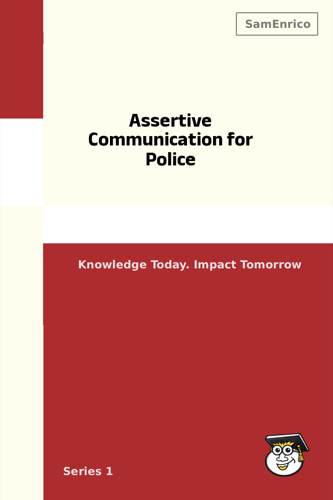
Assertive Communication for Police eBook
De escalate confrontations using calm authority in
De escalate confrontations using calm authority instead of aggressive commands.
Formats
Free sample
Chapter 1: The Whisper That Wins...--–- The siren died exactly two blocks from the address. Officer Mia Chen killed the lights, then the engine, and sat in the sudden silence of a residential street at 2:17 a.m. Her training sergeant had taught her one thing that stuck: "Never arrive loud. Sound travels faster than you do, and fear runs ahead of both."The call was a "possible domestic disturbance." The dispatcher's code—211D—meant nothing physical yet, but the voice on the line had been a neighbor who whispered, "I think he's going to hurt her." Mia had twelve years on the force, six of them as a field training officer. She had learned to read a scene before she stepped out of the car.
Tonight, the house at the end of the cul-de-sac had every light on, which was wrong. Angry people hide in the dark. Desperate people turn on every light because they are looking for an escape route.She stepped out, adjusted her body camera, and walked alone. Backup was three minutes out. She could wait.
She chose not to.The front door was ajar. Not open—ajar. She pushed it with the back of her hand, not her palm, so she wouldn't leave prints if things went bad. Inside, a man in his early thirties stood in the center of the living room, fists clenched, chest heaving. A woman sat on the floor against the wall, knees to her chin, silent.
The man's eyes were locked on Mia the second she appeared."You need to get the fuck out of my house," he said. His voice was loud. Not shouting yet, but loaded.Mia stopped exactly six feet from him. She did not put her hand on her weapon. She opened her palms, turned them slightly outward, and lowered her chin just enough to soften her gaze.
She did not say, "Calm down." She did not say, "You need to lower your voice." She did not say, "Sir, I'm here to help."She said, quietly, "Looks like tonight has been really hard on both of you."The man blinked. His fists loosened by one degree. He said, "You don't know what the fuck you're talking about."Mia said nothing for three full seconds. That silence—the Strategic Pause, though she didn't have a name for it yet—felt like a lifetime. The man's eyes flicked to the woman on the floor, then back to Mia.
He said, "She's been lying to me for months."Mia said, still quiet, "I hear that you feel betrayed. That's a terrible feeling." She did not agree that the woman had lied. She validated the emotion, not the accusation. "Right now, we need to make sure everyone is safe. Then you can tell me everything."The man sat down on the couch.
Not because he was commanded to. Because the volume of authority had been so low that his nervous system had no enemy to fight.Ten minutes later, backup arrived to find the man crying, the woman giving a statement, and Mia sitting on the coffee table with her hands in her lap. No handcuffs were used. No report of force was filed. A neighbor who watched through the blinds later wrote a letter to the chief: "That officer was the calmest person I have ever seen.
She didn't raise her voice once."The chief framed the letter. Then he called Mia into his office and asked, "How did you do that?"Mia said, "I stopped trying to sound like a cop. I started trying to sound like a human who happens to be a cop."This book is the answer to that question. It is the science, the tactics, and the training behind the whisper that wins.The Collapse of the Aggression Myth For decades, police culture has operated under a false binary: that authority requires volume, and that calmness equals weakness. This myth has been reinforced in academy training, in field training officer programs, and in the unspoken code of the locker room.
"You have to be the alpha," the saying goes. "If you let them talk, they'll walk all over you."The data tells a different story.A 2018 study published in the Journal of Police and Criminal Psychology analyzed 487 body-worn camera recordings of officer-citizen encounters that escalated from conversation to physical resistance. The single strongest predictor of escalation was not the subject's intoxication level, not the subject's criminal history, and not the time of day. The strongest predictor was the officer's vocal volume and pitch in the first thirty seconds of the interaction. Officers who began the encounter with loud, declarative commands ("Hey!
You! Stop right there!") experienced a 72% escalation rate. Officers who began with quiet, neutral statements ("Evening. Got a second to talk?") experienced a 14% escalation rate.Seventy-two percent versus fourteen percent. That is not a small difference.
That is the difference between a career of violence and a career of resolution.The myth persists because it feels true. When an officer yells and a subject complies, the officer attributes the compliance to the volume. But this is a classic causal fallacy. In most cases, the subject complies not because of the volume but because of the threat of force that the volume signals. And that threat works only as long as the officer is willing to back it up.
The moment the officer yells and cannot or will not use force—because backup is too far, because there are cameras, because the subject is a child or an elderly person—the authority collapses. The subject realizes the yell was a bluff, and the officer loses all credibility.The whisper, by contrast, is never a bluff. The whisper does not promise violence. The whisper promises something far more dangerous to a resistant subject: unstoppable patience.The Triune Brain: Why Your Voice Is a Biological Weapon To understand why loud commands fail, we must first understand how the human brain processes threat. The most useful model for law enforcement is the Triune Brain, developed by neuroscientist Paul Mac Lean in the 1960s and validated by decades of functional MRI research.The brain has three layers, each evolved on top of the previous one:The Lizard Brain (Brainstem and Cerebellum) – This is the oldest layer, responsible for survival instincts: fight, flight, freeze, and fawn.
The Lizard Brain does not process language. It processes sensory input—sound, movement, light, pressure—and makes split-second survival decisions. When the Lizard Brain detects a threat, it floods the body with cortisol and adrenaline, shuts down non-essential systems (including higher reasoning), and prepares for physical action. The Lizard Brain cannot be reasoned with. It can only be soothed or triggered.The Monkey Brain (Limbic System) – This layer handles emotion, memory, and social bonding.
The Monkey Brain processes tone of voice, facial expression, and body language. It is where fear, anger, joy, and trust reside. The Monkey Brain can learn, but it learns through association, not logic. If the Monkey Brain associates police presence with past trauma, it will trigger the Lizard Brain before the officer says a single word.The Human Brain (Neocortex) – This is the rational, language-processing layer. The Human Brain…
This is the end of the free sample. Get the eBook to keep going. Buy now
About this book
Details
- Author
- Rossi Ezekiel
- Publisher
- SamEnrico
- Language
- English
- Genre
- Non-Fiction, Self-Help, Law Enforcement
- Released
- 2026-06-10
- Pages (approx.)
- 144
- Available as
- eBook, Audiobook

Read better in the ZLOADR app
Your eBooks on your phone or tablet. Sign in with your SamEnrico account and start reading.
More by Rossi Ezekiel
 Disappointment Recovery GuideRossi Ezekiel$11.99
 Former Child Star ComebacksRossi Ezekiel$11.99
 Burnout Prevention WorkbookRossi Ezekiel$11.99
 Scott Peterson Childhood BackgroundRossi Ezekiel$11.99
 DoorDash Stack Order StrategyRossi Ezekiel$11.99
 Couples Support Groups GuideRossi Ezekiel$11.99
 Citation Rules for Dummies HandbookRossi Ezekiel$11.99
 UK VAT Digital Records Making Tax Digital PrimerRossi Ezekiel$11.99
 The Ghosts of Arnhem: Operation Market Garden's Silent SaboteursRossi Ezekiel$11.99
 The Unbreakable Comeback: How a Broken Leg Made a ChampionRossi Ezekiel$11.99
 The Great Timber Heist: The Untold Story of the 1871 Logging WarsRossi Ezekiel$11.99
 How to Start a Motor Vehicle Servicing Business (Beginners Guide)Rossi Ezekiel$11.99
You may also like
 Hong Kong Handover 1997Dunn Johnnie$11.99
 Zumba For Postnatal Recovery CourseNeal Christian$11.99
 Zumba for BeginnersLadner Nikia$11.99
 YouTube Comment Mining GuideHumes Pandora$12.99
 Worry Box MeditationCarlin Rudy$11.99
 Workplace Stress MeditationNguyen Lynn$11.99
 Workplace Stress and Sleep RepairHawley Ivory$11.99
 Workplace Perfectionism CureDelaney Jeffry$11.99
 Workplace Injustice Anger GuideWallen Isabelle$11.99
 Work Addiction and Burnout LinkGreenwood Ester$11.99
 Women in Yoga and WellnessBeattie Galina$11.99
 Women in Stand Up ComedyChun Evangeline$11.99