
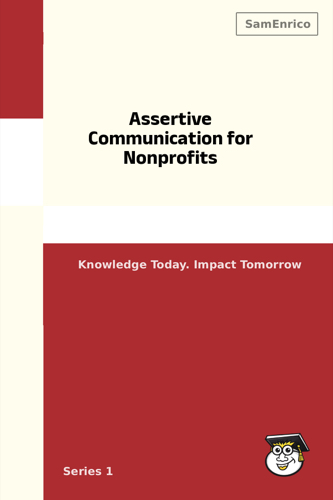
Non-FictionSelf-HelpNonprofit Management
Assertive Communication for Nonprofits eBook
Advocate for mission without burning out or aliena
Advocate for mission without burning out or alienating donors.
Formats
Free sample
Chapter 1: The Cult of Yes--–- The email arrived at 11:47 on a Tuesday night. "Quick question," it began, which everyone knows means the opposite of quick. A major donor wanted a custom report by 8:00 AM. Not because of a board meeting or a granting deadline, but because he was "curious" before a breakfast meeting. The development associate, Sarah, had been awake for nineteen hours.
She had already said yes to three unreasonable requests that week. She said yes to this one too. Then she cried in the bathroom, ate cold takeout over the sink, and started building the report at midnight. Six months later, she quit the sector entirely.This is not an outlier. This is the norm.Nonprofit professionals are among the most passionate, mission-driven people in the workforce.
They trade higher salaries for meaning, stability for purpose. But somewhere along the way, something breaks. The passion curdles into exhaustion. The purpose becomes a trap. And the word that kills them, slowly and systematically, is a word that sounds harmless, even virtuous.Yes.Nonprofits have built a culture where "yes" is the only acceptable answer.
Yes to the unreasonable donor request. Yes to the board member's last-minute idea. Yes to the report that requires pulling an all-nighter. Yes to the meeting that could have been an email. Yes to the grant with absurd reporting requirements.
Yes to the event that no one has time to plan. Yes to the strategic plan that ignores capacity. Yes to the fundraising goal that no human being could meet.And when staff finally break, when they quit or burn out or simply stop caring, the organization blames them. "They couldn't handle the pressure." "They weren't cut out for this work." "We need thicker skin around here."The problem is not the staff. The problem is the system.
And the system runs on a single, toxic fuel: the Cult of Yes.The Confession No One Wants to Make Let me ask you a question that most fundraising books are too polite to ask. Do you hate asking for money?Not the mission. Not the cause. Not the people you serve. But the act of asking.
The phone call you dread making. The email you rewrite six times before sending. The meeting where you sit across from someone with more money than you will ever see, knowing that your entire program budget depends on their mood that morning.If you answered yes, you are not alone. And here is the secret that no one tells you: your hatred of asking is not a personal failing. It is a structural inevitability.You have been placed in an impossible position.
You are expected to raise money, but you are given no authority. You are expected to build relationships, but you are given no time. You are expected to say no to misaligned funding, but you are punished when you try. You are expected to set boundaries, but the culture rewards the opposite.The Cult of Yes is not a conspiracy. It is an emergent property of a sector that has confused self-sacrifice with virtue.
The nonprofit industrial complex has taught us that the good fundraiser is the one who never says no. The good development director is the one who always figures it out. The good executive director is the one who never complains about the board.And so we say yes. We say yes until we resent the mission. We say yes until we resent the donors.
We say yes until we resent ourselves.The Two Types of Fundraising (And Why One Is Killing You)To understand why the Cult of Yes is so destructive, we need to understand two fundamentally different ways of approaching fundraising. Most organizations claim to practice the second but actually operate on the first.Transactional Fundraising Transactional fundraising treats each gift as an isolated exchange. The donor gives money. The organization gives a tax receipt and perhaps a newsletter. There is no relationship before the gift, no follow-up after the gift, and no sense of shared purpose.
The donor is a wallet. The fundraiser is a cashier.Here is how you know you are in a transactional culture. Your donor communication is almost entirely one-way. You send appeals. You send newsletters.
You send event invitations. You rarely ask donors what they care about. You never ask for feedback. You definitely never ask for advice, because that would imply that the donor has something to offer beyond money.Your metrics are about volume, not depth. How many emails did you send?
How many calls did you make? How many meetings did you schedule? The number of touches matters more than the quality of connection. Your fundraising is reactive, not strategic. You chase whatever funding is available, regardless of whether it aligns with your mission.
A corporate sponsor with terrible values offers money? Take it. A restricted grant that requires ridiculous reporting? Take it. A donor who wants to fund something you don't actually do?
Take it anyway and figure it out later.The result of transactional fundraising is what I call the Hamster Wheel. Staff run faster and faster, chasing the next gift, the next deadline, the next report. They never feel secure because there is no relationship to anchor the funding. Every gift is a one-night stand. And like any relationship built on transaction rather than trust, it is exhausting, empty, and ultimately unsustainable.The Hamster Wheel has a predictable timeline.
Month one to six: excitement. You are new, the mission is inspiring, and you believe you can make a difference. Month six to twelve: reality sets in. The workload is crushing. The donors are demanding.
The board is clueless. Month twelve to eighteen: burnout. You start dreading Monday mornings. You fantasize about quitting. You develop physical symptoms you cannot explain.
Month eighteen to twenty-four: either you quit, or you become numb. The numb ones are worse. They stay, but they stop caring. They do the minimum. They become the bitter colleague who warns new hires not to get too invested.Transactional fundraising is a machine for producing burnout.
And the fuel for that machine is the word yes.Relational Fundraising Relational fundraising treats each gift as one moment in an ongoing partnership. The donor and the organization share values, goals, and a definition of success. Communication is two-way, transparent, and bi-directional. The donor is a partner. The fundraiser is a facilitator.Here is how you know you are in a relational culture.
Your donor communication is a conversation. You ask donors what they care about before you tell them what you need. You share both successes and struggles. You invite feedback and actually use it. You ask for advice, not just money.Your metrics are about depth, not volume.
How many donors had meaningful conversations this quarter? How many donors increased their engagement (not just their giving)? How many donors feel like they are part of the mission, not just funding it?Your fundraising is strategic, not reactive. You say no to funding that doesn't align, even when you need the money. You invest in donors who share your values, even if their capacity is currently small.
You build for the long term, not the next deadline.The result of relational fundraising is stability. Staff are not constantly…
This is the end of the free sample. Get the eBook to keep going. Buy now
About this book
Details
- Author
- Benton Regena
- Publisher
- SamEnrico
- Language
- English
- Genre
- Non-Fiction, Self-Help, Nonprofit Management
- Released
- 2026-06-10
- Pages (approx.)
- 136
- Available as
- eBook, Audiobook

Read better in the ZLOADR app
Your eBooks on your phone or tablet. Sign in with your SamEnrico account and start reading.
More by Benton Regena
 Golden Age Child Stars 30sBenton Regena$11.99
 Laci Peterson Impact StatementsBenton Regena$11.99
 Fiverr Quick Response HandbookBenton Regena$11.99
 Mindfulness For Ambitious PeopleBenton Regena$11.99
 Citation Rules for Chicago Style CourseBenton Regena$11.99
 Apology Reconciliation GuideBenton Regena$11.99
 UK VAT Import and Export Registration PrimerBenton Regena$11.99
 Resentment In MarriageBenton Regena$11.99
 Love in the Time of the Cold War: The Secret Affair That Changed HistoryBenton Regena$11.99
 The Aqueducts of Rome: Liquid Gold of the Eternal CityBenton Regena$11.99
 Shadows of the Way: The Last Ronin’s MentorBenton Regena$11.99
 Maintenance AssistantBenton Regena$11.99
You may also like
 Hong Kong Handover 1997Dunn Johnnie$11.99
 Zumba For Postnatal Recovery CourseNeal Christian$11.99
 Zumba for BeginnersLadner Nikia$11.99
 YouTube Comment Mining GuideHumes Pandora$12.99
 Worry Box MeditationCarlin Rudy$11.99
 Workplace Stress MeditationNguyen Lynn$11.99
 Workplace Stress and Sleep RepairHawley Ivory$11.99
 Workplace Perfectionism CureDelaney Jeffry$11.99
 Workplace Injustice Anger GuideWallen Isabelle$11.99
 Work Addiction and Burnout LinkGreenwood Ester$11.99
 Women in Yoga and WellnessBeattie Galina$11.99
 Women in Stand Up ComedyChun Evangeline$11.99