
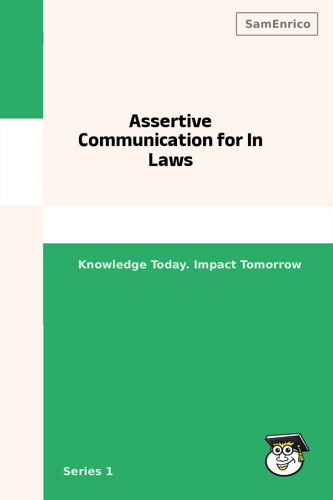
Assertive Communication for In Laws eBook
Set boundaries with extended family without causin
Set boundaries with extended family without causing rifts.
Formats
Free sample
Chapter 1: The Silent Explosion--–- Margaret had not raised her voice in eleven years of marriage. Not once. She had smiled through her mother-in-law’s comments about her cooking (“Bless your heart, you tried”), through the unsolicited advice about potty training (“In my day, we knew what we were doing”), and through the annual holiday guilt trips (“I suppose we’ll just eat alone if you can’t make it”). She had bitten her tongue so many times she had nearly lost the ability to taste her own resentment. And then, on a random Tuesday afternoon in March, with no warning and no audience, Margaret snapped.
Her mother-in-law had called to suggest—no, to inform—that she would be staying for two weeks after the baby was born. Margaret did not say, “Let me talk to my husband.” She did not say, “That doesn’t work for us.” She said, “Over my dead body,” and hung up. The silence that followed lasted fourteen months.Margaret’s story opens this book not because it is unusual, but because it is painfully ordinary. Thousands of spouses—daughters-in-law, sons-in-law, and partners of every description—live inside this exact trajectory. They remain silent to “keep the peace.” They tell themselves that speaking up would be rude, selfish, or disrespectful.
They believe that if they can just endure one more holiday, one more unsolicited opinion about their parenting, one more unannounced visit, the situation will somehow resolve itself. It never does. The resentment does not dissolve; it calcifies. And eventually, inevitably, it explodes.This chapter dismantles the most dangerous myth in extended family dynamics: the belief that silence is a virtue. Drawing on psychological research about emotional suppression, clinical case studies, and real-life interviews with couples who have navigated in-law conflict, we will explore why “keeping the peace” is the single fastest way to guarantee a future war.
We will introduce the concept of the silent explosion—the seemingly sudden eruption that has actually been building for years. And we will establish the foundational reframe that will guide every tool and script in this book: assertiveness is not aggression. It is the most compassionate long-term strategy for preserving relationships you cannot walk away from.The High Cost of Biting Your Tongue When Margaret described her eleven years of silence to a therapist, she used the word “polite.” She thought she was being a good wife by not causing trouble with her husband’s family. She thought she was being respectful by deferring to her mother-in-law’s seniority and experience. What she did not realize was that her politeness was a form of slow self-erasure.Psychologists have studied the effects of emotional suppression for decades.
The research is consistent and unsettling. When people consistently suppress their authentic feelings—particularly feelings of frustration, anger, or violation—they do not simply “get over it.” The emotional energy does not disappear. Instead, it is redirected inward or stored for later release. Studies using functional magnetic resonance imaging have shown that suppressing emotions increases activity in the amygdala, the brain’s fear and threat center, while simultaneously reducing activity in the prefrontal cortex, the region responsible for rational decision-making. In plain language: when you bite your tongue, your brain goes into a low-grade threat response that impairs your ability to think clearly.
You become more reactive, not less.But the damage is not only neurological. Longitudinal studies tracking couples over decades have found that emotional suppression in relationships predicts three specific outcomes: increased frequency of passive-aggressive behaviors (forgetting commitments, “accidentally” arriving late, making pointed comments disguised as jokes), higher rates of stress-related physical illness (chronic headaches, digestive disorders, hypertension, and autoimmune conditions), and sudden, explosive conflict over seemingly minor triggers. The explosion is never about the trigger. The trigger is simply the last straw. The explosion is about the eleven years of silence that came before.Margaret’s Tuesday afternoon explosion followed this exact pattern.
The trigger—a two-week visit after the baby—was not unreasonable on its face. Many families accommodate such visits. What made Margaret snap was not the request itself but the cumulative weight of every unspoken boundary she had swallowed for over a decade. Her mother-in-law had rearranged her kitchen. She had shown up unannounced.
She had criticized Margaret’s career choices at family dinners. She had offered “advice” on everything from laundry detergent to lawn care. And Margaret had smiled and said “thank you” every single time. The two-week visit was not the cause of the explosion. It was simply the moment when the dam could hold no more.The Snowball Effect: How Small Things Become Large In-law conflicts almost never begin as crises.
They begin as snowflakes: tiny, almost invisible moments that seem too small to address. A comment here. An assumption there. A minor overstep that feels petty to mention. “It’s just one dinner,” you tell yourself.
“She doesn’t mean anything by it.” “I don’t want to make things awkward.” So you let it go. And then another snowflake falls. And another. And another.This is what we call the Snowball Effect in extended family dynamics. A single unaddressed comment about how you dress your child is a snowflake.
A single unannounced visit is a snowflake. A single passive-aggressive jab about your career is a snowflake. No single snowflake is heavy enough to crush you. But snowflakes do not stay single. They accumulate.
They compress. They freeze together into ice. And eventually, what began as harmless white flakes becomes an avalanche that destroys everything in its path.Consider the case of David, a forty-two-year-old father of two whose mother-in-law had been “helping” with childcare for eight years. Her help took the form of arriving at 7am every weekday, staying until 6pm, and systematically undermining every parenting decision David and his wife made. She fed the children sugar after being told not to.
She allowed unlimited screen time against their rules. She dismissed their discipline strategies as “harsh.” And David never said a word. He did not want to seem ungrateful. He did not want to start a fight. He told himself that the free childcare was worth the cost.Eight years later, David’s marriage was in crisis.
He and his wife had stopped having sex. He drank every night. He snapped at his children over small infractions. When he finally entered therapy, he could not identify a single “big” event that had caused the collapse. There was no affair, no financial disaster, no health crisis.
There were simply eight years of snowflakes. His mother-in-law had not destroyed his marriage. His silence had.The Snowball Effect operates on three distinct levels. First, there is the accumulation of unexpressed frustration. Each small violation adds a layer of resentment that does not dissipate with time.
Second, there is the normalization of disrespect. When you tolerate a small overstep, you communicate—to your in-law and to yourself—that such oversteps are acceptable. The bar for what counts as “too far” shifts incrementally downward. Third, and most insidiously, there is the erosion of your own sense of reality. After years of smiling through behavior that feels wrong, you begin to doubt whether your feelings are legitimate.…
This is the end of the free sample. Get the eBook to keep going. Buy now
About this book
Details
- Author
- Hermann Brianna
- Publisher
- SamEnrico
- Language
- English
- Genre
- Non-Fiction, Self-Help, In-Laws
- Released
- 2026-06-10
- Pages (approx.)
- 144
- Available as
- eBook, Audiobook

Read better in the ZLOADR app
Your eBooks on your phone or tablet. Sign in with your SamEnrico account and start reading.
More by Hermann Brianna
 Punitive Parenting Recovery GuideHermann Brianna$11.99
 Office Chair Stretching GuideHermann Brianna$11.99
 Perfectionism In Students HandbookHermann Brianna$11.99
 Travel Influencer Comparison CureHermann Brianna$11.99
 The Celtic Tide: How the Portuguese Carved the AtlanticHermann Brianna$11.99
 Corporate Strategy AnalystHermann Brianna$11.99
 Citing Websites and Social MediaHermann Brianna$12.99
 Promotion Readiness Self AuditHermann Brianna$12.99
 How to Start a Oxfam (not Shops) Business (Beginners Guide)Hermann Brianna$11.99
 Understanding Myxoma-spotty Pigmentation-endocrine OveractivityHermann Brianna$17.99
You may also like
 Hong Kong Handover 1997Dunn Johnnie$11.99
 Zumba For Postnatal Recovery CourseNeal Christian$11.99
 Zumba for BeginnersLadner Nikia$11.99
 YouTube Comment Mining GuideHumes Pandora$12.99
 Worry Box MeditationCarlin Rudy$11.99
 Workplace Stress MeditationNguyen Lynn$11.99
 Workplace Stress and Sleep RepairHawley Ivory$11.99
 Workplace Perfectionism CureDelaney Jeffry$11.99
 Workplace Injustice Anger GuideWallen Isabelle$11.99
 Work Addiction and Burnout LinkGreenwood Ester$11.99
 Women in Yoga and WellnessBeattie Galina$11.99
 Women in Stand Up ComedyChun Evangeline$11.99