
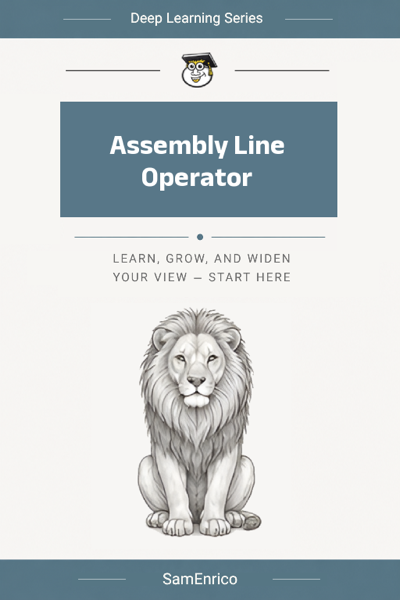
Non-FictionInformativeEducational
Assembly Line Operator eBook
A Coursebook on Assembly Line Operator
by Boswell Dina
A Coursebook on Assembly Line Operator
Formats
Free sample
Chapter 1: The Cog’s Awakening--–- Maria stood at Station 7 of the final assembly line, her hands moving with the automatic precision of a machine that had been running the same program for eight years. Screw. Torque. Check. Pass.
Screw. Torque. Check. Pass. The conveyor brought a new chassis every sixty-two seconds.
She had done this motion 1,936,000 times since she was hired. Her right shoulder ached in cold weather. Her left knee had developed a click that worried her but not enough to see a doctor. She was good at her job—or so she believed. She never caused a line stop.
She never questioned the work instruction. She never spoke to the engineers who walked past her station twice per shift, clipboards in hand, looking at everything except her eyes. Maria was what the plant manager called “a reliable pair of hands.” And for eight years, that was enough.Then the recall happened.Twenty-three thousand units. Fourteen million dollars in rework, shipping, legal fees, and customer compensation. The defect was traced to Station 7.
A specific bolt on a specific subassembly had been undertorqued on three consecutive shifts. The root cause investigation—conducted by engineers who had never touched a torque wrench—concluded that “operator error” was responsible. Maria was not fired. She was retrained. She was given a new torque stick and told to “pay more attention.” But deep in her chest, something had shifted.
She had not made a mistake. She had followed the work instruction exactly. The instruction was wrong. The torque specification had been changed six months earlier, but the laminated card at her station still showed the old number. Maria had pointed this out to her team lead, Juan, three times.
Juan had said, “I’ll put in a ticket.” No ticket was ever put in. No card was ever changed.Maria began to pay attention differently. Not to the bolts—she already knew the bolts. She began to pay attention to the system. The mislabeled bins.
The flickering light over the parts rack. The way the conveyor speed fluctuated when the temperature in the plant dropped below fifty degrees. She began to see that her station was not a problem to be managed but a system to be understood. She began to ask questions. Not loud questions.
Not confrontational questions. Small, curious questions. “Why does this bin have two different part numbers written on it?” “Why do we still have this inspection step when the gauge broke six months ago?” “Why am I walking thirty feet to get a part when the Water Spider passes within three feet of my station every twelve minutes?”Juan started avoiding her. The engineers stopped making eye contact. But the night shift supervisor, a woman named Delia who had started on the line in 1995, pulled Maria aside one night and said something that changed everything: “You’re not a pair of hands.
You’re the only person in this building who actually knows what happens at Station 7. Act like it.”This chapter is about becoming Maria. It is about shedding the identity of the “cog”—the passive, reactive, silent assembly line worker who believes their job is to execute and nothing more. It is about stepping into the identity of the Master Assembler: active, analytical, communicative, and relentlessly focused on value. By the end of this chapter, you will see your workstation differently.
You will understand that your employer did not hire you to tighten bolts. They hired you to solve problems. And the bolts are just the medium.The Invention of the Cog To understand why most assembly line workers think of themselves as cogs, we have to go back to 1913. Henry Ford did not invent the automobile, but he invented a way to build them that changed the world. The moving assembly line at the Highland Park plant in Michigan reduced the time to build a Model T from twelve hours to ninety-three minutes.
The price of a car dropped from $850 to $260. Ford sold fifteen million Model Ts. And in the process, he created a new kind of human being: the repetitive-task operator.Ford’s system was brilliant in its brutality. He broke every complex job into tiny, mindless tasks. A worker did not “build a carburetor.” A worker inserted one screw, over and over, eight hours a day.
Ford famously said, “I want a workforce of men who think only of their work and not of its purpose.” He hired efficiency experts—Frank and Lillian Gilbreth among them—who filmed workers with stopwatches and broke their motions into “therbligs” (Gilbreth’s term for basic motion elements). The goal was not to make the worker smarter. The goal was to make the worker replaceable. If a man quit or was fired, a new man could be trained in six hours. The plant owned the process.
The worker owned nothing but his two hands and his willingness to repeat the same motion 20,000 times per shift.This model made Ford rich. It won World War II—American assembly lines produced 300,000 aircraft and 100,000 tanks. It built the postwar middle class, paying wages high enough for assembly line workers to buy the cars they built. But it came with a psychological cost that persists to this day. The assembly line worker became a stereotype: silent, unthinking, interchangeable.
A cog in the machine. A pair of hands.You have felt this stereotype even if no one has said it aloud. It is in the way the engineers walk past you without speaking. It is in the way the plant manager celebrates “throughput” and “uptime” but never celebrates the operator who noticed a misaligned fixture before it caused a defect. It is in the way your own family asks, “When are you going to do something with your life?” as if eight years on the line is a holding pattern rather than a career.Here is what Ford did not anticipate.
The moving assembly line was a technology of its time—brute force, dumb repetition, hierarchical control. But the assembly line of the 2020s is a different beast entirely. It is populated by collaborative robots (cobots), real-time data screens, radio-frequency identification (RFID) trackers, and statistical process control charts. A modern automotive assembly line has more computing power than the Apollo guidance system. An electronics line for smartphones requires operators to understand ESD (electrostatic discharge) precautions, automated optical inspection results, and just-in-time kanban systems.The old model rewarded speed and silence.
The new model rewards observation, judgment, and communication. The problem is that most operators—and most managers—still operate under the old model. They are running Henry Ford’s software on 2025 hardware. And that mismatch is costing you, your plant, and your industry billions of dollars every year.Redefining Your Job: From Task Execution to Value Creation Here is the single most important sentence in this entire chapter, and I want you to write it on a sticky note and put it on your tool box, your locker, or the inside of your hard hat:My job is not to tighten bolts. My job is to ensure that the assembly leaving my station meets customer specifications at the lowest possible internal cost, in the safest possible…
This is the end of the free sample. Get the eBook to keep going. Buy now
About this book
Details
- Author
- Boswell Dina
- Publisher
- SamEnrico
- Language
- English
- Genre
- Non-Fiction, Informative, Educational
- Released
- 2026-06-02
- Pages (approx.)
- 155
- Available as
- eBook, Audiobook

Read better in the ZLOADR app
Your eBooks on your phone or tablet. Sign in with your SamEnrico account and start reading.
More by Boswell Dina
 Adolescent Anger TriggersBoswell Dina$11.99
 The Overworker's Vacation RecoveryBoswell Dina$11.99
 EQ Personal Branding GuideBoswell Dina$11.99
 Gene Autry Singing Cowboy GuideBoswell Dina$11.99
 The Unlikely Hero of Flight 1549: The Story Behind the Miracle on the HudsonBoswell Dina$11.99
 The Last Oracle of Delphi: When Prophecy Collided with PowerBoswell Dina$11.99
 Understanding Froster–iskenius–waterson SyndromeBoswell Dina$17.99
 Ingredient SubstitutionBoswell Dina$12.99
 Founder Led Content HandbookBoswell Dina$12.99
 How to Become a Script SupervisorBoswell Dina$11.99
You may also like
 Hong Kong Handover 1997Dunn Johnnie$11.99
 Zumba For Postnatal Recovery CourseNeal Christian$11.99
 Zumba for BeginnersLadner Nikia$11.99
 YouTube Comment Mining GuideHumes Pandora$12.99
 Worry Box MeditationCarlin Rudy$11.99
 Workplace Stress MeditationNguyen Lynn$11.99
 Workplace Stress and Sleep RepairHawley Ivory$11.99
 Workplace Perfectionism CureDelaney Jeffry$11.99
 Workplace Injustice Anger GuideWallen Isabelle$11.99
 Work Addiction and Burnout LinkGreenwood Ester$11.99
 Women in Yoga and WellnessBeattie Galina$11.99
 Women in Stand Up ComedyChun Evangeline$11.99