
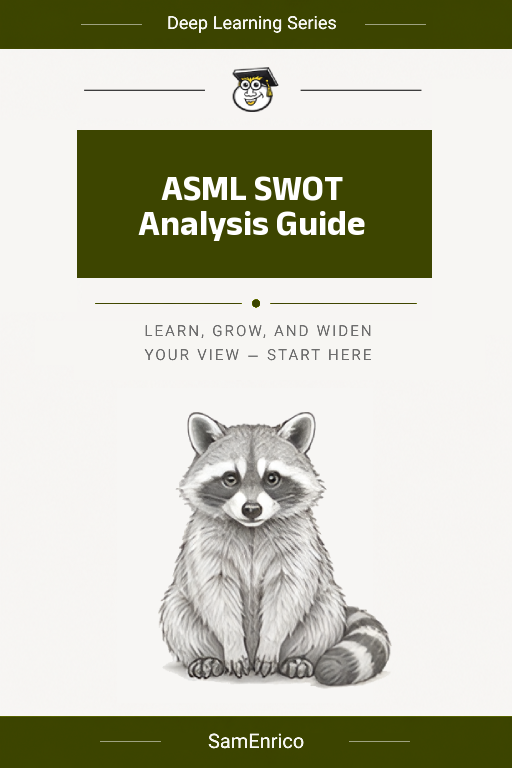
Non-FictionStrategic AtlasSemiconductor Equipment
ASML SWOT Analysis Guide
Analyze EUV monopoly, high-NA adoption, China rest
Analyze EUV monopoly, high-NA adoption, China restrictions, and customer concentration risk for lithography leader.
Formats
About this book
Free sample
Chapter 1: The Tin Genie--In a clean room the size of a soccer field, buried inside a nondescript building in the Dutch town of Veldhoven, a machine is about to destroy itself. It is 2016, the machine is the first prototype of ASML's newest EUV lithography tool, and for the past seventy-two hours, engineers have watched in horror as the data logs filled with error codes no one has ever seen before. The problem is tin. Molten tin, to be precise – microscopic droplets fired fifty thousand times per second, each one struck twice by a laser so powerful it would blind a person from a mile away. The first laser pulse flattens the droplet into a pancake.
The second vaporizes it into plasma. That plasma emits Extreme Ultraviolet light at a wavelength of 13.5 nanometers, which is the entire reason the machine exists. But something has gone wrong. The tin isn't fully vaporizing. Tiny remnants are accumulating on the collector mirror – a component so exquisitely precise that it took Zeiss in Germany fifteen years to learn how to make it.
The mirror has a surface roughness measured in picometers. A single atom of tin landing on it is like a boulder rolling across a sheet of glass. Within minutes, the reflectivity drops. Within hours, the mirror is destroyed. The machine has eaten itself.Peter Wennink, ASML's then-chief financial officer and soon-to-be CEO, remembers the night.
In his telling, he received a phone call at 3:00 AM from the company's lead engineer in Taiwan, where the machine had been shipped to TSMC for testing. "Peter, we have a problem," the engineer said, which in Dutch understatement meant a catastrophe. A TSMC fab manager was already on the line, demanding to know when the machine would be back online. Wennink did not have an answer. No one did.
The EUV program had already consumed more than a decade of research, over €6 billion in development costs, and the full attention of the company's five thousand suppliers across thirty countries. If this problem could not be solved, the entire semiconductor industry's roadmap would collapse. No EUV meant…
This is the end of the free sample. Get the eBook to keep going. Buy now
Contents
- Chapter 1
- Chapter 2
- Chapter 3
- Chapter 4
- Chapter 5
- Chapter 6
- Chapter 7
- Chapter 8
- Chapter 9
- Chapter 10
- Chapter 11
- Chapter 12
Details
- Author
- German Vannesa
- Publisher
- SamEnrico
- Language
- English
- Genre
- Non-Fiction, Strategic Atlas, Semiconductor Equipment
- Released
- 2026-06-01
- Pages (approx.)
- 127
- Available as
- eBook, Audiobook

Read better in the ZLOADR app
Your eBooks on your phone or tablet. Sign in with your SamEnrico account and start reading.
More by German Vannesa
 TM And Fibromyalgia Pain GuideGerman Vannesa$11.99
 The Joy of AgingGerman Vannesa$11.99
 Bus System FamilyGerman Vannesa$11.99
 Emotional Intelligence for ArtistsGerman Vannesa$11.99
 The Breath Awareness Meditation PrimerGerman Vannesa$11.99
 The Hurling Kings: Ireland's Forgotten Warriors of the Medieval ArenaGerman Vannesa$11.99
 Understanding Myhre–ruvalcaba–kelley SyndromeGerman Vannesa$17.99
 Cash Flow Formulas That WorkGerman Vannesa$12.99
 How to Become a Spot CleanerGerman Vannesa$11.99
 AI Video Editing and Production BusinessGerman Vannesa$11.99
You may also like
 Hong Kong Handover 1997Dunn Johnnie$11.99
 Zumba For Postnatal Recovery CourseNeal Christian$11.99
 Zumba for BeginnersLadner Nikia$11.99
 YouTube Comment Mining GuideHumes Pandora$12.99
 Worry Box MeditationCarlin Rudy$11.99
 Workplace Stress MeditationNguyen Lynn$11.99
 Workplace Stress and Sleep RepairHawley Ivory$11.99
 Workplace Perfectionism CureDelaney Jeffry$11.99
 Workplace Injustice Anger GuideWallen Isabelle$11.99
 Work Addiction and Burnout LinkGreenwood Ester$11.99
 Women in Yoga and WellnessBeattie Galina$11.99
 Women in Stand Up ComedyChun Evangeline$11.99