
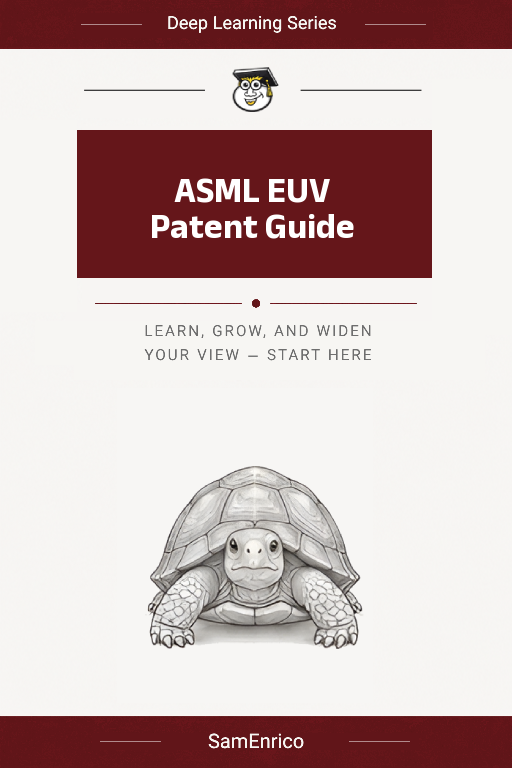
Non-FictionStrategic AtlasSemiconductor Equipment
ASML EUV Patent Guide eBook
Map Dutch lithography leader's extreme ultraviolet
by Corbin Adell
Map Dutch lithography leader's extreme ultraviolet light sources, mirror technology, and High-NA innovations.
Formats
Free sample
Chapter 1: The 4,995 Locks...--On a Tuesday morning in March 2016, a 37-year-old patent examiner in Alexandria, Virginia, opened a file that would eventually shape the fate of the global semiconductor industry. The application, numbered US20110233429, described something seemingly mundane: a method for generating tiny droplets of molten tin. But buried within its 47 pages of dense legalese was the first lock on a door that ASML would spend the next decade fortifying with 4,994 additional patents. By the time the last lock clicked into place, three of the world's largest electronics companies had effectively surrendered their right to build the most advanced chipmaking machines on Earth without paying tribute to a modest Dutch firm headquartered in a small town south of Eindhoven.This is the story of those locks—how they were forged, how they fit together, and why no competitor has yet found a key.The Number That Changed Everything Let us begin with a number that will appear throughout this book: 4,995. That is the number of patent families—distinct inventions, each protected by claims that can be enforced in courts across dozens of countries—that ASML and its partners hold covering extreme ultraviolet lithography.
To understand what 4,995 means, consider the math of competition. A single well-written patent can block a competitor for twenty years. Ten patents, strategically arranged, can create a thicket that requires years of legal work to navigate. One hundred patents, and even a well-funded rival begins to reconsider its investment.Four thousand nine hundred ninety-five is not a thicket. It is a fortress.But raw numbers tell only part of the story.
Among those 4,995 families, 2,020 are currently active—meaning their claims are enforceable today. Another 1,367 have expired or been abandoned, but they remain lethal as prior art, preventing anyone from patenting similar ideas in the future. The remaining 866 are pending, lurking in patent offices around the world like submarines that could surface at any moment with claims that might cover technologies competitors thought were safe.Active Patents (2,020): Enforceable today. Infringe one, and ASML can seek injunctions and damages.Inactive Patents (1,367): No longer enforceable, but act as prior art to block new patents.Pending Patents (866): Invisible until granted; potential submarine claims.The distribution alone is strategic. ASML maintains roughly twice as many active patents as it has allowed to expire, ensuring that its legal firepower increases even as older protections fade.
And the pending category—866 families, each containing multiple claims that have not yet been examined—represents a weapon that competitors cannot fully see.The Forward Citation Signature Numbers like 4,995 can be misleading. A company could file ten thousand trivial patents on minor variations of a screw thread and claim a large portfolio. ASML's portfolio tells a different story, revealed by a metric called forward citations. When a later patent cites an earlier patent, it signals that the earlier invention is foundational—subsequent inventors could not avoid referencing it.ASML's average patent receives 113 forward citations.The industry average for semiconductor equipment patents is 12.This gap is not incremental. It is the difference between a fence and a fortress.
A patent with 113 citations means that hundreds of subsequent inventors, including those working for competitors, acknowledged that they were building on ASML's ideas. They could not design around it. They could not ignore it. They could only cite it and hope their own contributions were sufficiently distinct.The Three Phases of a Monopoly ASML did not arrive at 4,995 patents through accident or simple accumulation. The portfolio was built in three distinct phases, each responding to a different technological and competitive challenge.Phase One: DUV Maturation (2010–2016)Deep ultraviolet lithography, using 193 nm light, was the workhorse of the semiconductor industry throughout the 2000s.
By 2010, the fundamental physics of DUV were well understood, and the patent landscape was crowded with contributions from Nikon, Canon, and dozens of other players. ASML's strategy during this phase was not to dominate DUV through sheer volume of new patents but to use DUV as a cash engine for EUV research and to acquire strategic DUV patents that would later become bargaining chips.The key insight: a patent portfolio is not only a sword but also a shield. During cross-licensing negotiations with Nikon in 2013, ASML was able to trade access to its DUV patents for freedom to operate in EUV. Without that trade, ASML might have faced infringement claims on basic DUV technologies that it needed for the metrology and alignment systems of its EUV tools.Phase Two: EUV Commercialization (2017–2023)This was the period of maximum patent aggression. As ASML shipped its first commercial EUV systems (the NXE:3400 series), it filed patents at a rate of nearly one per day.
The targets were specific and deliberate: source power (tin droplet generators), collector mirrors (multilayer coatings and debris mitigation), and pellicles (the transparent shields that protect masks from particles).Why these three areas? Because each represented a bottleneck that competitors would need to solve. A rival could build a vacuum chamber. It could design a wafer stage. But without a stable source of 13.5 nm light, a mirror that could collect that light without being destroyed by tin debris, and a pellicle that could survive the intense heat, it would have nothing to sell.By 2023, ASML had filed on every significant solution to these problems.
The patent thicket was complete.Phase Three: High-NA Deployment (2024–2026+)With the introduction of High-NA (0.55 numerical aperture) in the EXE:5000 series, ASML shifted its patent strategy again. The new targets were anamorphic optics (mirrors with different magnifications in different directions), larger reticles (6 inches by 10.5 inches instead of 6 by 6), and the thermal management systems required to keep everything stable at higher power levels.This phase is notable for what it reveals about ASML's long-term thinking. The company is not merely protecting its current products. It is anticipating the next generation of competitors. Any firm hoping to build a Hyper-NA (0.75) tool in the 2030s will first have to navigate the High-NA patent landscape.
By filing early and broadly, ASML ensures that the path to future technology runs through its portfolio.The Geography of Control Patents are national rights. A US patent provides no protection in China, and a Chinese patent provides no protection in Europe. ASML's geographic filing strategy therefore reveals where it perceives the greatest threats and opportunities.The three key jurisdictions are the United States, Europe, and China.United States: The largest semiconductor market and the most predictable legal system for patent enforcement. ASML files in the US early and often. The US Patent and Trademark Office (USPTO) has granted more than 1,200 ASML EUV patents, more than any other jurisdiction.
The International Trade Commission (ITC) provides a fast path to exclude infringing imports—a critical weapon if a foreign competitor attempts to sell EUV components into the US market.Europe: ASML's home jurisdiction. European patents are granted by the European Patent Office (EPO) and then validated in individual countries. Germany is particularly important because Carl Zeiss SMT, ASML's mirror supplier, is based there. Many mirror-related patents are filed in Germany to enable rapid injunctions against any competitor attempting to manufacture or import optical components.China: The most complex jurisdiction. China is both a massive market (Chinese fabs will purchase billions of dollars of lithography equipment over the next decade) and…
This is the end of the free sample. Get the eBook to keep going. Buy now
About this book
Details
- Author
- Corbin Adell
- Publisher
- SamEnrico
- Language
- English
- Genre
- Non-Fiction, Strategic Atlas, Semiconductor Equipment
- Released
- 2026-06-01
- Pages (approx.)
- 135
- Available as
- eBook, Audiobook

Read better in the ZLOADR app
Your eBooks on your phone or tablet. Sign in with your SamEnrico account and start reading.
More by Corbin Adell
 PCOS Spironolactone Anti AndrogenCorbin Adell$11.99
 Elevator Nonverbal Etiquette GuideCorbin Adell$11.99
 Veterans Benefits for Aging GuideCorbin Adell$11.99
 HRT For Perimenopause WorkbookCorbin Adell$11.99
 Laci Peterson Evidence Preservation StudyCorbin Adell$11.99
 The Basilica of Hagia Sophia: A Beacon of Byzantine SplendorCorbin Adell$11.99
 How to Start a Packing Service Incidental To Transport Business (Beginners Guide)Corbin Adell$11.99
 Understanding Patent Ductus Arteriosus FamilialCorbin Adell$17.99
 Email Hosting for Geo DomainsCorbin Adell$12.99
 Market DirectorCorbin Adell$11.99
You may also like
 Hong Kong Handover 1997Dunn Johnnie$11.99
 Zumba For Postnatal Recovery CourseNeal Christian$11.99
 Zumba for BeginnersLadner Nikia$11.99
 YouTube Comment Mining GuideHumes Pandora$12.99
 Worry Box MeditationCarlin Rudy$11.99
 Workplace Stress MeditationNguyen Lynn$11.99
 Workplace Stress and Sleep RepairHawley Ivory$11.99
 Workplace Perfectionism CureDelaney Jeffry$11.99
 Workplace Injustice Anger GuideWallen Isabelle$11.99
 Work Addiction and Burnout LinkGreenwood Ester$11.99
 Women in Yoga and WellnessBeattie Galina$11.99
 Women in Stand Up ComedyChun Evangeline$11.99