
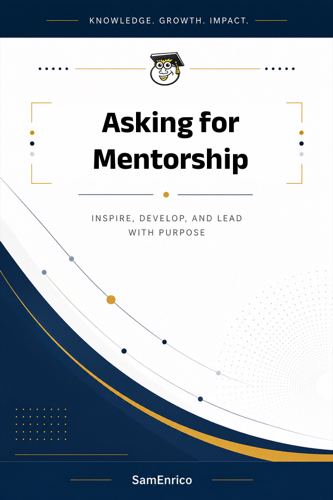
Non-FictionSelf-HelpMentorship
Asking for Mentorship eBook
Request guidance from senior professionals without
Request guidance from senior professionals without awkwardness.
Formats
Free sample
Chapter 1: The Generosity Gap...--–- Maria had just finished drafting what she thought was a perfect email. She had spent forty-five minutes on it—rewriting, softening, second-guessing, deleting entire paragraphs, starting over. The recipient was David, a senior vice president at her company whom she had admired from afar for two years. He ran the division she wanted to eventually lead. He had given a brilliant presentation last quarter about market strategy, and Maria had a thousand questions about how he thought through risk.But she could not press send.Her cursor hovered over the button.
Her stomach tightened. Who am I to ask for his time? she thought. He has forty-seven direct reports. He probably gets a hundred emails like this a day.
He will read mine, roll his eyes, and delete it. Or worse—he will say yes out of politeness, and then I will have to sit across from him for an hour, and he will realize I have nothing intelligent to say.Maria closed her laptop and went to get coffee instead.She is not alone. Across every industry, at every level, thousands of professionals do exactly what Maria did every single day. They identify someone whose wisdom they desperately need. They craft a message.
And then they freeze. The freeze is not laziness or lack of ambition. It is fear—specifically, the fear that asking for help is an imposition, a burden, or an admission of incompetence.This chapter exists to shatter that fear.It will introduce you to a counterintuitive truth that flips everything you think you know about mentorship on its head: Senior professionals do not merely tolerate requests for guidance. They actively want to help. The evidence for this claim is not wishful thinking.
It is drawn from decades of research in social psychology, organizational behavior, and the study of adult development. And once you internalize it, the act of asking for mentorship transforms from a terrifying gamble into a strategic, mutually beneficial conversation.We will call this counterintuitive truth The Generosity Gap—the measurable distance between how burdensome you think your request will feel to a senior person and how rewarding it actually feels to them. Closing that gap is the first and most important task of the proactive protégé.The Generosity Gap Defined In 2018, a team of researchers at Cornell and Harvard conducted a study that should be required reading for anyone who has ever hesitated to ask for help. They asked hundreds of professionals to imagine receiving a request for mentorship or advice from a junior colleague. Then they asked a separate group of junior professionals to predict how the senior professionals would feel about receiving that same request.The results were striking.
The junior professionals consistently overestimated how annoyed the senior professionals would be. They underestimated how flattered, useful, and energized the senior professionals would feel. The researchers called this mismatch the generosity gap—and they found it across industries, genders, and seniority levels.Why does this gap exist? The answer lies in two psychological mechanisms that operate beneath conscious awareness.First, the empathy gap. When you are the one asking for help, you are acutely aware of your own anxiety, your own uncertainty, your own fear of rejection.
You project those feelings onto the other person. You assume they will feel burdened because you would feel burdened if someone asked you for an hour of your time when you are already overwhelmed. But this is a projection error. Senior professionals are not you. They have different relationships to time, to expertise, and to requests for help.
They have already accumulated enough career capital that an hour of teaching does not feel like a cost—it feels like an investment.Second, the visibility gap. When you are a junior professional, you see senior leaders as distant, busy, and unapproachable. You see their calendars, their titles, their authority. What you do not see is the quiet loneliness that often accompanies seniority. Many senior leaders report feeling isolated, underutilized as teachers, and hungry for meaningful human connection that is not transactional.
A request for mentorship is not a disruption to that loneliness—it is an antidote.Maria, in our opening story, had no way of knowing that David had told his own coach three weeks earlier, "I miss the early days of my career when I actually got to teach people. Now I just manage spreadsheets and approve budgets. I feel like I am not making a real difference anymore." She could not see his generosity gap because it existed in his internal experience, not on his calendar.The first job of the proactive protégé is to stop guessing how senior leaders feel and start learning the actual psychology of helping.The Psychology of Helping: Why Saying "Yes" Feels So Good To understand why senior professionals actually want to mentor you, we have to go beneath the surface of politeness and professional obligation. Three powerful psychological forces are at work.Force One: The Franklin Effect In the eighteenth century, Benjamin Franklin wrote about a political rival who had publicly opposed him. Rather than attack the man, Franklin asked to borrow a rare book from the rival's library.
The rival sent the book immediately. Weeks later, the rival began showing Franklin public kindness and eventually became a lifelong ally. Franklin's conclusion: "He that has once done you a kindness will be more ready to do you another than he whom you yourself have obliged."Modern social psychology has confirmed this as the Franklin Effect. When someone helps you, they experience cognitive dissonance if they also hold negative feelings toward you. To resolve that dissonance, their brain unconsciously revises their opinion: "I helped this person.
I must like them. They must be worth helping." Asking for help does not make you look incompetent—it makes you look like someone worth investing in.For senior professionals, this effect is magnified. They have internal identities as successful, intelligent, perceptive people. If they agree to mentor you, their brain works hard to justify that decision. The justification usually sounds like: "This person has potential.
I see something in them. My time is valuable, so if I am spending it on them, they must be valuable." Your request triggers a chain of positive rationalizations that benefit you long after the conversation ends.Force Two: The Legacy Drive Psychologist Erik Erikson proposed that human development unfolds in stages. In midlife and beyond, adults enter a stage he called generativity versus stagnation. The central psychological need of this stage is to contribute to the next generation—to teach, to guide, to leave something behind. When senior professionals cannot satisfy this need, they experience stagnation, boredom, and a quiet sense of irrelevance.Mentorship is generativity in action.
When a senior leader agrees to help you, they are not doing you a favor. They are satisfying a deep psychological drive that their day-to-day work may no longer fulfill. Spreadsheets do not offer generativity. Budget meetings do not offer legacy. But a conversation with a curious, ambitious junior professional?
That offers exactly what their developmental stage craves.This is why the most effective mentorship requests frame the ask not as…
This is the end of the free sample. Get the eBook to keep going. Buy now
About this book
Details
- Author
- Crowe Clarita
- Publisher
- SamEnrico
- Language
- English
- Genre
- Non-Fiction, Self-Help, Mentorship
- Released
- 2026-06-08
- Pages (approx.)
- 138
- Available as
- eBook, Audiobook

Read better in the ZLOADR app
Your eBooks on your phone or tablet. Sign in with your SamEnrico account and start reading.
More by Crowe Clarita
 International Networking Protocol GuideCrowe Clarita$11.99
 Loneliness Dance Fitness GuideCrowe Clarita$11.99Loneliness Dance Fitness GuideCrowe Clarita$11.99
 The Focus Mirror MethodCrowe Clarita$11.99
 Washington GeneralCrowe Clarita$11.99
 Senior Change AdaptationCrowe Clarita$11.99
 Control Release TranceCrowe Clarita$11.99
 The Recovery Movement GuideCrowe Clarita$11.99
 Magnetic Hands InductionCrowe Clarita$11.99
 The Day the Music Burned: The Lost Tapes of the National Recording RegistryCrowe Clarita$11.99
 The Black Rider of the CarpathiansCrowe Clarita$11.99
 Into the Abyss: The Forgotten Divers of the PacificCrowe Clarita$11.99
You may also like
 Hong Kong Handover 1997Dunn Johnnie$11.99
 Zumba For Postnatal Recovery CourseNeal Christian$11.99
 Zumba for BeginnersLadner Nikia$11.99
 YouTube Comment Mining GuideHumes Pandora$12.99
 Worry Box MeditationCarlin Rudy$11.99
 Workplace Stress MeditationNguyen Lynn$11.99
 Workplace Stress and Sleep RepairHawley Ivory$11.99
 Workplace Perfectionism CureDelaney Jeffry$11.99
 Workplace Injustice Anger GuideWallen Isabelle$11.99
 Work Addiction and Burnout LinkGreenwood Ester$11.99
 Women in Yoga and WellnessBeattie Galina$11.99
 Women in Stand Up ComedyChun Evangeline$11.99