
Non-FictionSelf-HelpQuestioning
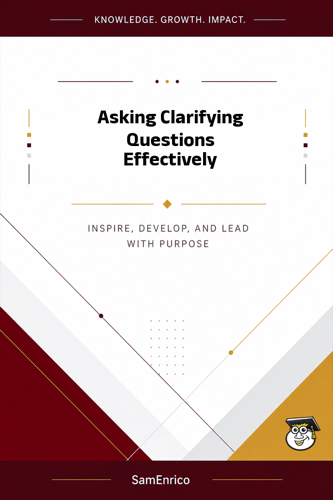
Asking Clarifying Questions Effectively eBook
Teaches open-ended and probing questions to deepen
by Bolt Huey
Teaches open-ended and probing questions to deepen understanding without interrogation.
Formats
Free sample
Chapter 1: The Sponge Trap--Most people walk through life as human sponges. They absorb everything—opinions, complaints, explanations, stories, data, nonsense—without discrimination. They assume that listening is simply the act of not talking while someone else makes noise. And they are wrong.This chapter is about the single most important shift you will make in learning to ask clarifying questions effectively: moving from passive absorption to active sifting. I call this shift the "Panning-for-Gold Mindset," and it is the foundation upon which every other skill in this book is built.Let me start with a story.The Meeting That Changed Everything A few years ago, I sat in a quarterly planning meeting at a mid-sized tech company.
The room was full of smart, well-meaning people. The CEO, a charismatic woman named Diane, was presenting a new strategic initiative. She spoke for twenty minutes without interruption. Her slides were beautiful. Her logic seemed sound.
At the end, she asked, "Any questions?"Hands went up. But here is what I noticed: almost every question was actually a statement disguised as a question. "Don't you think we should consider the budget constraints?" meant "You haven't considered the budget." "Are you sure the timeline is realistic?" meant "I think you're wrong about the timeline." "Have you talked to the engineering team about this?" meant "You should have talked to them and you didn't."Diane answered each pseudo-question patiently, but the room grew tense. People were not trying to understand. They were trying to win.
They were interrogating, not clarifying.Then something remarkable happened. A junior product manager named Elena raised her hand. She had been quiet the entire meeting, taking notes, frowning occasionally. When Diane called on her, Elena said: "I want to make sure I actually understand what you're proposing before I have any opinions about it. So if I'm hearing you correctly, you're suggesting we move the launch date up by six weeks by deprioritizing three features that were in the original scope.
Is that right?"Diane blinked. "Yes. Exactly."Elena continued: "And the reason for moving the date up is that our largest competitor is releasing something similar in Q3, and being first to market matters more than having every feature. Did I get that part right?""Perfectly," Diane said. The tension in the room dropped noticeably.Elena had done nothing fancy.
She had not challenged Diane. She had not agreed with her, either. She had simply clarified. And in doing so, she had done something that no one else in the room had managed: she had created a shared foundation of understanding from which actual discussion could begin.After the meeting, Diane pulled Elena aside. "That was the most useful question anyone asked all day."Elena shrugged.
"I just wanted to make sure I knew what we were talking about."That moment—the moment when someone chooses understanding over winning—is what this book is about.The Sponge vs. The Pan Most people listen like sponges. They absorb information passively, trusting that whatever they soak up is valuable simply because it came from someone else. The sponge approach feels comfortable. It requires no effort.
You just open your pores and let the liquid of other people's words flow in.But there is a hidden cost to the sponge approach: you absorb the good and the bad indiscriminately. You absorb assumptions dressed as facts. You absorb emotional language as if it were data. You absorb conclusions without examining the reasoning behind them. And because you never sift, you never notice what is worthless until long after the conversation is over—if you notice at all.The alternative is the Panning-for-Gold Mindset.Imagine a prospector standing in a stream, swirling a pan full of gravel and water.
The goal is not to keep everything. The goal is to let the worthless material wash away so that only the valuable nuggets remain. This takes work. You have to swirl. You have to tilt.
You have to discriminate. But the result is gold, not gravel.When you listen with a Panning-for-Gold Mindset, you are not passively absorbing. You are actively sifting. You are constantly asking yourself: What matters here? What is the speaker actually trying to communicate?
What am I assuming that might be getting in the way? What do I need to clarify before I can understand?The panning mindset transforms you from a passive receiver into an active participant. You stop waiting for the conversation to hand you meaning. You start extracting it.A Clear Definition: What Is a Clarifying Question?Before we go further, we need a working definition. Throughout this book, when I say "clarifying question," I mean this:A clarifying question seeks to remove ambiguity from the speaker's intended meaning without introducing the asker's assumptions, judgment, or agenda.Let me break that down."Seeks to remove ambiguity" – The goal is understanding, not agreement, not disagreement, not persuasion, not exposure.
You are not trying to prove a point. You are trying to see what the speaker sees."From the speaker's intended meaning" – You are asking about their meaning, not about objective truth. Later, you may evaluate whether their meaning corresponds to reality. But first, you must understand what they actually mean."Without introducing the asker's assumptions" – This is the hardest part. Most of us unconsciously insert our own assumptions into our questions.
"Were you angry?" assumes anger. "Why didn't you call me?" assumes fault. A clean clarifying question removes those assumptions. Chapter 4 will teach you exactly how to do this."Judgment" – Clarifying questions are neutral. They do not praise or condemn.
They simply seek to understand."Or agenda" – This is the killer. Most questions are not really questions. They are moves in a game. They are designed to steer the conversation toward a predetermined outcome. A genuine clarifying question has no agenda except clarity.When you master this definition, everything changes.
You become the person who actually listens. The person who understands before responding. The person others seek out when they need to think through something complicated.Clarifying vs. Interrogating: The Critical Distinction If clarifying questions seek understanding, interrogating questions seek something else entirely: exposure, contradiction, confession, or victory.Interrogation asks: How can I prove this person wrong? How can I catch them in an inconsistency?
How can I make them admit something they don't want to admit? How can I win this exchange?Clarification asks: What is this person actually trying to say? What am I missing? What would help me see what they see?The words can be identical. "What happened next?" can be a genuine question or a trap.
The difference is not in the vocabulary. It is in the intent, and intent is communicated through tone, timing, and the questions that follow.Consider two versions of the same exchange:Interrogation version:You: "What happened next?"Speaker: "I called the client."You: "Did you have approval to do that?"Speaker: "Well, no, but—"You: "So you went around the process?"Clarification version:You: "What happened next?"Speaker: "I called the client."You: "Tell me about that call. What led you to reach out directly?"Speaker: "I was worried about the deadline and thought a personal conversation would help."You: "So you called because you were concerned about timing. What happened…
This is the end of the free sample. Get the eBook to keep going. Buy now
About this book
Details
- Author
- Bolt Huey
- Publisher
- SamEnrico
- Language
- English
- Genre
- Non-Fiction, Self-Help, Questioning
- Released
- 2026-06-10
- Pages (approx.)
- 130
- Available as
- eBook, Audiobook

Read better in the ZLOADR app
Your eBooks on your phone or tablet. Sign in with your SamEnrico account and start reading.
More by Bolt Huey
 Fear of Failure Affirmation DeckBolt Huey$11.99
 Mindful Social Media ScrollBolt Huey$11.99
 Fertility Benefit ComplianceBolt Huey$11.99
 Overcoming Remote ProcrastinationBolt Huey$11.99
 SAD And Music TherapyBolt Huey$11.99
 De escalation JournalBolt Huey$11.99
 Networking for Data ScientistsBolt Huey$11.99
 The Portrait That Broke the Curse: Peter Graham and the All Blacks' RedemptionBolt Huey$11.99
 How to Produce Wall Plates and CoversBolt Huey$11.99
 US Virtual Address for LLC FormationBolt Huey$12.99
 Angel Investor Non-Disclosure AgreementsBolt Huey$12.99
 How to Produce LeisBolt Huey$11.99
You may also like
 Hong Kong Handover 1997Dunn Johnnie$11.99
 Zumba For Postnatal Recovery CourseNeal Christian$11.99
 Zumba for BeginnersLadner Nikia$11.99
 YouTube Comment Mining GuideHumes Pandora$12.99
 Worry Box MeditationCarlin Rudy$11.99
 Workplace Stress MeditationNguyen Lynn$11.99
 Workplace Stress and Sleep RepairHawley Ivory$11.99
 Workplace Perfectionism CureDelaney Jeffry$11.99
 Workplace Injustice Anger GuideWallen Isabelle$11.99
 Work Addiction and Burnout LinkGreenwood Ester$11.99
 Women in Yoga and WellnessBeattie Galina$11.99
 Women in Stand Up ComedyChun Evangeline$11.99