
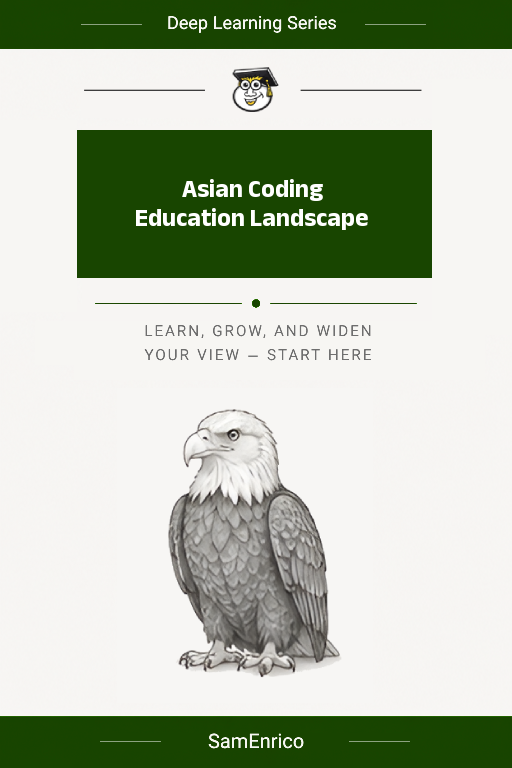
Non-FictionStudent's ShortcutAsian MarketGlobal Education
Asian Coding Education Landscape eBook
Navigate coding bootcamps and CS degrees in Singap
by Gipson Mila
Navigate coding bootcamps and CS degrees in Singapore Bangalore and Shanghai including cultural hiring preferences.
Formats
Free sample
Chapter 1: The Three Engines--Every year, more than two million students graduate from computer science programs across India, China, and Southeast Asia. Nearly half a million more emerge from coding bootcamps, online degrees, and self-taught tracks. They have mastered Python, optimized Leet Code, and built portfolios. And yet, in the technology hubs of Shanghai, Bangalore, and Singapore, a brutal truth awaits them: technical fluency is the price of entry, not the key to success.The Western myth of coding careers—that merit, skill, and passion alone determine your trajectory—collapses the moment you land in any of these three cities. In San Francisco or Berlin, a brilliant Git Hub portfolio can override a lackluster degree.
A startup founder who dropped out of college can raise venture capital. A self-taught developer can become a principal engineer. But in Asia's most dynamic tech capitals, different rules apply. Not better rules. Not worse rules.
Different rules—rooted in centuries of cultural logic, statecraft, and economic strategy.This book is about those rules. And this first chapter is about the machines that generate them.Shanghai, Bangalore, and Singapore are not interchangeable tech hubs. They are fundamentally different economic engines, each with its own understanding of what a coder should be, how a coder should be educated, and who gets to call themselves a senior engineer. To navigate the Asian coding education landscape, you must first understand the landscape itself: who built it, what they want, and why your technical skills alone will never be enough.Shanghai is a state-capitalist machine where the government acts as the primary venture capitalist, funding AI sovereignty and semiconductor independence. Bangalore is the world's back office, optimized for Global Capability Centers and IT services that serve Western multinationals.
Singapore is the hybrid regulator, a city-state that balances Western soft skills with Eastern hierarchy, positioning itself as the headquarters for fintech, cybersecurity, and cross-border data flows.Each city produces—and hires—a different kind of engineer. And each city will judge you by a different standard.This chapter dissects the three engines. We will examine their economic DNA, their industrial priorities, and their hidden hierarchies of respect. By the end, you will understand why a senior engineer in Bangalore commands respect for shipping code at 2 AM, while a senior engineer in Shanghai is respected for their network and tenure, and a senior engineer in Singapore is valued for their compliance and predictability. You will also begin to see the first outlines of the cultural architecture that determines who succeeds, who fails, and who never even gets invited to the interview.Let us begin in Shanghai, where the state writes the code that writes the code.Shanghai: The State as Venture Capitalist Shanghai is not Silicon Valley with Chinese characteristics.
It is something entirely different.In Silicon Valley, venture capital flows toward disruption, risk, and founder charisma. In Shanghai, the primary venture capitalist is the Chinese state, operating through a complex web of sovereign wealth funds, state-owned enterprises (SOEs), and policy banks. The government does not merely regulate the tech industry—it builds it. The five-year plans, drafted in Beijing, determine which sectors receive funding, which universities expand their CS programs, and which coding bootcamps (if any) receive official certification.This matters enormously for anyone seeking a coding career in Shanghai. You are not just competing for jobs at Alibaba, Huawei, or Tencent—though those giants dominate the headlines.
You are also competing for positions at state-backed AI labs, semiconductor design firms, and defense-adjacent technology companies that never appear on Western tech news sites. These employers do not hire like Google or Meta. They hire like extensions of the civil service, because in many ways, they are.Consider the numbers. China produces over 1.2 million software engineering graduates annually, more than any other country. Yet only 38 percent are considered "ready" for industry by employers—a statistic we will explore in depth in Chapter 3.
The state views this gap as a national security issue, not just an educational failure. In response, the government has poured billions into university partnerships, state-run MOOC platforms like Xuetang X, and targeted upskilling programs that bypass the private bootcamp market entirely.The result is a coding education landscape that feels familiar to anyone who has navigated China's broader social systems. Your hukou (household registration) influences where you can attend university. Your university's prestige—Tsinghua versus a local college—determines which SOE internships you can access. Your Party membership opens doors that remain sealed to equally talented non-members.
And your ability to navigate guanxi (relationships) often matters more than your ability to reverse a linked list on a whiteboard.But Shanghai is not merely a political machine. It is also a technological powerhouse with genuine innovation. The city leads China's push for AI sovereignty—developing large language models that do not rely on Western chips or training data. It is the center of China's semiconductor strategy, with companies like SMIC (Semiconductor Manufacturing International Corporation) attempting to close the gap with Taiwan and South Korea. It hosts the Chinese headquarters of every major global tech firm that is still allowed to operate in the country.For the coder who understands these dynamics, Shanghai offers extraordinary opportunities.
Salaries for senior engineers at top firms can rival those in New York or London. The pace of innovation is relentless. And the sheer scale of the market—1.4 billion consumers, a digital infrastructure that integrates payments, social media, and logistics into a single ecosystem—means that the problems you solve in Shanghai are unlike anything you will encounter elsewhere.But the price of entry is high. You must accept that your career trajectory will be shaped by forces far beyond your technical ability. You must learn to read the five-year plans.
You must understand which sectors the state is funding today and which it will abandon tomorrow. And you must develop the soft skills—the ability to navigate hierarchy, to show deference without appearing weak, to build relationships over years rather than weeks—that Shanghai's employers prize above all else.In the hierarchy of respect that governs Shanghai's tech scene, guanxi and tenure sit at the top. A senior engineer with fifteen years of experience at a state-owned enterprise, a deep network of party-connected mentors, and a reputation for reliability will command more respect—and more compensation—than a brilliant twenty-five-year-old who can code circles around them but lacks the connections. This is not corruption. It is a different definition of value.
In Shanghai, stability and relationships are assets. The coder who understands this will thrive. The coder who fights it will find every door closed.Bangalore: The Global Capability Center If Shanghai is the state as venture capitalist, then Bangalore is the world as customer.Bangalore's tech economy did not emerge from state planning. It emerged from outsourcing. In the 1990s and 2000s, Western companies discovered that they could hire Indian engineers—fluent in English, trained in rigorous university programs, and willing to work for a fraction of US salaries—to handle everything from customer support to software maintenance.
Infosys, Wipro, and Tata Consultancy Services (TCS) built billion-dollar businesses on this model. And Bangalore, with its pleasant climate and existing educational infrastructure, became the…
This is the end of the free sample. Get the eBook to keep going. Buy now
About this book
Details
- Author
- Gipson Mila
- Publisher
- SamEnrico
- Language
- English
- Genre
- Non-Fiction, Student's Shortcut, Asian Market, Global Education
- Released
- 2026-05-26
- Pages (approx.)
- 131
- Available as
- eBook, Audiobook

Read better in the ZLOADR app
Your eBooks on your phone or tablet. Sign in with your SamEnrico account and start reading.
More by Gipson Mila
 Psychoeducation for Explosive ParentsGipson Mila$11.99
 The Beit Yosef CompilerGipson Mila$11.99
 Hostage Negotiation LessonsGipson Mila$11.99
 Growth Hormone Deficiency DiagnosisGipson Mila$11.99
 Panic Disorder Comorbidity CourseGipson Mila$11.99
 The Hypnos Code: Decoding the Ancient Dream Oracle of DelphiGipson Mila$11.99
 Love Letters from the Front: The Secret Correspondence of Vera Brittain and Roland LeightonGipson Mila$11.99
 Understanding Brachydactyly Type BGipson Mila$17.99
 Fishing GuideGipson Mila$11.99
 10 Ways to Use Cinnamomum Citriodorum (Recipe Book)Gipson Mila$11.99
 Headless Commerce Five Year ForecastGipson Mila$12.99
You may also like
 Hong Kong Handover 1997Dunn Johnnie$11.99
 Zumba For Postnatal Recovery CourseNeal Christian$11.99
 Zumba for BeginnersLadner Nikia$11.99
 YouTube Comment Mining GuideHumes Pandora$12.99
 Worry Box MeditationCarlin Rudy$11.99
 Workplace Stress MeditationNguyen Lynn$11.99
 Workplace Stress and Sleep RepairHawley Ivory$11.99
 Workplace Perfectionism CureDelaney Jeffry$11.99
 Workplace Injustice Anger GuideWallen Isabelle$11.99
 Work Addiction and Burnout LinkGreenwood Ester$11.99
 Women in Yoga and WellnessBeattie Galina$11.99
 Women in Stand Up ComedyChun Evangeline$11.99