
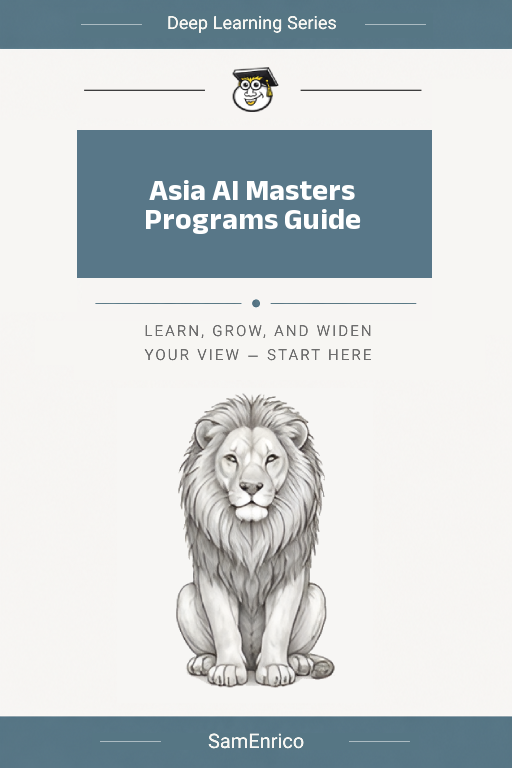
Non-FictionStudent's ShortcutAsia
Asia AI Masters Programs Guide eBook
Study AI at Tsinghua, Peking, National University
by Logue Tonda
Study AI at Tsinghua, Peking, National University of Singapore, Nanyang Technological, and KAIST.
Formats
Free sample
Chapter 1: The Eastward Shift--For the past decade, the default path for an ambitious artificial intelligence researcher has been a straight line from undergraduate computer science to a master’s program in the United States – Stanford, MIT, Carnegie Mellon, or Berkeley. That line has been drawn so deeply into the mental maps of aspiring AI professionals that many have never stopped to ask whether it remains the right route. This book exists because that question now demands a radically different answer.The global landscape of AI education and employment has shifted beneath our feet. While American universities continue to produce groundbreaking research, the ecosystem in which that research translates into careers has become fractured, unpredictable, and increasingly hostile to international talent. Simultaneously, five institutions in East Asia have built programs that rival – and in some specialized areas, exceed – their Western counterparts.
Tsinghua University and Peking University in Beijing, the National University of Singapore and Nanyang Technological University in Singapore, and the Korea Advanced Institute of Science and Technology in Daejeon have become the new poles of AI excellence.This chapter dismantles the Western-centric assumption that has guided generations of graduate school applicants. It presents data showing why Asia has become the world’s most dynamic AI training ground, compares the three national ecosystems against traditional Western destinations, and helps you identify which Asian hub aligns with your specific career ambitions. By the end of this chapter, you will understand that choosing Asia is not a fallback plan for rejected US applicants. It is a strategic career move that positions you where the future of AI is being built – at scale, with urgency, and with resources that increasingly surpass those available elsewhere.The Unspoken Crisis in Western AI Education To understand why Asia has become the rational choice for many AI master’s applicants, one must first confront the deteriorating conditions in traditional Western destinations. The United States, long the undisputed leader in graduate technology education, has made itself increasingly inaccessible to international students through a combination of policy chaos and structural dysfunction.The H1-B visa lottery system has become a source of chronic anxiety for international graduates.
Each year, approximately 85,000 visas are awarded through a random lottery that attracts over 400,000 applicants. A master’s degree from an American university confers a marginally better chance – two entries in the lottery instead of one – but the odds remain brutally low. This means that a student who invests two years and upwards of $120,000 in an American AI master’s degree faces a greater than seventy percent chance of being forced to leave the country upon graduation, regardless of job offers or academic performance.The problem extends beyond visas. American AI labs have experienced rolling hiring freezes since 2022. Google, Meta, and Amazon – historically the largest employers of AI master’s graduates – have reduced entry-level research engineering roles by approximately forty percent.
Simultaneously, the cost of American graduate education has continued its relentless climb. Private university master’s programs in AI now routinely exceed $60,000 per year in tuition alone, with no corresponding increase in financial aid for international students.European alternatives offer little relief. The United Kingdom’s graduate visa route requires a job offer with a minimum salary that exceeds typical entry-level AI positions, while mainland European programs, though more affordable, lack the industry density and English-language research output that define elite AI training. The result is a growing gap between the promise of Western AI education and the reality of Western AI employment.The Asian Alternative: Three Distinct Ecosystems Asia does not offer a single alternative to the Western model. It offers three distinct ecosystems, each with different strengths, cultures, and career trajectories.
Understanding these differences is the first step in building a coherent application strategy.China: Scale and State Ambition The Chinese AI ecosystem operates at a scale that no other country can match. China produces more AI research papers annually than the United States – a fact often dismissed by Western critics who question Chinese research quality, but increasingly difficult to ignore as Chinese institutions lead in computer vision, natural language processing, and large language model efficiency.The driving force behind China’s AI expansion is the central government’s Next Generation Artificial Intelligence Development Plan, released in 2017 and continually updated. This plan sets specific goals for AI leadership by 2030, backed by billions in research funding, compute cluster subsidies, and talent recruitment programs. Unlike the fragmented, project-based funding typical in the West, Chinese AI funding flows from a coordinated national strategy.For master’s students, this translates into unusual opportunities. Tsinghua and Peking University labs receive direct industry funding from Tencent, Alibaba, Huawei, and Byte Dance, allowing students to work on production-scale problems that Western students only encounter after graduation.
The Large Model Engineering program at Tsinghua’s Shenzhen International Graduate School, co-developed with Tencent, gives students access to compute clusters and engineering teams that would be impossible to replicate in an academic setting elsewhere.The challenges of studying in China are real and should not be minimized. Mandarin proficiency is essential for full integration into research labs. The academic culture is hierarchical, with professors expecting deference and students rarely challenging authority publicly. The political environment requires foreign students to navigate censorship, surveillance, and restricted access to Western research tools and communication platforms. Yet for students whose career goals include working at Chinese tech giants or building AI applications for the Chinese market, these trade-offs are acceptable.Singapore: The Neutral Global Bridge Singapore occupies a unique position in the global AI landscape.
It is an English-speaking, common-law jurisdiction with transparent visa policies and a government that has made AI adoption a national priority. The National AI Strategy 2.0, launched with over S$500 million in funding, focuses on applying AI to finance, healthcare, and logistics – sectors where Singapore already holds global advantages.What makes Singapore distinctive is not research volume but application density. The country’s small size and efficient governance mean that AI policies translate rapidly into practice. The Monetary Authority of Singapore has issued binding guidance on AI governance in financial services. The health ministry has deployed AI diagnostic tools across public hospitals.
This creates an environment where AI master’s students can see their work deployed in production within months, not years.For international students, Singapore offers the most straightforward post-graduation pathway among Asian destinations. The ONE Pass, introduced in 2023, provides five-year work visas for high-earning professionals, while the Tech.Pass offers a similar pathway for startup founders and technical leads. Unlike the US lottery system, Singapore’s visa policies are deterministic – meet the criteria, receive the visa.The cost of Singaporean education is higher than China or Korea, but lower than the United States. Total two-year costs for international students at NUS or NTU range from 88,000to88,000 to 88,000to122,000, including living expenses. Graduates typically earn starting salaries between 80,000and80,000 and 80,000and120,000, making the investment recoverable within two to three years.South Korea: Hardware and Research Intensity South Korea’s AI ecosystem is defined by its strengths in adjacent technologies: semiconductors, robotics, and consumer electronics.
KAIST, often described as the Korean MIT, produces graduates who are equally comfortable deriving backpropagation proofs and optimizing inference on custom silicon.The Korean government’s National AI…
This is the end of the free sample. Get the eBook to keep going. Buy now
About this book
Details
- Author
- Logue Tonda
- Publisher
- SamEnrico
- Language
- English
- Genre
- Non-Fiction, Student's Shortcut, Asia
- Released
- 2026-06-01
- Pages (approx.)
- 145
- Available as
- eBook, Audiobook

Read better in the ZLOADR app
Your eBooks on your phone or tablet. Sign in with your SamEnrico account and start reading.
More by Logue Tonda
 The Vitamin D Brain LinkLogue Tonda$11.99
 The Academic Accommodation RequestLogue Tonda$11.99
 Imposter Syndrome Before TalksLogue Tonda$11.99
 Food Addiction And Hormonal ImbalanceLogue Tonda$11.99
 Employee Walkout Immediate Response ManualLogue Tonda$11.99
 Cannabis Use Disorder DrivingLogue Tonda$11.99
 Spouse Grief Nature TherapyLogue Tonda$11.99
 Masturbation Sobriety WorkbookLogue Tonda$11.99
 DOJ Merger Challenge CasesLogue Tonda$11.99
 The Alchemist of the Nile: The Secret Science of ApriesLogue Tonda$11.99
 The Silk Road Tycoon: How an African Merchant Built an Empire Across ContinentsLogue Tonda$11.99
 How to Produce Baby OilLogue Tonda$11.99
You may also like
 Hong Kong Handover 1997Dunn Johnnie$11.99
 Zumba For Postnatal Recovery CourseNeal Christian$11.99
 Zumba for BeginnersLadner Nikia$11.99
 YouTube Comment Mining GuideHumes Pandora$12.99
 Worry Box MeditationCarlin Rudy$11.99
 Workplace Stress MeditationNguyen Lynn$11.99
 Workplace Stress and Sleep RepairHawley Ivory$11.99
 Workplace Perfectionism CureDelaney Jeffry$11.99
 Workplace Injustice Anger GuideWallen Isabelle$11.99
 Work Addiction and Burnout LinkGreenwood Ester$11.99
 Women in Yoga and WellnessBeattie Galina$11.99
 Women in Stand Up ComedyChun Evangeline$11.99