
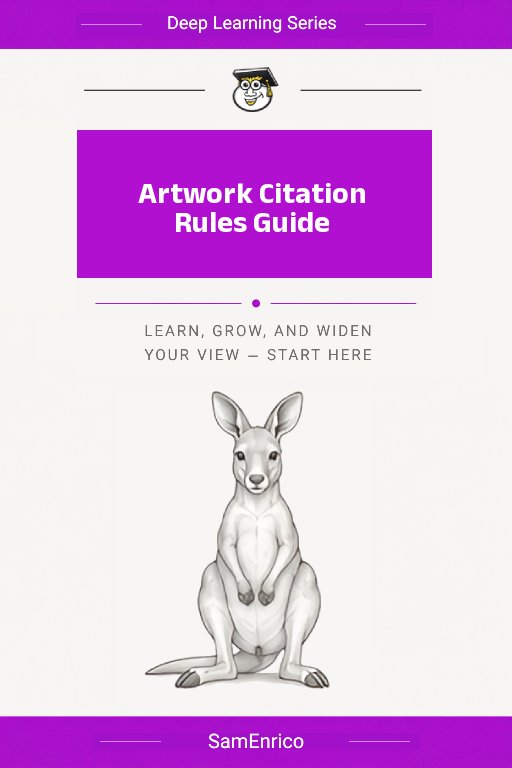
Artwork Citation Rules Guide eBook
Cite paintings photographs and museum exhibits in
by Noyes Lindsy
Cite paintings photographs and museum exhibits in academic papers.
Formats
Free sample
Chapter 1: The Citation Trap...--Every year, thousands of students and academics lose points, fail assignments, or face publication delays because of a single, avoidable mistake: they assume citing art works just like citing books. It does not. A painting has no author page. A photograph has no publication date in the traditional sense. A museum exhibition has no DOI.
And yet, the academic world demands that you treat these visual sources with the same rigor as any printed text. The result is a quiet crisis of misattribution, incomplete citations, and unwitting plagiarism that spreads across research papers, dissertations, and even published journal articles. This chapter exists to ensure you never become a statistic in that silent epidemic.Let us begin with a story—one that is true, though the names have been anonymized to protect the embarrassed.In 2019, a graduate student at a respected university submitted her master's thesis on the iconography of domestic space in Dutch Golden Age painting. She had spent two years conducting research across three countries. She had photographed paintings in the Rijksmuseum, the Mauritshuis, and the Metropolitan Museum of Art.
She had written a compelling argument about the symbolic function of windows in Vermeer's interiors. Her thesis advisor called it "publishable work." Then came the citation audit.The second reader, a stickler for accuracy, ran a random check of five image citations. Two were incomplete. One cited a painting's location as "Rijksmuseum" without an accession number, making it impossible for another scholar to locate the specific version of a multi-version composition. Another attributed a photograph to the museum's generic "imaging department" rather than the specific photographer whose work was under copyright.
The fifth error was the most damaging: the student had reproduced an image from a book but cited only the artist, not the book's author or publisher. The publisher held the reproduction rights. Technically, the student had violated the terms of use. The thesis was returned for revision. The defense was delayed by six months.
The student lost her post-graduation job offer because she could not provide proof of degree completion on time.All of this—the delay, the humiliation, the lost opportunity—could have been prevented by understanding a single principle: citation is not a bureaucratic chore. It is a chain of evidence.When you cite a book, the chain is short: author, title, publisher, year, page. When you cite an artwork, the chain is longer and more fragile: artist, title, date, medium, dimensions, location, accession number, rights holder, reproduction source, and often a URL or database identifier. Break any link in that chain, and your reader cannot find what you found. Break the wrong link, and you may be committing copyright infringement without knowing it.
This chapter will teach you why that chain exists, how it protects you, and what happens when it breaks.The High Stakes of Art Citation Before we discuss the mechanics of citation, we must understand the stakes. Most students believe that citation is about avoiding plagiarism. That is true, but it is only the beginning. Proper citation of artwork serves four essential functions that go far beyond academic honesty.First, citation enables verification. When you write that Rembrandt's The Night Watch uses chiaroscuro to dramatic effect, your reader should be able to locate the exact painting you mean.
That seems obvious. Yet there are multiple versions of many famous works—Rembrandt's self-portraits alone number over eighty. Van Gogh painted multiple Sunflowers. Munch created several versions of The Scream. Without an accession number or a specific museum location, your reader cannot know which version you analyzed.
Verification fails. Your argument loses its evidentiary foundation.Second, citation establishes provenance. Provenance—the history of ownership and location of an artwork—is the bedrock of art historical scholarship. When you cite a painting as being in the Louvre, you are also making a claim about its history: how did it get there? Was it acquired legitimately?
Was it looted during wartime? Does its current location reflect political realities or colonial legacies? Proper citation requires you to name the repository, and that naming carries historical weight. A student who cites the "Benin Bronzes" without noting that they are held in the British Museum has missed an opportunity to acknowledge the ongoing debate about repatriation. Citation is never neutral.Third, citation clarifies rights and permissions.
Every image carries legal baggage. Some images are in the public domain, meaning you can reproduce them freely with attribution. Others are under copyright, meaning you need permission to reproduce them in any published work. Still others fall into gray areas: orphan works whose copyright holder cannot be located, or works under Creative Commons licenses with specific attribution requirements. Your citation is the first place a reader looks to understand what rights apply.
If you omit the rights statement or credit line, you leave your reader (and your publisher) guessing about legal exposure.Fourth, citation contributes to the scholarly conversation. When you cite a photograph from a particular archive, you signal to other researchers that this archive holds relevant material. When you cite a digital reproduction from a museum's open access initiative, you validate that initiative's value. When you note that you viewed an exhibition in person, you add a primary source to the historical record. Citations are not just guardrails against plagiarism; they are the threads that weave individual research into a collective scholarly fabric.The Fundamental Misunderstanding: Citation vs.
Permission One of the most common and dangerous confusions in art citation is the difference between citing a source and seeking permission to reproduce an image. These are not the same thing. They serve different purposes, follow different rules, and have different consequences when ignored.Citation answers the question: "Where did you get this information?" It is required for every source you use, whether you quote it directly, paraphrase it, or refer to it indirectly. Citation is governed by style guides (Chicago, APA, MLA) and ethical norms. You cite an artwork when you mention it in your text, refer to it in an argument, or list it in your bibliography.
Citation does not require permission because you are not reproducing the image itself—you are only referencing it. You can write "Van Gogh's Starry Night (1889) in the Museum of Modern Art" without asking anyone for permission. That is citation.Permission answers the question: "May I reproduce this image in my work?" Permission is required whenever you include an actual copy of the image—a photograph, a scan, a screenshot—in your paper, thesis, or publication. Permission is governed by copyright law, fair use doctrine, and the policies of museums and rights holders. Even if you cite the image perfectly, you still need permission to reproduce it if the image is under copyright and your use exceeds fair use.
You can cite Starry Night freely. To reproduce a photograph of Starry Night in your book, you need permission from Mo MA (which holds the rights to the painting's images) or the photographer (if a contemporary photograph).The confusion arises because many students see images reproduced in books and journals with captions that look like citations. Those captions often combine citation and permission information: "Fig. 1. Vincent van Gogh, The…
This is the end of the free sample. Get the eBook to keep going. Buy now
About this book
Details
- Author
- Noyes Lindsy
- Publisher
- SamEnrico
- Language
- English
- Genre
- Non-Fiction, Student's Shortcut
- Released
- 2026-05-30
- Pages (approx.)
- 144
- Available as
- eBook, Audiobook

Read better in the ZLOADR app
Your eBooks on your phone or tablet. Sign in with your SamEnrico account and start reading.
More by Noyes Lindsy
 Pinterest Perfection ComparisonNoyes Lindsy$11.99
 LinkedIn Professional Envy GuideNoyes Lindsy$11.99
 Declutter Habit GuideNoyes Lindsy$11.99
 Overtime Execution RulesNoyes Lindsy$11.99
 The Self Talk Audit GuideNoyes Lindsy$11.99
 The Critical Parent Voice SilencerNoyes Lindsy$11.99
 Carson Smithsonian ExhibitNoyes Lindsy$11.99
 Meeting Fatigue BurnoutNoyes Lindsy$11.99
 Accomplishment Log MethodNoyes Lindsy$11.99
 Tangaroa's Whisper: The Navigator Who Rode the Tides of TimeNoyes Lindsy$11.99
 The Sands of Sinai: Israel's Alternate 1973Noyes Lindsy$11.99
 The Dancer's Guide to PolkaNoyes Lindsy$11.99
You may also like
 Hong Kong Handover 1997Dunn Johnnie$11.99
 Zumba For Postnatal Recovery CourseNeal Christian$11.99
 Zumba for BeginnersLadner Nikia$11.99
 YouTube Comment Mining GuideHumes Pandora$12.99
 Worry Box MeditationCarlin Rudy$11.99
 Workplace Stress MeditationNguyen Lynn$11.99
 Workplace Stress and Sleep RepairHawley Ivory$11.99
 Workplace Perfectionism CureDelaney Jeffry$11.99
 Workplace Injustice Anger GuideWallen Isabelle$11.99
 Work Addiction and Burnout LinkGreenwood Ester$11.99
 Women in Yoga and WellnessBeattie Galina$11.99
 Women in Stand Up ComedyChun Evangeline$11.99