
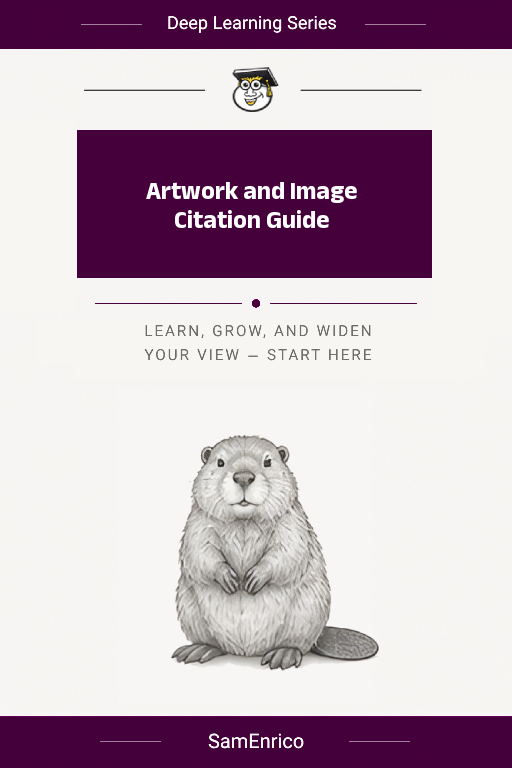
Non-FictionStudent's ShortcutArt Citation
Artwork and Image Citation Guide
Cite paintings, photographs, sculptures, and digit
by Mccool Abbie
Cite paintings, photographs, sculptures, and digital images in galleries and online collections.
Formats
About this book
Free sample
Chapter 1: The Image Trap--–- You have ten minutes left on your final thesis submission. Your argument is perfect. Your prose is polished. Your advisor has signed off. But as you scroll through your document one last time, your stomach drops.
There, on page 34, is a high-resolution photograph of Frida Kahlo's The Two Fridas. You found it on Google Images six months ago. You have no idea where it came from. You don't know if it belongs to the Museo de Arte Moderno in Mexico City, a private collector, or a stock photo agency. You don't know if you're allowed to use it.
And you have no idea how to cite it. Your cursor blinks. The clock ticks. This is the image trap.If you are reading this book, you have either been in this situation, will be in this situation, or are wise enough to know you want to avoid it entirely. The image trap is not a failure of intelligence or effort.
It is a failure of education. Across universities, publishing houses, museums, and corporate marketing departments, millions of people use images every day—in presentations, papers, websites, social media posts, and books—without the faintest idea of how to properly credit them. They assume that because an image appears on Google, it belongs to everyone. They assume that because a museum website offers a "download" button, the image is free. They assume that because a photograph is old, it has no copyright.
These assumptions are not just wrong. They are dangerous.This chapter is not a dry lecture about punctuation and style manuals. This chapter is an intervention. It will change how you see every image you encounter from this moment forward. By the time you finish reading these pages, you will understand why citing images matters more than citing text, how a single uncited photograph can derail a career, and why the distinction between plagiarism and copyright infringement is the single most important legal and ethical concept you will learn this year.
More than that, you will begin to see images not as decorations or illustrations, but as sources—sources with authors, histories…
This is the end of the free sample. Get the eBook to keep going. Buy now
Contents
- Chapter 1
- Chapter 2
- Chapter 3
- Chapter 4
- Chapter 5
- Chapter 6
- Chapter 7
- Chapter 8
- Chapter 9
- Chapter 10
- Chapter 11
- Chapter 12
Details
- Author
- Mccool Abbie
- Publisher
- SamEnrico
- Language
- English
- Genre
- Non-Fiction, Student's Shortcut, Art Citation
- Released
- 2026-05-30
- Pages (approx.)
- 127
- Available as
- eBook, Audiobook

Read better in the ZLOADR app
Your eBooks on your phone or tablet. Sign in with your SamEnrico account and start reading.
More by Mccool Abbie
 Negotiation Nonverbal TacticsMccool Abbie$11.99
 League of Legends Time ManagementMccool Abbie$11.99
 Scalp Wound Bleeding ControlMccool Abbie$11.99
 Polysomnography GuideMccool Abbie$11.99
 Mnemonic Major System GuideMccool Abbie$11.99
 Asana Bulk Edit for TasksMccool Abbie$11.99
 Remote Work Entrepreneur GuideMccool Abbie$11.99
 Atomic Habits For HonestyMccool Abbie$11.99
 Fists of Righteous Harmony: The Boxer Rebellion's Last StandMccool Abbie$11.99
 Growing BulbineMccool Abbie$11.99
 How to Produce 100% Jute FabricMccool Abbie$11.99
 How to Become a Roof BolterMccool Abbie$11.99
You may also like
 Hong Kong Handover 1997Dunn Johnnie$11.99
 Zumba For Postnatal Recovery CourseNeal Christian$11.99
 Zumba for BeginnersLadner Nikia$11.99
 YouTube Comment Mining GuideHumes Pandora$12.99
 Worry Box MeditationCarlin Rudy$11.99
 Workplace Stress MeditationNguyen Lynn$11.99
 Workplace Stress and Sleep RepairHawley Ivory$11.99
 Workplace Perfectionism CureDelaney Jeffry$11.99
 Workplace Injustice Anger GuideWallen Isabelle$11.99
 Work Addiction and Burnout LinkGreenwood Ester$11.99
 Women in Yoga and WellnessBeattie Galina$11.99
 Women in Stand Up ComedyChun Evangeline$11.99