
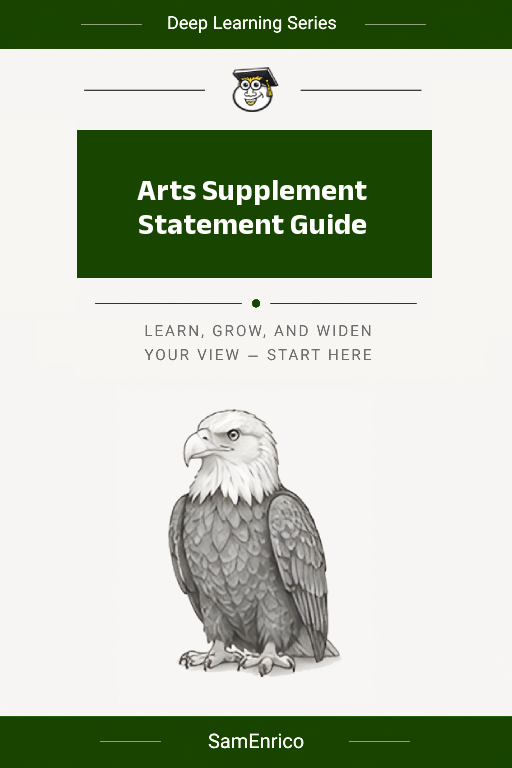
Arts Supplement Statement Guide
Write descriptions for music, theater, or dance po
Write descriptions for music, theater, or dance portfolios, explaining your artistic journey and growth without bragging.
Formats
About this book
Free sample
Chapter 1: Three Pieces Only--–- Most students open their arts supplement folder and feel a familiar panic. They have seventeen recordings, twelve performance videos, four very different monologues, and a dance reel that spans three years of growth. The instinct is to include everything impressive, to prove range and dedication and raw talent. That instinct is precisely wrong.This chapter will save you from that mistake. Before you write a single word about your artistic journey, before you define your identity or map your growth arc, you must first choose the raw material you will write about.
And here is the non-negotiable rule that separates successful arts supplements from forgettable ones: you will select exactly three pieces. Not two. Not four. Not seventeen. Three.Why three?
Because storytelling requires a beginning, a middle, and an end. Two pieces give you a before and after but no turning point. Four pieces risk redundancy and dilute your narrative focus. Three pieces create what narrative theorists call the triad structure: an initial state, a transformational event, and a new state. Admissions readers are not looking for a comprehensive archive of your high school career.
They are looking for evidence that you learn, that you change, that you ask better questions over time. Three pieces provide exactly the right amount of evidence to prove that arc without overwhelming your evaluator or boring them with repetition.Think of your supplement as a short story about your artistic life, not a complete biography. A good short story does not need every detail. It needs three carefully chosen scenes that reveal character through change. Your three pieces are those scenes.The Three-Stage Framework Every artist’s development follows a predictable pattern, whether they realize it or not.
You start by imitating what you admire. Then you struggle against your limitations. Then you begin to apply what you have learned in ways that feel genuinely your own. These three stages correspond directly to the three pieces you will select.Piece One: The Imitation or Limitation Piece This is your earliest work among the three, not necessarily chronologically earliest in…
This is the end of the free sample. Get the eBook to keep going. Buy now
Contents
- Chapter 1
- Chapter 2
- Chapter 3
- Chapter 4
- Chapter 5
- Chapter 6
- Chapter 7
- Chapter 8
- Chapter 9
- Chapter 10
- Chapter 11
- Chapter 12
Details
- Author
- Shrader Maxie
- Publisher
- SamEnrico
- Language
- English
- Genre
- Non-Fiction, Student's Shortcut
- Released
- 2026-06-01
- Pages (approx.)
- 132
- Available as
- eBook, Audiobook

Read better in the ZLOADR app
Your eBooks on your phone or tablet. Sign in with your SamEnrico account and start reading.
More by Shrader Maxie
 Progressive Overload ManualShrader Maxie$11.99
 Metta for Music TherapyShrader Maxie$11.99
 Major Depressive Disorder Explained for PastorsShrader Maxie$11.99
 Drain Cleaner Chemical BurnsShrader Maxie$11.99
 Wildlife Rehabilitator StoryShrader Maxie$11.99
 The Foster Care PrayerShrader Maxie$11.99
 Tupac Amaru IIShrader Maxie$11.99
 The Nobel Journey in PhysicsShrader Maxie$11.99
 The Ghosts of Timbuktu: Architects of the Sahara's Golden AgeShrader Maxie$11.99
 The Satanic Panic of the 2000s: Children Accused in a Modern Witch HuntShrader Maxie$11.99
 How to Produce Lotion and MoisturizerShrader Maxie$11.99
 How to Produce Watercraft Motor MountsShrader Maxie$11.99
You may also like
 LSE Online Program LengthAgee Letisha$11.99
 Harvard Extension School for Working AdultsRoush Yer$11.99
 LSE Online Reading ListAshford Ludivina$11.99
 LSE Online Language RequirementsWhitten Daphine$11.99
 LSE Online Class SizeHughey Garret$11.99
 LSE Online Alumni MentorshipWild Lyla$11.99
 London School of Economics Alumni NetworkDutton Chantal$11.99
 Harvard Extension School Student SupportCantrell Christene$11.99
 Harvard Extension School Library AccessSantana Adah$11.99
 Harvard Extension School Degree CompletionBray Wyatt$11.99
 Harvard Extension School Course AuditingAbbott Craig$11.99
 Harvard Extension School Extension DiplomaNew Joane$11.99