
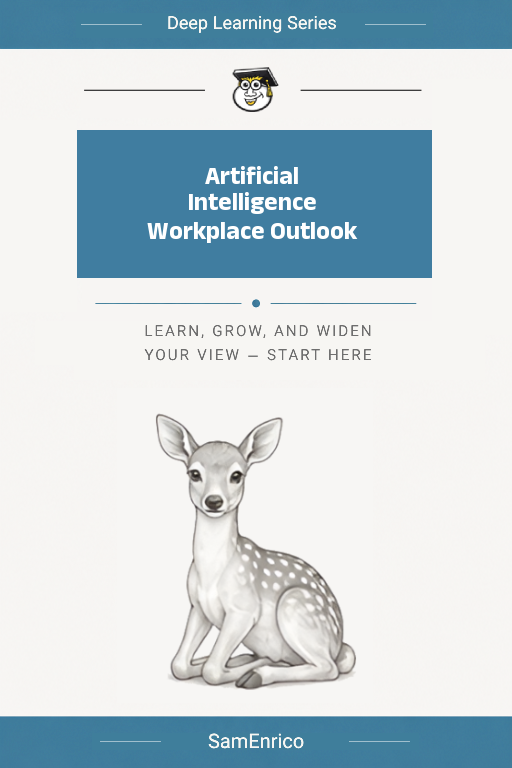
Non-FictionForecast & OutlookFuture of Work
Artificial Intelligence Workplace Outlook Audiobook
Forecast software integration, employee training n
by Spivey Lita
Forecast software integration, employee training needs, productivity gains, and the evolution of job roles across white collar functions.
Formats
Free sample
Chapter 1: The Prediction Paradox--–- In 2019, a prominent economist stood on a TED stage and declared that by 2025, forty percent of white-collar jobs would be permanently eliminated by artificial intelligence. The audience applauded nervously. In 2021, a different expert published a bestseller arguing that AI would create a four-day workweek for everyone, ushering in an era of creative leisure. That book sold millions. In 2023, a third voice emerged, warning that generative AI would trigger the single largest transfer of wealth from labor to capital in human history.
Each prediction felt plausible. Each prediction was wrong.Not because AI failed to deliver. It delivered spectacularly. But because the people making predictions misunderstood something fundamental about how technology actually transforms work. They treated jobs as static bundles of tasks that would either survive automation or be eliminated entirely.
They drew neat lines on timelines and announced winners and losers with the confidence of sports commentators predicting game outcomes. And they missed the messy, iterative, human-driven reality of how organizations actually change.This book is not another prediction. It is a framework for navigating a reality that no single forecast can capture. The Artificial Intelligence Workplace Outlook is not a destination you arrive at. It is a discipline you practice every day as software integrates deeper, as training becomes hyper-personalized, as productivity metrics shift from hours to outcomes, and as every white-collar job description gets rewritten from first principles.But before we get to the frameworks, the taxonomies, and the ninety-day action plans, we need to confront the single biggest obstacle to clear thinking about AI at work.
That obstacle is not technology. It is not cost. It is not even fear. It is the prediction paradox itself.The Prediction Paradox Defined The prediction paradox is a simple but powerful observation: the more specific a forecast about AI and jobs, the more likely it is to be wrong. The more general it is, the less useful it becomes.
This paradox exists because AI adoption does not follow a predictable S-curve across industries, companies, or roles. It spreads like a contagion through a population with wildly different immunity levels.Consider two accounting firms of identical size, both serving mid-market clients, both using the same off-the-shelf AI tools. Firm A fires thirty percent of its bookkeepers within six months, believing it has automated their tasks completely. Chaos follows. Clients receive misclassified expenses.
Auditors find unreconciled discrepancies. The remaining bookkeepers, now overwhelmed by exception handling they were never trained for, quit within another…
This is the end of the free sample. Get the Audiobook to keep going. Buy now
About this book
Details
- Author
- Spivey Lita
- Publisher
- SamEnrico
- Language
- English
- Genre
- Non-Fiction, Forecast & Outlook, Future of Work
- Released
- 2026-05-30
- Pages (approx.)
- 139
- Available as
- eBook, Audiobook

Listen in the VoxFlicks app
Audiobooks and audio dramas wherever you go. Sign in with your SamEnrico account and press play.
More by Spivey Lita
 Teen Menstrual Health PrimerSpivey Lita$11.99
 Iranian Revolution KurdsSpivey Lita$11.99
 Combat Veteran Dream ProcessingSpivey Lita$11.99
 GAD Therapy Termination GuideSpivey Lita$11.99
 Lucid Dreaming Trauma Work GuideSpivey Lita$11.99
 The Hollow Men: Unraveling the Enigma of the Axeman of New OrleansSpivey Lita$11.99
 The Ghost in the Machine: How a Teen Hacker Exposed a Global CyberwarSpivey Lita$11.99
 Aquatic EcotoxicologistSpivey Lita$11.99
 Understanding HarpaxophobiaSpivey Lita$17.99
 Meta Remote Internship Application PrimerSpivey Lita$12.99
 How to Start a Hobby in PaintballSpivey Lita$11.99
You may also like
 Hong Kong Handover 1997Dunn Johnnie$11.99
 Zumba For Postnatal Recovery CourseNeal Christian$11.99
 Zumba for BeginnersLadner Nikia$11.99
 YouTube Comment Mining GuideHumes Pandora$12.99
 Worry Box MeditationCarlin Rudy$11.99
 Workplace Stress MeditationNguyen Lynn$11.99
 Workplace Stress and Sleep RepairHawley Ivory$11.99
 Workplace Perfectionism CureDelaney Jeffry$11.99
 Workplace Injustice Anger GuideWallen Isabelle$11.99
 Work Addiction and Burnout LinkGreenwood Ester$11.99
 Women in Yoga and WellnessBeattie Galina$11.99
 Women in Stand Up ComedyChun Evangeline$11.99