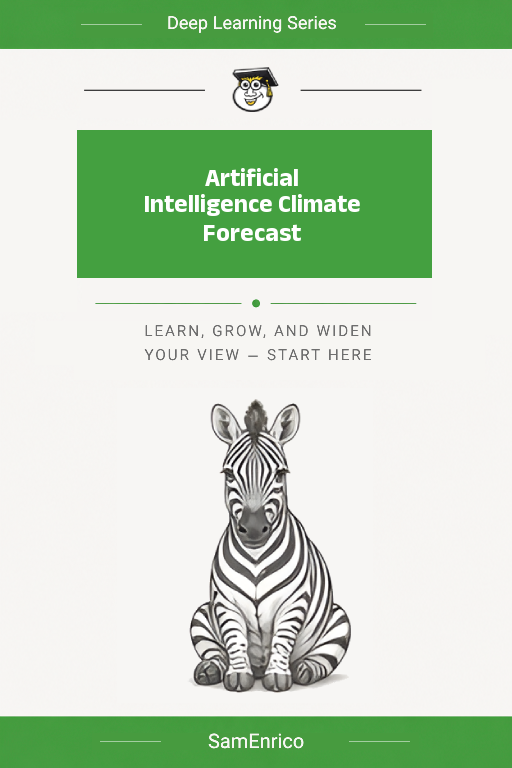
Artificial Intelligence Climate Forecast Audiobook
Project AI applications for climate modeling, carb
Project AI applications for climate modeling, carbon capture optimization, grid management, and extreme weather prediction through the decade.
Formats
Free sample
Chapter 1: The Calculation Engine--The summer of 2028 broke everything.In July of that year, the state of California experienced something its grid operators had feared for two decades but never actually witnessed: a complete, cascading blackout that lasted forty-seven hours. It did not begin with a cyberattack, a wildfire, or a heatwave that exceeded all forecasts. It began with a cloud.A single, unremarkable cumulus cloud, approximately eleven kilometers wide, drifted over the Blythe solar complex at 2:17 PM on July fourteenth. The Blythe complex, a 485-megawatt facility that had cost 1.2 billion dollars to build, was at that moment supplying nine percent of the state's electricity. The cloud reduced its output from 412 megawatts to 89 megawatts in seventy-three seconds.
Grid operators, relying on a numerical weather prediction model that had been run at 4:00 AM that morning, had no warning. Their screens showed green—stable—until they did not. Within eleven minutes, the frequency on the California Independent System Operator grid dropped below 59.5 Hertz. Automated systems began shedding load: first industrial customers, then hospitals, then, finally, half a million residential customers in the Central Valley.The temperature in Fresno that day was 107 degrees Fahrenheit. Forty-seven people died.The official investigation later revealed that the cloud had been visible in satellite imagery at 2:05 PM.
An intern had noticed it but did not escalate because, as she later testified, "I didn't think a single cloud could take down the grid." The numerical weather prediction model used by CAISO had a spatial resolution of seventy-five kilometers. The cloud was eleven kilometers wide. The model literally could not see it. This was not a failure of human attention. It was a failure of physics simulation at scale.This book argues that the California blackout of 2028—and thousands of similar events that will occur over the coming decade—cannot be solved by building more solar farms, more batteries, or more transmission lines alone.
Those are necessary but insufficient. The bottleneck is computational. We are trying to manage the most complex nonlinear system on Earth—the global climate—with tools designed for the age of mainframe computers. Traditional General Circulation Models, Numerical Weather Prediction, and physics-based simulations are noble achievements of human ingenuity. They are also, for the purpose of real-time planetary management, catastrophically slow.The Last Actionable Decade The decade from 2025 to 2035 is the last actionable window for climate mitigation.
This is not a rhetorical device or an emotional plea. It is a physical constraint. Atmospheric carbon dioxide concentrations are…
This is the end of the free sample. Get the Audiobook to keep going. Buy now
About this book
Details
- Author
- Petit Felicita
- Publisher
- SamEnrico
- Language
- English
- Genre
- Non-Fiction, Forecast & Outlook, Climate Tech
- Released
- 2026-05-30
- Pages (approx.)
- 155
- Available as
- eBook, Audiobook

Listen in the VoxFlicks app
Audiobooks and audio dramas wherever you go. Sign in with your SamEnrico account and press play.
More by Petit Felicita
 The Body Scan MBSR PracticePetit Felicita$11.99
 Ayatollah Khomeini Fatwa PowerPetit Felicita$11.99
 The Relaxation Response InductionPetit Felicita$11.99
 GAD News Consumption GuidePetit Felicita$11.99
 Eisenhower for Financial PrioritiesPetit Felicita$11.99
 The OxyContin Tapes: How Purdue Pharma's Secret Recordings Exposed the Opioid CrisisPetit Felicita$11.99
 Eshu's Crossroads: The Trickster's Jazz SymphonyPetit Felicita$11.99
 Understanding Hallucinogen Persisting Perception DisorderPetit Felicita$17.99
 Zero Tuition German University GuidePetit Felicita$12.99
 Writing SongsPetit Felicita$11.99