
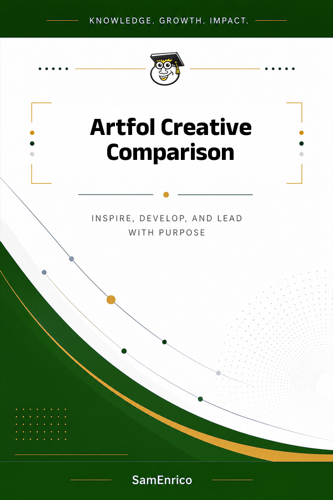
Artfol Creative Comparison eBook
Reduces artistic jealousy in art-focused platform.
Reduces artistic jealousy in art-focused platform.
Formats
Free sample
Chapter 1: The Jealousy Lie--–- Every artist I have ever interviewed—hundreds of them, from fresh-faced beginners to veterans with museum retrospectives—has confessed the same secret in almost the exact same words. "I know I shouldn't feel this way," they whisper, leaning closer, as if the platform itself might be listening. "But when I see their work, I feel sick. What's wrong with me?"Nothing is wrong with you. That is the central argument of this book, and it is an argument I will defend across the next twelve chapters.
Your jealousy is not a character flaw. It is not evidence of a small soul or a fragile ego. It is not something to be ashamed of, hidden from your peers, or meditated away with wishful thinking. Your jealousy is data. It is a signal.
It is a rational response to an environment that was designed—sometimes deliberately, sometimes accidentally—to manufacture that exact feeling in your chest.The lie that this chapter dismantles is the lie of personal failure. The lie that says: "If you were a better person, a more secure artist, a more enlightened creative, you wouldn't feel jealous." This lie is pervasive. It is repeated in artist forums, in wellness content, in the comments sections of popular art advice columns. It is whispered by well-meaning friends who tell you to "just focus on your own journey." It is screamed by the algorithm every time it shows you a nineteen-year-old with half your experience and ten thousand times your engagement.The lie is comfortable for platforms. It is comfortable for the art world.
It is comfortable for everyone except you. Because if jealousy is a personal failure, then the solution is also personal: fix yourself. Be better. Try harder. Meditate more.
The platforms do not need to change. The algorithms do not need to be interrogated. The structural conditions that produce jealousy can remain invisible, and you will continue to scroll and seethe and blame yourself.This chapter is the antidote to that lie. It will reframe jealousy not as poison but as a diagnostic tool. It will show you how to read your envy like a map, how to distinguish between useful signals and noise, and how to stop wasting energy on shame that belongs to your environment, not your soul.
By the end of this chapter, you will never again ask "What's wrong with me?" when jealousy strikes. You will ask a much more useful question: "What is this feeling telling me about what I actually want?"The answer to that question will change everything.The Anatomy of Algorithmic Envy Let us begin with a thought experiment. Imagine you are in a room with nine other artists. The room is well-lit. There is a table in the center covered in art supplies.
Each artist has been given the same prompt and the same amount of time. At the end of the hour, you all lay your work on the table and look at each other's pieces.Does jealousy emerge? Possibly. Some artists will have executed the prompt more effectively than others. Some will have taken creative risks that paid off.
Some will have failed interestingly. But here is what is crucial: the jealousy you might feel in this room is finite, contextual, and tethered to something real. You can see the other artists' hands. You watched them mix the same paints you mixed. You know how much time they had.
The comparison, while potentially painful, is grounded in shared reality.Now imagine a different room. This room has no walls. It extends infinitely in every direction. There are millions of artists in this room, not ten. They did not all start at the same time.
They did not all have the same supplies. Some have been practicing for decades; some have been drawing for three weeks and accidentally discovered a shortcut you spent years missing. You cannot see their hands. You cannot see their process. You only see their finished work, polished and filtered and presented in the best possible light, floating past you on an endless conveyor belt.This second room is your feed.
Every artist who has ever lived, plus every artist who is currently alive, plus every artist who will be born tomorrow, is potentially visible to you at any moment. The comparison set is not nine peers in a well-lit studio. It is infinity.This is the first structural truth about artistic jealousy in the age of social media: the comparison set has expanded beyond the capacity of the human psyche to process. Our brains evolved to compare ourselves to perhaps a few hundred people in our immediate tribe or village. We did not evolve to compare ourselves to every talented human on the planet simultaneously.
When you feel overwhelmed by jealousy, you are not weak. You are human. Your brain is doing exactly what it was designed to do—it just was not designed for this.The second structural truth is about attention economics. Platforms like Artfol, Instagram, and Tik Tok are not neutral galleries. They are businesses.
Their revenue depends on keeping you on the platform for as long as possible. And nothing keeps you scrolling like the intermittent possibility of seeing someone less talented than you fail—or someone more talented than you succeed. Both outcomes trigger emotional responses. Both responses keep your thumb moving.Psychologists call this "variable rewards." The same mechanism that makes slot machines addictive makes your feed addictive. You never know whether the next piece will make you feel inspired, indifferent, or crushed.
That uncertainty is the hook. The platform does not care which emotion you feel, as long as you feel something strongly enough to keep scrolling.This is not a conspiracy theory. It is not even controversial. The designers of these platforms have spoken openly about optimizing for "engagement," and engagement is not evenly distributed across emotional states. Calm contentment is low engagement.
Jealousy, outrage, anxiety, and aspiration are high engagement. The platform is not trying to make you miserable. It is simply indifferent to your misery as long as you keep scrolling.The third structural truth is about visibility and the zero-sum game. On traditional social media platforms—Instagram, Tik Tok, Twitter—the algorithm favors recency and popularity. A piece that gets early engagement is shown to more people, which generates more engagement, which generates more visibility.
This is a winner-take-most system. For one artist to be seen, others must be unseen. The total amount of attention is finite. Every like your piece receives is a like that someone else's piece did not receive. This is not a conspiracy; it is mathematics.Artfol's chronological feed attempts to solve this problem.
By showing work in the order it was posted, rather than in the order of popularity, Artfol reduces the winner-take-most dynamic. Your work is not buried because someone else's work got more likes. It vanishes only because time passes and newer work appears. This is an improvement. It is a meaningful improvement.
But it is not a complete solution.The chronological feed replaces one anxiety with another. When the algorithm is popularity-based, you obsess over likes. When the feed is time-based…
This is the end of the free sample. Get the eBook to keep going. Buy now
About this book
Details
- Author
- Mackenzie Hermelinda
- Publisher
- SamEnrico
- Language
- English
- Genre
- Non-Fiction, Self-Help
- Released
- 2026-06-06
- Pages (approx.)
- 137
- Available as
- eBook, Audiobook

Read better in the ZLOADR app
Your eBooks on your phone or tablet. Sign in with your SamEnrico account and start reading.
More by Mackenzie Hermelinda
 MDD Self Management PlanMackenzie Hermelinda$11.99
 Post Meal Walks GlucoseMackenzie Hermelinda$11.99
 The Medical Research Charity FraudMackenzie Hermelinda$11.99
 The Phantom Broadcast: The 1938 War of the Worlds Radio PanicMackenzie Hermelinda$11.99
 How to Become a Potato-chip-processing SupervisorMackenzie Hermelinda$11.99
 Cap Table Due DiligenceMackenzie Hermelinda$12.99
 Cloud Engagement LeadMackenzie Hermelinda$11.99
 Learn to Play the KazooMackenzie Hermelinda$11.99
You may also like
 Hong Kong Handover 1997Dunn Johnnie$11.99
 Zumba For Postnatal Recovery CourseNeal Christian$11.99
 Zumba for BeginnersLadner Nikia$11.99
 YouTube Comment Mining GuideHumes Pandora$12.99
 Worry Box MeditationCarlin Rudy$11.99
 Workplace Stress MeditationNguyen Lynn$11.99
 Workplace Stress and Sleep RepairHawley Ivory$11.99
 Workplace Perfectionism CureDelaney Jeffry$11.99
 Workplace Injustice Anger GuideWallen Isabelle$11.99
 Work Addiction and Burnout LinkGreenwood Ester$11.99
 Women in Yoga and WellnessBeattie Galina$11.99
 Women in Stand Up ComedyChun Evangeline$11.99