
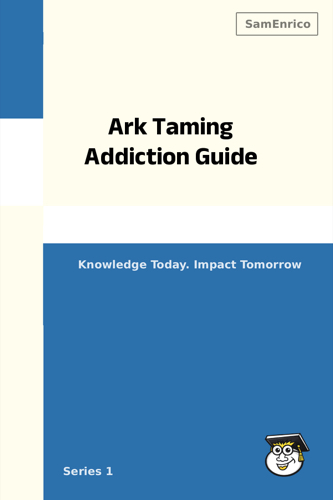
Non-FictionSelf-HelpSurvival Addiction
Ark Taming Addiction Guide eBook
Manages dinosaur taming compulsion and base mainte
by Gooch Amira
Manages dinosaur taming compulsion and base maintenance pressure.
Formats
Free sample
Chapter 1: The Dodo Paradox–- Every ARK player knows the moment. You're flying back to base after a routine metal run. Your argentavis is laden with ore, your stamina is low, and you're mentally planning which crafting project to tackle first. Then you see it. A level 150 Tek Rex standing in a clearing, backlit by the setting sun like a prehistoric god.
Your heart rate doubles. Your hand moves to the tranquilizer darts before your brain has fully processed what's happening. The metal run is abandoned. The next four hours belong to the Rex. And somewhere in the back of your mind, a quiet voice whispers: You already have eight Rexes.
Why do you need a ninth?You silence the voice. This one is different. The colors are better. The stats might roll higher. And besides, you're not addicted.
You're just prepared.This chapter is about why that voice is lying to you – and why the eight Rexes you already own are the key to understanding the most deceptive addiction in gaming.The Diagnosis You Didn't Know You Needed Let me tell you about Dave. Dave is a composite of dozens of players I've interviewed, counseled, and (on one memorable occasion) physically dragged away from a computer at 4 AM. Dave has been playing ARK for three years. He has four thousand hours logged across three servers. He owns seventy-three dinosaurs, including seventeen Rexes, twelve Argies, eight Therizinos, and a partridge in a pear tree that he tamed because "you never know when you might need a backup egg supply."Dave's base is a sprawling metal monstrosity that covers half an island.
He has thirty preserving bins, eighteen refrigerators, and a vault full of Ascendant blueprints he will never craft because he lacks the resources – resources he spends all his time farming instead of crafting. Dave's tribe mates have stopped asking him to go on cave runs. They've stopped asking him to help with boss fights. They've stopped asking him anything because Dave is always, always, always "busy" – feeding troughs, repairing walls, checking on the baby Gigas, or sitting in front of an unconscious dinosaur watching a torpor bar slowly drain.Dave will tell you he's not addicted. He's just dedicated.
He's just thorough. He's just prepared for anything the Ark might throw at him.Dave is wrong. And if you're reading this book, there's a good chance you're wrong too.The problem with ARK is that it hides its addictive mechanics behind a veneer of legitimate gameplay. When a slot machine addict pulls the lever, they know they're gambling. When a social media addict scrolls their feed, they know they're wasting time.
But when an ARK player spends six hours farming metal, they feel productive. They built something. They achieved something. They can point to the metal base and say, "Look what I made."This is the trap. ARK is the only addiction that comes with a progress bar.The Three Profiles of Problematic Play Before we go any further, I need you to understand something critical: not all ARK players are addicted, and not all problematic play looks the same.
In the chapters that follow, we're going to explore three distinct psychological mechanisms that drive compulsive ARK behavior. But first, you need to know which profile fits you.Take a moment to answer these seven questions honestly. This is an adaptation of the Bergen Gaming Addiction Scale, validated for behavioral addictions and modified for ARK's specific mechanics.For each question, answer on a scale of 1 (Never) to 5 (Very Often):Do you spend more time thinking about ARK (your base, your tames, your next project) than you do engaged with real-world activities?Do you feel an urge to log in and check on your base or tames when you're away from the game – even for short periods?Do you find yourself neglecting sleep, meals, or social obligations to finish a tame, complete a breeding cycle, or defend against a potential raid?Have friends or family members expressed concern about the amount of time you spend on ARK?Do you feel irritable, anxious, or restless when you're unable to log in for a day or more?Have you tried to reduce your ARK time but found yourself logging back in within a week?Do you continue playing ARK even when it has caused problems in your relationships, work, or physical health?Scoring: If you answered 4 or 5 to three or more questions, you are experiencing problematic ARK play that warrants attention. But the type of attention depends on why you play.This is where the three profiles come in.The Collector (Low Risk)The Collector plays ARK for mastery and exploration. They tame dinosaurs strategically, maintain a lean base, and stop playing when they're bored or tired.
A Collector might have one Rex for boss fights, two Argies for metal runs, and a handful of utility tames. They can go a week without logging in without feeling anxious. When they play, they're having fun. When they stop, they don't think about ARK until the next session.The Collector does not need this book to change their behavior. They might find the strategies useful for optimization, but they are not addicted.
If this is you, skip ahead to Chapter 12 for the "maintenance mode" content. The rest of the book will be educational but not urgent.The Hoarder (Moderate Risk)The Hoarder plays ARK to possess. Their base is overflowing with dinosaurs they never use, resources that will spoil before they're consumed, and blueprints for items they lack the skills to craft. The Hoarder's compulsion is driven by anxiety about future scarcity. They tame the 150 Tek Rex not because they need it, but because they're afraid of not having it.
What if a better Rex spawns and they can't compare stats? What if their current Rexes die in a raid and they have no backup? What if, what if, what if.The Hoarder's cryofridge is a museum of "just in case" – and the anxiety is never satisfied because there is always another "just in case" around the corner.If this sounds like you, focus on Chapters 5 and 11. Your path to recovery involves exposure therapy: proving to yourself that nothing bad happens when you delete half your dinosaurs and let the meat spoil.The Slave (High Risk)The Slave plays ARK out of obligation. They don't log in because they want to – they log in because they have to.
The base will decay. The troughs will empty. The baby Gigas will starve. The Slave has invested hundreds of hours into their base and feels trapped by the sunk cost fallacy: I can't quit now. I've put too much into this.The Slave experiences withdrawal when away from the game – not because they miss playing, but because they're anxious about what's happening in their absence.
They check the tribe log at work. They wake up at 3 AM to imprint on a Wyvern. They negotiate with partners, bosses, and their own bodies for "just five more minutes" that turn into five more hours.If this is you, focus on Chapters 3, 7, and 8. Your path to recovery involves breaking the obligation loop and learning that the…
This is the end of the free sample. Get the eBook to keep going. Buy now
About this book
Details
- Author
- Gooch Amira
- Publisher
- SamEnrico
- Language
- English
- Genre
- Non-Fiction, Self-Help, Survival Addiction
- Released
- 2026-06-07
- Pages (approx.)
- 124
- Available as
- eBook, Audiobook

Read better in the ZLOADR app
Your eBooks on your phone or tablet. Sign in with your SamEnrico account and start reading.
More by Gooch Amira
 Chazelle Rhythm and EditingGooch Amira$11.99
 Parent Networking StrategiesGooch Amira$11.99
 Grandparent Caregiver Self CareGooch Amira$11.99
 Self Worth After Retirement WorkbookGooch Amira$11.99
 Blood and Veldt: The Boer Wars' Forgotten GuerrillasGooch Amira$11.99
 Understanding Mental Retardation Epilepsy Bulbous NoseGooch Amira$17.99
 Ultimate Handbook Guide to Xingning : (China) Travel GuideGooch Amira$11.99
 Peer Benchmarking Promotion GuideGooch Amira$12.99
 World Bank Treasury Careers GuideGooch Amira$12.99
 Seafood HACCP CoordinatorGooch Amira$11.99
You may also like
 Hong Kong Handover 1997Dunn Johnnie$11.99
 Zumba For Postnatal Recovery CourseNeal Christian$11.99
 Zumba for BeginnersLadner Nikia$11.99
 YouTube Comment Mining GuideHumes Pandora$12.99
 Worry Box MeditationCarlin Rudy$11.99
 Workplace Stress MeditationNguyen Lynn$11.99
 Workplace Stress and Sleep RepairHawley Ivory$11.99
 Workplace Perfectionism CureDelaney Jeffry$11.99
 Workplace Injustice Anger GuideWallen Isabelle$11.99
 Work Addiction and Burnout LinkGreenwood Ester$11.99
 Women in Yoga and WellnessBeattie Galina$11.99
 Women in Stand Up ComedyChun Evangeline$11.99