
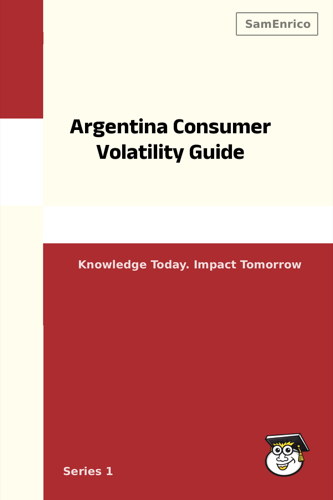
Non-FictionForecast & OutlookArgentina
Argentina Consumer Volatility Guide eBook
Navigate hyperinflation and currency controls impa
by Taylor Jon
Navigate hyperinflation and currency controls impacting household spending in the Southern Cone.
Formats
Free sample
Chapter 1: The Green Calling...–- The first lie the financial system tells you is that saving pesos is prudent. The second lie is that you are paranoid for distrusting your own currency. In Argentina, paranoia is not a mental illness. It is a survival skill passed down through generations like a family recipe for locro—equal parts memory, trauma, and bitter practicality.You learn it before you learn to read. The shuffle of abuelo’s slippers to the bedroom closet.
The creak of the loose floorboard. The soft crinkle of hundred-dollar bills wrapped in aluminum foil, hidden inside a worn leather shoe. You are told never to speak of it. Never to count it in front of strangers. Never to deposit it in a bank because el corralito taught everyone that the bank is not a vault—it is a casino where you are the only one who loses.This is the vocación verde.
The green calling. The instinctive, almost allergic reaction to convert every Argentine peso that touches your hand into United States dollars as quickly as humanly possible. Tourists and foreign economists call it irrational. They write papers about "dollarization preferences" and "currency substitution behaviors" as if Argentines are a peculiar species of economic lemming. They are wrong.You are not irrational.
You are not paranoid. You are a survivor of a system that has systematically destroyed the purchasing power of your currency approximately fourteen times since 1945. The peso you earned last month is worth less today. The salary you negotiated in December is a joke by March. And the savings account your grandmother urged you to open has, over the course of Argentine history, been the single fastest way to turn a middle-class inheritance into bus fare.This chapter is not a history lesson.
It is a diagnosis of the psychological and behavioral framework you must understand before any tactical advice—buying dollars, stockpiling rice, negotiating in installments—will make sense. Because if you do not understand why you reach for the dollar, you will misuse it. You will hoard physical cash in a mattress until it is stolen or forgotten. You will refuse to spend when spending would protect you. Or worse, you will believe the financial planners who tell you that "this time is different" and that you should "diversify into pesos" because "the worst is behind us."The worst is never behind us.
The worst is always three to six months away, waiting for an election, an IMF deadline, or a soybean harvest to trigger the next devaluation. Your job is not to predict the future. Your job is to understand your own reflexes so that when the ground shakes—and it will shake—you do not freeze. You move.The Architecture of Mistrust: Why the Peso Failed You Before You Were Born To understand the green calling, you must first understand that you inherited it. It is not a choice you made after reading an economics blog.
It is encoded in the nervous system of every Argentine over the age of thirty, and passed unconsciously to every Argentine under thirty through family stories, whispered warnings, and the visible panic in your mother’s eyes when the news anchor mentions the Central Bank.The modern history of Argentine currency is a graveyard of failed promises. Between 1975 and 1991, the peso underwent three complete transformations. The Peso Ley died. The Peso Argentino died. The Austral died.
Each time, the government chopped zeros off the bills—three zeros, four zeros, thirteen zeros—as if the problem was merely typographical. Each time, they promised that this currency would be different. And each time, the printing presses ran hot, inflation climbed into quadruple digits, and families who had saved for decades discovered that their entire life’s work could not buy a week’s worth of bread.But the wound that still bleeds is the corralito of 2001. That is the event that broke the social contract between Argentines and their banks. In December of that year, the government froze all bank accounts.
You could not withdraw more than 250 pesos per week—roughly $250 at the time, though the peg was about to shatter. Middle-class families who had done everything right—paid their taxes, saved their salaries, trusted the system—suddenly could not access their own money to buy medicine, pay rent, or purchase food.The streets erupted. Cacerolazos—the banging of pots and pans—filled every neighborhood. People died in protests. Five presidents came and went in two weeks.
And when the freeze finally lifted, the government had converted dollar-denominated accounts into pesos at an artificial rate, stealing approximately 40% of the value of every dollar saved. Those who had kept their dollars outside the banking system—in the mattress, the shoe, the hollowed book—emerged intact. Those who had trusted the banks were financially castrated.This is the memory that lives in the bones of every Argentine over forty. And it is the story that every Argentine under forty has heard so many times that it feels like personal experience. The lesson is brutally simple: The banking system is not your friend.
The peso is not a store of value. And the only money you truly own is the money you can touch, hide, and move without asking permission.Ahorrista vs. Reservista: Two Kinds of Savers, Only One Survives Before you can channel your green calling intelligently, you must understand which of two archetypes you embody. Most people believe they are one, only to discover in a crisis that they are the other. The distinction is the difference between eating well during hyperinflation and eating beans from a can while your neighbors feast on asado.The Ahorrista (The Saver)The ahorrista believes in growth.
She puts money in a plazo fijo (fixed-term deposit) because the bank offers 6% monthly interest. She buys government bonds because the Minister of Economy promised they are "risk-free." She diversifies into mutual funds and follows the advice of financial advisors who wear expensive suits and speak in calm, reasonable tones about "market corrections."The ahorrista is a creature of stable economies. She believes that saving is a virtue because she has never lived through a currency collapse. In Argentina, the ahorrista is an endangered species—not because she is foolish, but because she is trusting. And trust, in the Argentine financial system, is a fatal vulnerability.Consider the case of the plazo fijo during the 2018–2020 crisis.
Banks offered 40% annual interest. Inflation ran at 50%. The ahorrista calculated that she was beating inflation by 10 points. But inflation was not 50% for her personal basket of goods—it was 70% for food, 80% for medicine, 100% for rent. The bank’s interest rate was a lie wrapped in a statistic.
She lost purchasing power every single month while believing she was winning.The Reservista (The Reserver)The reservista does not seek growth. He seeks non-loss. His goal is not to get rich. His goal is to wake up tomorrow with the same ability to buy bread, pay rent, and afford his blood pressure medication as he had today. The reservista looks at a 40% interest rate and asks: "What is inflation really?" He looks at government bonds and asks: "Will the government exist to…
This is the end of the free sample. Get the eBook to keep going. Buy now
About this book
Details
- Author
- Taylor Jon
- Publisher
- SamEnrico
- Language
- English
- Genre
- Non-Fiction, Forecast & Outlook, Argentina
- Released
- 2026-06-06
- Pages (approx.)
- 157
- Available as
- eBook, Audiobook

Read better in the ZLOADR app
Your eBooks on your phone or tablet. Sign in with your SamEnrico account and start reading.
More by Taylor Jon
 Affirmations For Forgiveness CourseTaylor Jon$11.99
 Estate Planning with Qualified PlansTaylor Jon$11.99
 DBT for Anger Management GuideTaylor Jon$11.99
 The Last Song of the AurochsTaylor Jon$11.99
 Understanding Pancreatic Beta Cell Agenesis With Neonatal Diabetes MellitusTaylor Jon$17.99
 Facebook Ads Holiday Calendar GuideTaylor Jon$12.99
 Brian Chesky GuideTaylor Jon$12.99
 Covellite MiningTaylor Jon$11.99
 How to Start a Visitors Bureaus BusinessTaylor Jon$11.99
You may also like
 Hong Kong Handover 1997Dunn Johnnie$11.99
 Zumba For Postnatal Recovery CourseNeal Christian$11.99
 Zumba for BeginnersLadner Nikia$11.99
 YouTube Comment Mining GuideHumes Pandora$12.99
 Worry Box MeditationCarlin Rudy$11.99
 Workplace Stress MeditationNguyen Lynn$11.99
 Workplace Stress and Sleep RepairHawley Ivory$11.99
 Workplace Perfectionism CureDelaney Jeffry$11.99
 Workplace Injustice Anger GuideWallen Isabelle$11.99
 Work Addiction and Burnout LinkGreenwood Ester$11.99
 Women in Yoga and WellnessBeattie Galina$11.99
 Women in Stand Up ComedyChun Evangeline$11.99