
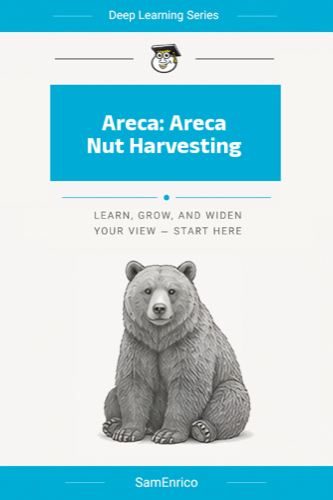
Non-FictionInformativeEducational
Areca: Areca Nut Harvesting
This harvesting publication, published by SamEnric
This harvesting publication, published by SamEnrico, covers Areca: Areca Nut Harvesting
Formats
About this book
Free sample
Chapter 1: The Living Engine--–- The first thing you notice about an areca palm, standing alone at the edge of a Karnataka plantation as the morning fog burns off, is how unremarkable it appears. A slender grey trunk, ringed with leaf scars like stacked bracelets. A crown of six to eight arching fronds, each dripping condensation onto the red laterite soil. No branches. No dramatic silhouette.
Just a vertical column of vascular tissue ending in a burst of green. And yet, inside that unassuming column flows one of the most efficient nutrient transport systems ever evolved – a system that, if you understand it, will tell you precisely when to harvest, how much to expect, and why some palms make you rich while others break your heart.This is the living engine of your livelihood. The areca palm (Areca catechu L.) is not a tree in the botanical sense – it is a monocotyledonous perennial, more closely related to grasses and lilies than to timber trees. That distinction matters enormously for harvesting. Unlike a banyan or teak, the areca palm has no secondary growth (no annual rings, no widening trunk).
It grows upward from a single apical meristem hidden deep in the crown. Damage that meristem – cut it, burn it, let a borer tunnel into it – and the entire palm dies. There is no second chance, no coppicing, no regrowth from the base. This vulnerability shapes every decision you make, from the angle of your harvest pole to the timing of your pruning.But the real story lies beneath the visible trunk. The areca palm's root system is a fibrous mat extending radially up to five meters from the base, but staying remarkably shallow – most roots live in the top 30 centimeters of soil.
This shallow feeding zone means the palm is exquisitely sensitive to soil moisture, nutrient concentration, and compaction. Walk too heavily on wet soil around the base, and you crush the feeder roots. Let the ground dry out for two weeks during fruit set, and you will harvest empty nuts six months later. The palm remembers everything you do to…
This is the end of the free sample. Get the eBook to keep going. Buy now
Contents
- Chapter 1
- Chapter 2
- Chapter 3
- Chapter 4
- Chapter 5
- Chapter 6
- Chapter 7
- Chapter 8
- Chapter 9
- Chapter 10
- Chapter 11
- Chapter 12
Details
- Author
- Spears Chance
- Publisher
- SamEnrico
- Language
- English
- Genre
- Non-Fiction, Informative, Educational
- Released
- 2026-05-18
- Pages (approx.)
- 154
- Available as
- eBook, Audiobook

Read better in the ZLOADR app
Your eBooks on your phone or tablet. Sign in with your SamEnrico account and start reading.
More by Spears Chance
 Letterboxd Film Comparison GuideSpears Chance$11.99
 Time Blocking for Real EstateSpears Chance$11.99
 Dolly Parton Coat of ColorsSpears Chance$11.99
 Email Smart Folder AutomationSpears Chance$11.99
 Scripting for IBS ReliefSpears Chance$11.99
 Congressional Staff Turnover CrisisSpears Chance$11.99
 Biological Prime Time TrackingSpears Chance$11.99
 Return to School After LayoffSpears Chance$11.99
 Mozart’s Divine Fire: The Genius Who Lit Up the EnlightenmentSpears Chance$11.99
 Blood and Blossoms: The Fall of the Taira Clan (1185 AD)Spears Chance$11.99
 How to Produce Dog DiapersSpears Chance$11.99
 US Virtual Account for Africans BlueprintSpears Chance$12.99
You may also like
 Hong Kong Handover 1997Dunn Johnnie$11.99
 Zumba For Postnatal Recovery CourseNeal Christian$11.99
 Zumba for BeginnersLadner Nikia$11.99
 YouTube Comment Mining GuideHumes Pandora$12.99
 Worry Box MeditationCarlin Rudy$11.99
 Workplace Stress MeditationNguyen Lynn$11.99
 Workplace Stress and Sleep RepairHawley Ivory$11.99
 Workplace Perfectionism CureDelaney Jeffry$11.99
 Workplace Injustice Anger GuideWallen Isabelle$11.99
 Work Addiction and Burnout LinkGreenwood Ester$11.99
 Women in Yoga and WellnessBeattie Galina$11.99
 Women in Stand Up ComedyChun Evangeline$11.99