
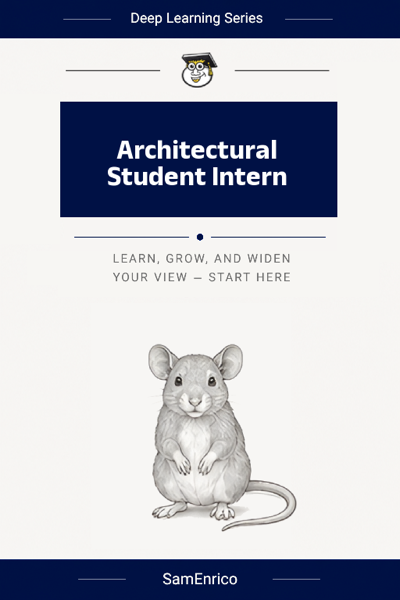
Non-FictionInformativeEducational
Architectural Student Intern eBook
A Coursebook on Architectural Student Intern
A Coursebook on Architectural Student Intern
Formats
Free sample
Chapter 1: The Studio Lie...--Every architecture student remembers the moment they realized studio was a fantasy. For some, it happens while standing in the rain on a construction site, watching a foreman scream into a phone about a steel shipment that arrived three inches too short. For others, it happens at a desk at 11 PM, staring at a redline that says “DOOR SWINGS WRONG” in capital letters, followed by three question marks and a sketch that looks like a chicken stepped in ink. For the lucky ones, it happens gently: a senior associate pulls them aside and says, “I know you learned it differently in school. Forget that now.
Here’s how we actually do it.”This chapter is for all of them. And for you.The primary shock of internship is not technical incompetence. You will not fail because you cannot use Revit or because your line weights are off. Those things can be taught in an afternoon. The primary shock is conceptual.
It is the collision between the abstract, idealized, controlled universe of architecture school and the messy, contingent, deeply frustrating reality of the construction industry. In studio, you were god. You decided where the sun hit, what materials cost, and whether the building code even existed. In an office, you are a small, replaceable part of a very large machine. The sun does what it wants.
Materials arrive late and damaged. The building code is not optional, and it is also not fair.This chapter is called “The Studio Lie” not because architecture school is useless. It is not. You learned to think spatially, to compose volumes, to understand light and material and precedent. Those are genuine skills.
But you also learned something else, something unspoken: that architecture is a solitary act of genius, that the rendering is the product, that the critic is the enemy, and that beauty justifies any means. Those are the lies. And they will hurt you if you carry them into your first internship.This chapter serves as the complete psychological and philosophical bridge for the student leaving the studio. By the time you finish reading, you will understand why you feel stupid (and why that feeling is actually a sign of intelligence), how to reframe your entire understanding of architectural work, and what the next twelve weeks or six months will actually demand from you. No subsequent chapter will re-litigate this gap.
It is assumed knowledge from here forward.Let us begin with the anatomy of a humiliation.The First Week: A Confession Every intern feels stupid in the first week. Not the gentle, academic stupidity of not knowing an architect’s name or forgetting the difference between Postmodernism and Deconstructivism. A deeper, more existential stupidity. The kind where you are asked to move a door six inches on a plan, and you spend forty-five minutes doing it, and when you present your work, the project manager stares at you and says, “Why did you move the entire corridor?”You did not know you moved the corridor. You did not know corridors could move.
You did not know that a door had relationships to walls, to fire egress, to the swing clearance, to the door schedule, to the hardware set, to the reflected ceiling plan above it. In studio, you would have dragged that door anywhere and called it “dynamic circulation.” In an office, you have just created a cascade of changes that will take someone else three hours to fix.Here is the confession, written by someone who has been there: I spent my first week as an intern moving furniture blocks in a plan for a law office. Not designing. Not detailing. Not even drawing.
Clicking and dragging. And I was terrible at it. I placed a conference table so that it blocked the fire exit. I rotated a desk so that the person sitting at it would stare directly into a column. I saved over the wrong file and had to ask the IT guy if “previous versions” was real or a lie.
He laughed at me. Not cruelly. Just the laugh of someone who has seen this happen forty-seven times before.That laugh was a gift. Because it told me something important: my humiliation was not unique. It was expected.
It was part of the process.You will be humiliated in your first week. Not because you are stupid. Because you have been trained in a different language, and offices speak another one. Studio speaks the language of intention, concept, and representation. Offices speak the language of coordination, liability, and sequencing.
They are related, like Italian and Spanish. But you cannot walk into a Barcelona construction site speaking classroom Italian and expect to be understood.The Dunning-Kruger Effect for Architects There is a well-documented cognitive bias called the Dunning-Kruger effect. In simple terms: novices overestimate their ability because they do not yet know what they do not know. Experts underestimate their ability because they are acutely aware of the gaps in their knowledge.Architecture school is a Dunning-Kruger machine. It rewards confidence, presentation, and the appearance of resolution.
A student who renders a beautiful section with confident line weights and a convincing material palette gets an A, even if the wall assembly would condense, collapse, or cost more than the GDP of a small country. The student does not know they have made an unbuildable drawing. The professor, who does know, often chooses not to say so because the point of the assignment was composition, not constructibility. This is not malice. It is the structure of architectural education.Then the student graduates, or takes an internship, and walks into an office.
Suddenly, the gap between what they thought they knew and what they actually know becomes visible. And it is enormous. This is not failure. This is the moment when the Dunning-Kruger curve bends downward, and real learning begins.Let us name this moment. Call it the Collision.The Collision happens differently for everyone, but it always involves the same realization: “I have no idea what I am doing.” The student who designed a museum of light now cannot figure out how to dimension a door swing.
The student who wrote a thesis on phenomenology now does not know what “R-value” means. The student who won a design competition now prints twenty sheets on the wrong paper size and breaks the plotter.If this is you, or if you are afraid it will be you, here is the truth: you are exactly where you are supposed to be. The Collision is not a sign of incompetence. It is a sign that you have left a simulation and entered reality. The only interns who do not experience the Collision are the ones who never noticed the gap between studio and site in the first place.
And those interns do not become good architects. They become dangerous ones.Pallasmaa and the Body’s Knowledge To understand why the Collision hurts, we need to understand what studio taught you to ignore. And for that, we turn to a book you may have read in theory class: Juhani Pallasmaa’s The Eyes of the Skin.If you read this book as a second-year student, you…
This is the end of the free sample. Get the eBook to keep going. Buy now
About this book
Details
- Author
- Forsythe Lissette
- Publisher
- SamEnrico
- Language
- English
- Genre
- Non-Fiction, Informative, Educational
- Released
- 2026-05-09
- Pages (approx.)
- 144
- Available as
- eBook, Audiobook

Read better in the ZLOADR app
Your eBooks on your phone or tablet. Sign in with your SamEnrico account and start reading.
More by Forsythe Lissette
 Exercise for Stressed CaregiversForsythe Lissette$11.99
 Reading Room Energy GuideForsythe Lissette$11.99
 Blue Light Blocking For Circadian HealthForsythe Lissette$11.99
 Open World Gaming CompulsionForsythe Lissette$11.99
 Psychological First Responder Relapse GuideForsythe Lissette$11.99
 The Bridge Jump SurvivorForsythe Lissette$11.99
 Resentment Toward AbuserForsythe Lissette$11.99
 Bipolar Parent Childhood GuideForsythe Lissette$11.99
 Atomic Bomb Secrecy and EspionageForsythe Lissette$11.99
 The Timbuktu Codebreakers: Cracking the Secrets of the SaharaForsythe Lissette$11.99
 The Silk Road Beneath the Waves: The Lost Ships of the Indian OceanForsythe Lissette$11.99
 Love, Lies, and Las Vegas: The Untold Split of Britney Spears and Jason AlexanderForsythe Lissette$11.99
You may also like
 Hong Kong Handover 1997Dunn Johnnie$11.99
 Zumba For Postnatal Recovery CourseNeal Christian$11.99
 Zumba for BeginnersLadner Nikia$11.99
 YouTube Comment Mining GuideHumes Pandora$12.99
 Worry Box MeditationCarlin Rudy$11.99
 Workplace Stress MeditationNguyen Lynn$11.99
 Workplace Stress and Sleep RepairHawley Ivory$11.99
 Workplace Perfectionism CureDelaney Jeffry$11.99
 Workplace Injustice Anger GuideWallen Isabelle$11.99
 Work Addiction and Burnout LinkGreenwood Ester$11.99
 Women in Yoga and WellnessBeattie Galina$11.99
 Women in Stand Up ComedyChun Evangeline$11.99