
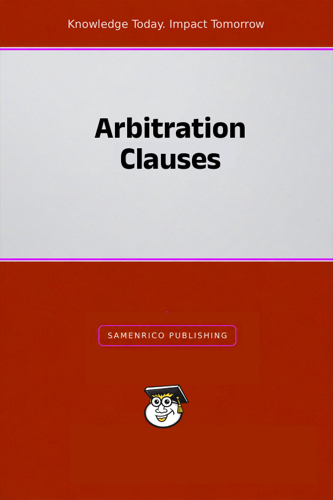
Arbitration Clauses eBook
Alternative dispute resolution terms in venture fi
Alternative dispute resolution terms in venture financing documents.
Formats
Free sample
Chapter 1: The Boilerplate Trap--–- It hides in plain sight. Page twenty-three of the Stock Purchase Agreement. Section 8.7. A block of text in eight-point font that your lawyer says is “standard” and your venture capitalist says “everyone uses.” You have seen it a hundred times. You have signed it a dozen.
You have never read it. Not really.You are not alone. I have watched founders spend six weeks negotiating valuation, four weeks on liquidation preferences, three weeks on board composition, and exactly seven minutes on the arbitration clause. I have watched general counsels at billion-dollar funds approve term sheets with dispute resolution provisions they did not understand. I have watched arbitrators read those clauses aloud in hearings and ask the parties, “What did you think this meant?”The silence is always uncomfortable.This chapter is called The Boilerplate Trap because that is what standard arbitration clauses are: traps disguised as routine paperwork.
They are drafted by someone—usually a law firm’s junior associate working from a ten-year-old form—to protect someone else’s interests. They are designed to be ignored. They are designed to be signed without thought. And when a dispute erupts, they explode in ways no one anticipated.I am going to show you how the trap works. Then I am going to show you how to escape it.
But first, let me tell you about a founder named Priya.The $10 Million Mistake Priya founded a fintech startup in 2019. She raised a $5 million Series A from a respected Sand Hill Road firm. The term sheet was eight pages. The definitive agreements were two hundred. She negotiated the valuation up by $2 million.
She gave up nothing on board control. She felt like a champion.The arbitration clause was on page 187 of the Stock Purchase Agreement. It read, in its entirety:“Any dispute arising under this Agreement shall be resolved by binding arbitration in accordance with the rules of the American Arbitration Association. The arbitration shall take place in San Francisco, California. Judgment upon the award may be entered in any court having jurisdiction thereof.”Priya’s lawyer said it was standard.
The VC’s lawyer said everyone uses it. She signed.Three years later, the startup was thriving. A strategic acquirer offered $200 million. The lead investor blocked the deal, insisting the company was worth $500 million. Priya believed the investor was acting in bad faith—protecting its own illiquidity preferences rather than maximizing shareholder value.
She wanted to sue for breach of fiduciary duty.Her lawyer delivered bad news. The arbitration clause only covered disputes “arising under” the agreement. Breach of fiduciary duty is a tort, not a contract claim. It did not “arise under” the SPA. The clause did not cover it.
She could not compel arbitration for her fiduciary duty claim. She could only sue in court.She sued in Delaware Chancery Court. The investor moved to dismiss, arguing that the dispute was really about the contract—the drag-along provisions, the voting agreement, the liquidation preferences. The court spent eight months deciding whether the claim belonged in arbitration or litigation. During those eight months, the acquirer walked away.
The startup raised a down round at a $40 million valuation. Priya was fired by the board six months later.The arbitration clause did not fail because arbitration is bad. It failed because it was narrow, incomplete, and poorly drafted. Priya fell into the boilerplate trap. This chapter will ensure you do not.The Psychology of Ignoring Boilerplate Before we dissect arbitration clauses, we must understand why smart people sign them without reading them.
The answer is not laziness. It is cognitive psychology.The Illusion of Standardization. When a lawyer says “this is standard,” our brains interpret that as “this is safe.” In reality, standard forms are not safe. They are merely common. Common does not mean fair, balanced, or even enforceable.
It means lazy lawyers copy them from each other.The Complexity Bias. Arbitration clauses are dense. They reference institutional rules, federal statutes, and legal doctrines most founders have never heard of. When faced with complexity, the human brain defaults to trust. “If I don’t understand it, surely an expert has made it correct.” This is a dangerous assumption.The Endowment Effect.
Once you have negotiated valuation and board seats, you feel invested in the deal. You do not want to reopen a “settled” issue. Arbitration clauses seem minor compared to economics and governance. So you let them slide. This is exactly what the other side expects.The Agency Problem.
Your lawyer bills by the hour. Negotiating an arbitration clause takes time. Time costs money. Many lawyers will not volunteer to spend your money on a clause they think is “fine.” Unless you push, they will let it pass.Understanding these psychological traps is the first step to escaping them. The second step is understanding what a well-drafted arbitration clause actually looks like—and what a poorly drafted one leaves exposed.The Anatomy of the Trap Most standard arbitration clauses contain five fatal flaws.
Priya’s clause had four of them. Here is what they are and why they matter.Flaw One: Narrow Scope.Priya’s clause said “arising under.” That is the narrowest possible scope. It covers only claims that literally arise under the specific contract language. It does not cover tort claims (fraud, negligence, fiduciary duty). It does not cover statutory claims (securities fraud, consumer protection).
It does not cover equitable claims (unjust enrichment, constructive trust).A broad clause would say “arising out of or relating to.” That covers everything. Every claim, whether contract, tort, statute, or equity, as long as it relates to the agreement or the relationship it created. Chapter 3 covers scope in exhaustive detail. For now, understand this: narrow scope is a trap.Flaw Two: No Institutional Rules.Priya’s clause said “in accordance with the rules of the American Arbitration Association.” That sounds specific. It is not.
The AAA has multiple rule sets: Commercial Rules, Consumer Rules, Employment Rules, Expedited Procedures, and the Private Investment Dispute Rules. Each has different timelines, different fee structures, and different procedural defaults.A well-drafted clause specifies which rule set applies. Even better, it specifies whether expedited procedures apply and whether the emergency arbitrator provisions are activated. Without these specifications, you are at the mercy of defaults you have never read.Flaw Three: No Arbitrator Qualifications.Priya’s clause said nothing about who the arbitrator would be. Under AAA default rules, the arbitrator is a retired judge or a commercial litigator.
Neither knows anything about venture capital. Neither understands liquidation preferences, anti-dilution protection, or drag-along rights.A well-drafted clause requires the arbitrator to have specific expertise: “ten or more years of experience in venture capital or startup financing.” This single sentence transforms the arbitration from a generic legal proceeding into a specialist determination. Chapter 5 explains why this is the most powerful sentence in your clause.Flaw Four: No Confidentiality.Priya’s clause said nothing about confidentiality. Under AAA default rules, arbitration is private—the public cannot attend hearings. But nothing prevents the parties from disclosing the existence of the dispute, the documents exchanged, or the final award.
If a VC wants to publicize an award to deter future founders, nothing in the default rules stops them.A well-drafted…
This is the end of the free sample. Get the eBook to keep going. Buy now
About this book
Details
- Author
- Durden Demetria
- Publisher
- SamEnrico
- Language
- English
- Genre
- Non-Fiction, Capital & Valuation Register, Arbitration
- Released
- 2026-06-07
- Pages (approx.)
- 153
- Available as
- eBook, Audiobook

Read better in the ZLOADR app
Your eBooks on your phone or tablet. Sign in with your SamEnrico account and start reading.
More by Durden Demetria
 Strength Training With ArthritisDurden Demetria$11.99
 Hypnotic Dream Incubation ScriptsDurden Demetria$11.99
 Sunrise Balloon FlightDurden Demetria$11.99
 Micronutrients For Immunity GuideDurden Demetria$11.99
 The Clinical Psychologist StressDurden Demetria$11.99
 Pelvic Floor for RunnersDurden Demetria$11.99
 Time Blocking For Job SearchDurden Demetria$11.99
 Jokes Saved My LifeDurden Demetria$11.99
 The Troll King’s Gambit: A Nordic Spy’s Deadly GameDurden Demetria$11.99
 The Raven’s Omen: A Slavic Knight’s Quest in Arthur’s ShadowDurden Demetria$11.99
 Zero to Billion: The Untold Story of the Mysterious Bitcoin CreatorDurden Demetria$11.99
 How to Become a ImmunohematologistDurden Demetria$11.99