
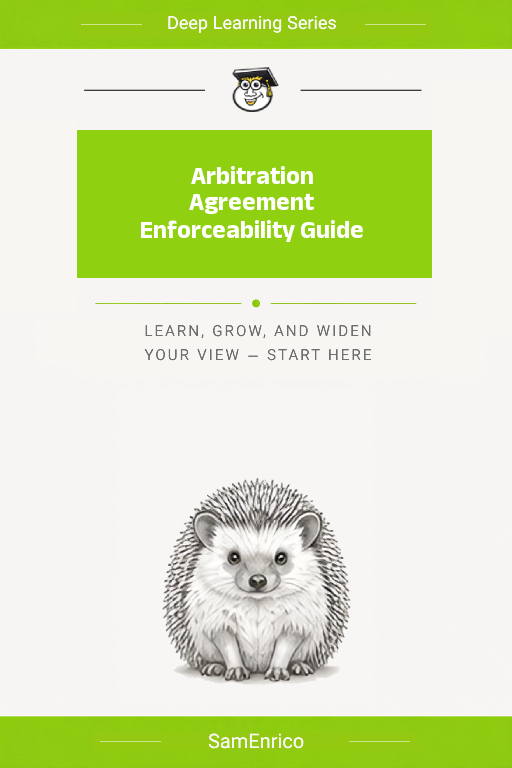
Non-FictionBusiness BriefArbitration Law
Arbitration Agreement Enforceability Guide eBook
Force first hire into arbitration for disputes—cla
by Bostick Hye
Force first hire into arbitration for disputes—class waiver, filing fee, and opt-out period must comply with FAA.
Formats
Free sample
Chapter 1: The Unholy Trinity–- Sarah had done everything right. She had incorporated her consulting firm, drafted solid client contracts, and even splurged on cyber liability insurance. When she hired her first employee—a sharp young salesperson named Marcus—she found a free arbitration agreement template online, tucked it into his onboarding packet, and thought nothing more of it. Eleven months later, Marcus quit. Three weeks after that, he filed a class action lawsuit on behalf of himself and forty-seven other alleged "similarly situated" employees.
Sarah had only ever employed Marcus. She had no other employees. The class action alleged that she had misclassified Marcus as an exempt employee, failed to pay overtime, and violated the state labor code in ways that would apply to a class of workers who did not exist.The lawsuit made no factual sense. But the legal fees alone would bankrupt her. Her lawyer filed a motion to compel arbitration based on the agreement she had used.
The court denied it. Not because the arbitration clause was missing—it was there in black and white—but because of three tiny provisions buried in the fine print. A class waiver that said "class actions are prohibited" but failed to mention "representative actions." A fee-splitting clause that required Marcus to pay half the JAMS filing fee, which the court calculated at 1,875againsthismonthlytake−homepayof1,875 against his monthly take-home pay of 1,875againsthismonthlytake−homepayof3,200. And an opt-out period that gave Marcus exactly three days after signing to reject arbitration, which the court called "procedurally grotesque."Sarah's lawyer explained the math: even if she won the motion to compel, the appeal would cost 60,000.Ifshelost,theclassactionwouldproceed.Shesettledfor60,000. If she lost, the class action would proceed.
She settled for 60,000.Ifshelost,theclassactionwouldproceed.Shesettledfor175,000. Her business never recovered.This book exists because Sarah's story happens thousands of times every year. And in nearly every case, the employer loses not because arbitration is legally disfavored—the Federal Arbitration Act famously declares arbitration agreements "valid, irrevocable, and enforceable" —but because the employer's agreement contains the same three fatal provisions. The same Unholy Trinity that killed Sarah's agreement will kill yours, unless you understand exactly what these provisions are, why courts strike them, and how to draft around them.This chapter introduces the three provisions that account for between 86% and 92% of arbitration agreement enforceability failures in employment cases, according to a 2023 study published by the American Arbitration Association and reviewed by the Cornell Labor Law Journal. These three provisions are: the class action waiver (Chapter 1 and Chapter 3), the filing fee allocation (Chapter 4), and the opt-out period (Chapter 5).
Alone, each is manageable. Together, they form a presumptively void agreement. Courts call this the "confluence of factors" test. This book calls it the Unholy Trinity.But before we dissect each provision, you need to understand the legal battlefield on which these battles are fought. You need to understand the tension between the Federal Arbitration Act and the unconscionability doctrine.
You need to understand why a federal judge who loves arbitration will still gut your agreement if you get these three provisions wrong. And you need to understand the balancing test that courts actually use—not the test that arbitration advocates wish they would use.The FAA's Promise and Its Limits The Federal Arbitration Act of 1925 was enacted to overturn centuries of judicial hostility toward arbitration. Before the FAA, many courts refused to enforce arbitration agreements, viewing them as ousting the courts of jurisdiction. The FAA's core provision, Section 2, could not be clearer: "A written provision in any maritime transaction or a contract evidencing a transaction involving commerce to settle by arbitration a controversy thereafter arising out of such contract or transaction shall be valid, irrevocable, and enforceable, save upon such grounds as exist at law or in equity for the revocation of any contract."That last phrase—"save upon such grounds as exist at law or in equity for the revocation of any contract"—is where the trouble begins. The FAA does not exist in a vacuum.
Arbitration agreements are still contracts, and contracts are subject to generally applicable contract defenses: fraud, duress, unconscionability, and the like. The Supreme Court has made clear that these defenses apply to arbitration agreements just as they apply to any other contract. But the Court has also made clear that courts cannot apply these defenses in a way that disfavors arbitration. You cannot have one rule for arbitration agreements and another rule for everything else.This creates a narrow but treacherous path for employers. Your arbitration agreement can be challenged on any ground that could challenge any contract.
But the most common ground—by a massive margin—is unconscionability. And unconscionability is where the Unholy Trinity lives.The Unconscionability Balancing Test Unconscionability is not a single defect. It is a sliding scale with two independent variables: procedural unconscionability and substantive unconscionability. Courts balance the two. A little of one can be offset by a little of the other.
Too much of both, and the agreement dies.Procedural unconscionability focuses on the process by which the agreement was formed. Did the employee have a meaningful choice? Was the agreement presented on a take-it-or-leave-it basis? Was it buried in a 40-page employee handbook? Was it written in legalese that no reasonable non-lawyer could understand?
Was the employee given time to review it? Was the employee told that signing was mandatory? Each of these factors adds procedural unconscionability points. The more points, the heavier the thumb on the scale against enforcement.Substantive unconscionability focuses on the terms of the agreement itself. Is the agreement one-sided?
Does it give the employer rights that it denies the employee? Does it impose excessive costs on the employee? Does it limit the employee's remedies? Does it shorten the statute of limitations? Each of these factors adds substantive unconscionability points.The key insight—and the reason the Unholy Trinity is so deadly—is that courts multiply these two factors.
A highly procedural unconscionability (the employer rushed the employee, hid the terms, and made signing mandatory) combined with even mild substantive unconscionability (a modest fee split, a short opt-out period) can render an agreement void. Conversely, an agreement with no procedural unconscionability (the employee had weeks to review, consulted a lawyer, and signed voluntarily) can survive even fairly one-sided terms.This is why the first hire scenario is so dangerous. The first hire has no prior experience with your company's arbitration program. You have no track record of fair dealing. The employee is likely signing under pressure—they need the job, and they know you could revoke the offer if they refuse.
That's procedural unconscionability baked into the transaction from the start. Which means your substantive terms must be absolutely pristine. No fee splitting. No short opt-out. No ambiguous class waiver.The Unholy Trinity, Provision by Provision Provision One: The Class Action Waiver A class action waiver prohibits the employee from bringing a lawsuit on behalf of a group of similarly situated employees.
Instead, the employee must arbitrate their claims individually. The U.S. Supreme Court upheld the enforceability of class action waivers in employment agreements in Epic Systems Corp. v. Lewis, 138 S.
Ct. 1612 (2018). That should be the end of the story. It is not.The problem is that plaintiffs' attorneys have…
This is the end of the free sample. Get the eBook to keep going. Buy now
About this book
Details
- Author
- Bostick Hye
- Publisher
- SamEnrico
- Language
- English
- Genre
- Non-Fiction, Business Brief, Arbitration Law
- Released
- 2026-06-01
- Pages (approx.)
- 160
- Available as
- eBook, Audiobook

Read better in the ZLOADR app
Your eBooks on your phone or tablet. Sign in with your SamEnrico account and start reading.
More by Bostick Hye
 Self Esteem After FallsBostick Hye$11.99
 Call Protection and Make WholeBostick Hye$11.99
 Trace Minerals Deficiency HandbookBostick Hye$11.99
 Family Guy Voice MemoirBostick Hye$11.99
 Boomer Travel PreferencesBostick Hye$11.99Boomer Travel PreferencesBostick Hye$11.99
 Creative Habits for LawyersBostick Hye$11.99
 TED Talk Style GuideBostick Hye$11.99
 Pelvic Floor Workout LogBostick Hye$11.99
 The Wind in Their Sails: How the Dutch Conquered the SeasBostick Hye$11.99
 The Phantom of the Grand Hotel: The Unsolved 1929 Disappearance of Agnes DriscollBostick Hye$11.99
 How to Produce Counterfeit Electronic ComponentsBostick Hye$11.99
You may also like
 Hong Kong Handover 1997Dunn Johnnie$11.99
 Zumba For Postnatal Recovery CourseNeal Christian$11.99
 Zumba for BeginnersLadner Nikia$11.99
 YouTube Comment Mining GuideHumes Pandora$12.99
 Worry Box MeditationCarlin Rudy$11.99
 Workplace Stress MeditationNguyen Lynn$11.99
 Workplace Stress and Sleep RepairHawley Ivory$11.99
 Workplace Perfectionism CureDelaney Jeffry$11.99
 Workplace Injustice Anger GuideWallen Isabelle$11.99
 Work Addiction and Burnout LinkGreenwood Ester$11.99
 Women in Yoga and WellnessBeattie Galina$11.99
 Women in Stand Up ComedyChun Evangeline$11.99