
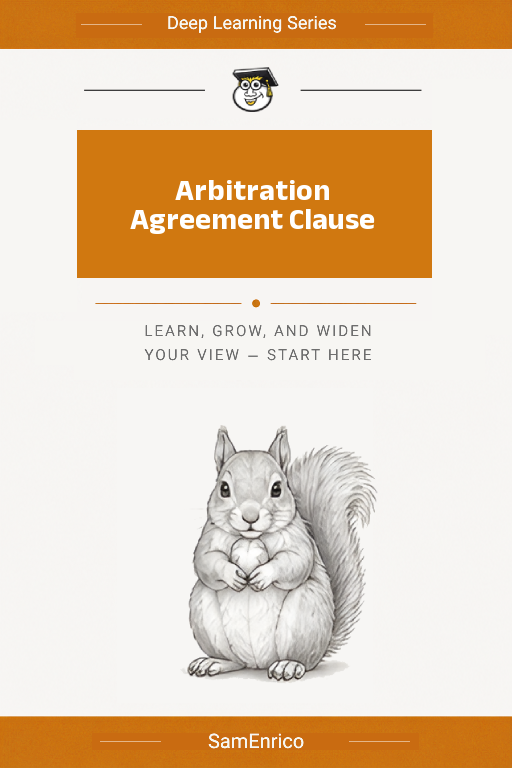
Non-FictionFirst 30 DaysArbitration
Arbitration Agreement Clause eBook
Include mandatory arbitration clause and class act
by Pride Karlyn
Include mandatory arbitration clause and class action waiver in your Terms of Service.
Formats
Free sample
Chapter 1: The Great Surrender--–- On a Tuesday afternoon in March 2019, a sixty-three-year-old retired nurse named Joanne signed up for a meal delivery service. She was recovering from knee replacement surgery, unable to drive, and hungry. The website asked for her name, her credit card, and her agreement to the Terms of Service. She did not read the Terms of Service. No one does.
In fourteen seconds—the average time a consumer spends reviewing a boilerplate contract—Joanne surrendered her right to ever sue that company in a court of law. She did not know it. The company did not tell her. And six months later, when the company's negligence sent her to the emergency room with a severe allergic reaction from mislabeled food, a judge would tell her that she had no recourse except a private arbitration proceeding held in a conference room forty-five miles from her home, with no jury, no public record, and no appeal. Her medical bills were 17,000.Herarbitrationawardwas17,000.
Her arbitration award was 17,000.Herarbitrationawardwas2,500. The company's lawyers billed $850 per hour. Joanne's story is not exceptional. It is the rule.This is the story of the great surrender. It is not a story about a single bad contract or a single greedy corporation.
It is the story of how an entire legal system was quietly, systematically, and almost invisibly replaced with a private justice system that favors the people who write the rules. It is the story of how you—yes, you, reading this sentence—have almost certainly signed away your right to a jury trial within the last seventy-two hours. Your coffee shop loyalty app. Your grocery store discount card. Your streaming service.
Your fitness tracker. Your child's school permission slip. Your credit card. Your bank account. Your phone.
Your car. Every click of "I agree" has been a silent surrender.The mechanism of this surrender is the arbitration clause. It is a handful of words buried in pages of legalese. It is the most powerful, least understood weapon in modern corporate law. And if you are a business owner, a founder, or an executive, the arbitration clause in your Terms of Service is either your strongest shield or your most vulnerable exposure.
There is almost no middle ground.This chapter dismantles the myth that arbitration is a neutral, efficient alternative to litigation. It reveals why corporations abandoned the public court system. It provides the statistical reality of arbitration outcomes—outcomes that would shock most consumers. And it traces the legal history of how the 1925 Federal Arbitration Act, a niche statute written for merchants trading perishable goods, became the single most powerful tool for corporations to avoid accountability. By the end of this chapter, you will understand the fundamental choice every company faces: whether to fight in the open arena of public courts or the hidden arena of private arbitration.
More importantly, you will understand the two distinct threats that arbitration creates—threats that most books, most lawyers, and most executives fail to distinguish.The Two Threats You Must Understand Immediately Before we go any further, you need to understand a distinction that is almost always confused. Most discussions of arbitration treat it as a single phenomenon: companies use arbitration clauses to prevent class actions. That is true. But it is incomplete. And that incompleteness has bankrupted companies that thought they were protected.There are two distinct threats in the modern dispute resolution landscape.
The first is the Nuclear Verdict. The second is the Death by a Thousand Fees.The Nuclear Verdict is what happens when thousands of consumers with small claims band together in a class action lawsuit. The company faces a single trial, a single jury, and a single potential damages award that can reach into the billions of dollars. Think of the Volkswagen diesel emissions scandal. Think of the opioid litigation.
Think of the Equifax data breach class action that settled for $425 million. A class action can destroy a company in a single judgment.The Death by a Thousand Fees is the opposite. It happens when plaintiffs' lawyers weaponize arbitration itself. Instead of filing one class action, they file thousands—or tens of thousands—of individual arbitration demands, each requiring the company to pay filing fees, arbitrator fees, and administrative costs. Under the American Arbitration Association's rules, a company may owe 2,200perclaimjusttostarttheprocess.Onethousandclaimsequal2,200 per claim just to start the process.
One thousand claims equal 2,200perclaimjusttostarttheprocess.Onethousandclaimsequal2.2 million in fees before any arbitrator has heard any evidence. This tactic has bankrupted startups and midsize companies that thought their arbitration clause made them safe.Here is the critical insight that most books miss: a standard arbitration clause with a class action waiver protects you against the Nuclear Verdict. It does almost nothing to protect you against the Death by a Thousand Fees. In fact, a poorly drafted arbitration clause can make you more vulnerable to mass arbitration attacks. The same fragmentation of claims that prevents a class action also enables a mass arbitration filing spree.This book will teach you how to defend against both threats.
But you cannot defend against what you do not understand. So let us begin with the foundation: why arbitration replaced litigation, what the statistics actually show, and how a ninety-nine-year-old law became the most important contract provision you have never read.Why Corporations Abandoned the Jury In 1980, almost every consumer contract was litigated in court. By 2020, more than eighty percent of consumer contracts contained mandatory arbitration clauses. This did not happen by accident. It happened because corporate America discovered that arbitration was cheaper, faster, and overwhelmingly more favorable to the party that drafted the contract.The jury is the fundamental problem for corporations.
Juries are unpredictable. Juries are sympathetic to individuals. Juries award emotional damages, punitive damages, and the kind of "pain and suffering" compensation that makes corporate risk managers lose sleep. A 2018 study by the U.S. Chamber of Commerce's Institute for Legal Reform found that the median jury award in civil cases was 125,000.Inarbitration,themedianawardwas125,000.
In arbitration, the median award was 125,000.Inarbitration,themedianawardwas19,000. That is not a coincidence. That is the system working exactly as designed.But juries are only the beginning. Discovery—the pretrial process where each side demands documents, emails, and depositions—is a nightmare for corporations. A class action lawsuit can generate millions of pages of discovery, revealing internal communications, embarrassing emails, and strategic decisions that the company would prefer to keep secret.
Arbitration sharply limits discovery. There are no depositions of senior executives. There are no sprawling document productions. There is no public record. What happens in arbitration stays in arbitration.Then there is the matter of precedent.
A court decision is published. It becomes law. It can be cited by every future plaintiff. An arbitration award is confidential. It creates no precedent.
A company can lose the same argument one hundred times in one hundred arbitrations, and the one hundred and first plaintiff will never know. This erases the deterrent effect of litigation. When there is no public record of wrongdoing, there is no public accountability.Corporations did not stumble into arbitration. They ran toward it. And they were helped by a statute that most Americans have never heard of.The 1925 Law That…
This is the end of the free sample. Get the eBook to keep going. Buy now
About this book
Details
- Author
- Pride Karlyn
- Publisher
- SamEnrico
- Language
- English
- Genre
- Non-Fiction, First 30 Days, Arbitration
- Released
- 2026-06-01
- Pages (approx.)
- 152
- Available as
- eBook, Audiobook

Read better in the ZLOADR app
Your eBooks on your phone or tablet. Sign in with your SamEnrico account and start reading.
More by Pride Karlyn
 Remote Work Energy ManagementPride Karlyn$11.99
 Parent Death AnniversaryPride Karlyn$11.99
 Rural Retirement Housing DownsizingPride Karlyn$11.99
 Afternoon Slump StrategyPride Karlyn$11.99
 The Prevention Focused LifePride Karlyn$11.99
 Sustainable Success HabitsPride Karlyn$11.99Remote Work Energy ManagementPride Karlyn$11.99
 Remote Work Background NoisePride Karlyn$11.99
 Assertive Family CommunicationPride Karlyn$11.99
 The Vanishing of the SS *Cumberland*: A 19th-Century Maritime MysteryPride Karlyn$11.99
 The Four Days' Battle: The Dutch Navy's Last Stand (1666)Pride Karlyn$11.99
 How to Produce Lip Balms and TreatmentsPride Karlyn$11.99
You may also like
 Hong Kong Handover 1997Dunn Johnnie$11.99
 Zumba For Postnatal Recovery CourseNeal Christian$11.99
 Zumba for BeginnersLadner Nikia$11.99
 YouTube Comment Mining GuideHumes Pandora$12.99
 Worry Box MeditationCarlin Rudy$11.99
 Workplace Stress MeditationNguyen Lynn$11.99
 Workplace Stress and Sleep RepairHawley Ivory$11.99
 Workplace Perfectionism CureDelaney Jeffry$11.99
 Workplace Injustice Anger GuideWallen Isabelle$11.99
 Work Addiction and Burnout LinkGreenwood Ester$11.99
 Women in Yoga and WellnessBeattie Galina$11.99
 Women in Stand Up ComedyChun Evangeline$11.99