
Non-FictionSelf-HelpStrengths Based
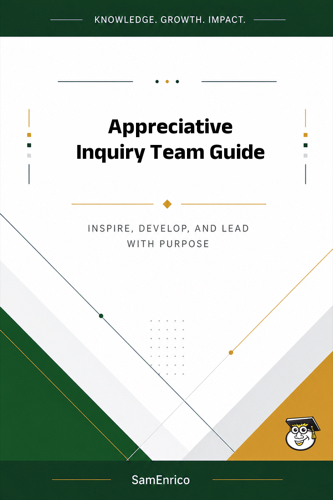
Appreciative Inquiry Team Guide eBook
Focus on strengths to boost group creativity using
by Acuna Lourie
Focus on strengths to boost group creativity using this positive collaboration approach.
Formats
Free sample
Chapter 1: The Deficit Trap...-- Every team meeting follows a script so familiar that most people have stopped noticing it. Someone says, "Let's go around the room and share our biggest challenges this week." Another person says, "We need to talk about what went wrong with the Johnson project." A third person chimes in, "Before we get started, let me flag a few problems I've noticed." By the time the meeting is ten minutes old, the whiteboard is filled with a list of everything that is broken, late, over budget, or underperforming. The energy in the room has dropped from neutral to exhausted. People are already checking their phones, not because they are rude, but because they have learned that problem-heavy meetings are more draining than they are productive.This is the deficit trap. It is the default operating system for most teams in most organizations.
And it is killing your team's creativity.The deficit trap is not caused by bad people or malicious intentions. It is caused by an assumption so deeply embedded in Western organizational culture that it has become invisible. That assumption is simple: the best way to improve something is to find what is wrong with it and fix it. If your team is missing deadlines, you identify the root causes of the delays and eliminate them. If customer satisfaction is dropping, you analyze the complaints and address the pain points.
If innovation is stagnating, you look for the bottlenecks and remove them.On the surface, this seems logical. It seems efficient. It seems like common sense. But here is the problem that three decades of organizational research has revealed: when teams focus on what is wrong, they see only what is wrong. The deficit gaze is a self-fulfilling prophecy.
You look for problems, you find problems, and then you spend all your energy trying to eliminate problems. Meanwhile, the strengths that could propel your team forward—the existing pockets of excellence, the moments of unexpected collaboration, the employees who are already doing extraordinary work—remain invisible, underutilized, and uncelebrated.This chapter introduces the central insight that will transform how you lead your team. It is an insight that has been validated by research in neuroscience, positive psychology, and organizational development. It is the foundation of Appreciative Inquiry, a methodology that has helped organizations ranging from Mc Donald's to the U.S. Navy to Green Mountain Coffee Roasters achieve breakthrough results.
And it can be stated in a single sentence:Organizations move in the direction of the questions they ask.If you ask "what's broken and who broke it," you will get blame, defensiveness, and a culture of fear. If you ask "what's working and how can we build on it," you will get energy, innovation, and a culture of possibility. The questions you ask are not neutral. They shape what your team sees, what your team feels, and what your team does.This is not positive thinking. This is not toxic optimism.
This is not about ignoring problems or pretending everything is fine. We will address that crucial distinction directly in this chapter, because it is the single most common misunderstanding about Appreciative Inquiry. The goal is not to deny that problems exist. The goal is to change your relationship to problems so that you stop being trapped by them.Let me tell you a story.The Unexpected Discovery In the late 1970s, a young doctoral student named David Cooperrider was studying organizational change at Case Western Reserve University. He was working with a large healthcare organization that was, by any traditional measure, a mess.
Morale was low. Turnover was high. Patient satisfaction was falling. The leadership team had hired consultants, run problem-solving workshops, and implemented countless corrective action plans. Nothing worked.Cooperrider tried something different.
Instead of studying what was wrong with the organization, he asked a different question: "What gives life to this organization when it is at its best?" He interviewed nurses, doctors, administrators, and patients. He asked them to tell stories about times when the organization had excelled—times when care was exceptional, collaboration was seamless, and people felt proud to be part of the team.The stories poured out. People described moments of extraordinary dedication, unexpected kindness, and creative problem-solving. They described times when the organization had worked exactly as it should. And as Cooperrider analyzed these stories, he noticed something remarkable.
The strengths that people described—the values, practices, and relationships that made excellence possible—were already present in the organization. They were just invisible. The relentless focus on problems had buried them so deep that no one could see them anymore.Cooperrider shared his findings with the leadership team. Instead of another problem-focused action plan, he proposed a different approach: identify the conditions that made excellence possible, and amplify them. The leadership team was skeptical, but they agreed to try.
Within eighteen months, the organization had transformed. Morale improved. Turnover dropped. Patient satisfaction soared. And the organization had done it not by fixing what was broken, but by building on what was strong.This was the birth of Appreciative Inquiry.The Hidden Cost of Problem-Solving Let me be clear: problem-solving is not evil.
It has its place. If a machine is broken, you need to diagnose the problem and fix it. If a financial error has occurred, you need to track down the cause and correct it. For mechanical and technical systems, the deficit approach works.But teams are not machines. They are living systems.
And living systems do not respond to deficit-focus the way machines do. When you tell a machine that something is wrong with it, the machine does not care. When you tell a person that something is wrong with them, they feel shame. When you tell a team that something is wrong with it, they become defensive. The problem-solving approach that works for engines and spreadsheets creates emotional resistance, psychological withdrawal, and cultural dysfunction when applied to human groups.The neuroscience is clear on this point.
When people are asked to focus on deficits—on what is wrong, what is missing, what has failed—their brains activate the same threat-response circuitry that evolved to detect predators. Cortisol rises. The amygdala, the brain's fear center, becomes more active. Blood flow is redirected away from the prefrontal cortex, the region responsible for creativity, abstract thinking, and long-term planning. In other words, when you ask your team to focus on problems, you are literally making them less intelligent.The research on the "positivity ratio" confirms this.
Psychologist Barbara Fredrickson and her colleagues have shown that individuals and teams who experience a ratio of approximately three positive interactions for every one negative interaction are more creative, more resilient, and more successful than those with lower ratios. Teams that focus exclusively on problems rarely achieve even a one-to-one ratio. They are swimming upstream against their own biology.But here is the crucial nuance that most discussions of this research miss. The "positive" in the positivity ratio does not mean ignoring problems or pretending everything is fine. It means framing your engagement with problems in a generative way.
Instead of asking "what's wrong and who caused it," you ask "what would it look like if this problem were…
This is the end of the free sample. Get the eBook to keep going. Buy now
About this book
Details
- Author
- Acuna Lourie
- Publisher
- SamEnrico
- Language
- English
- Genre
- Non-Fiction, Self-Help, Strengths Based
- Released
- 2026-06-06
- Pages (approx.)
- 140
- Available as
- eBook, Audiobook

Read better in the ZLOADR app
Your eBooks on your phone or tablet. Sign in with your SamEnrico account and start reading.
More by Acuna Lourie
 Pet Peeve EncyclopediaAcuna Lourie$11.99
 McClintock Intuitive Scientist HandbookAcuna Lourie$11.99
 Workaholism In Creative IndustriesAcuna Lourie$11.99
 Green Beret Q Course ManualAcuna Lourie$11.99
 The Beast of Gévaudan: France’s Phantom HunterAcuna Lourie$11.99
 Baking (Commercial)Acuna Lourie$11.99
 How to Start a Skeet Shooting Facilities BusinessAcuna Lourie$11.99
 IP Assignment PrimerAcuna Lourie$12.99
 Online ESL Classroom SetupAcuna Lourie$12.99
 Understanding Fryns–smeets–thiry SyndromeAcuna Lourie$17.99
You may also like
 Hong Kong Handover 1997Dunn Johnnie$11.99
 Zumba For Postnatal Recovery CourseNeal Christian$11.99
 Zumba for BeginnersLadner Nikia$11.99
 YouTube Comment Mining GuideHumes Pandora$12.99
 Worry Box MeditationCarlin Rudy$11.99
 Workplace Stress MeditationNguyen Lynn$11.99
 Workplace Stress and Sleep RepairHawley Ivory$11.99
 Workplace Perfectionism CureDelaney Jeffry$11.99
 Workplace Injustice Anger GuideWallen Isabelle$11.99
 Work Addiction and Burnout LinkGreenwood Ester$11.99
 Women in Yoga and WellnessBeattie Galina$11.99
 Women in Stand Up ComedyChun Evangeline$11.99