
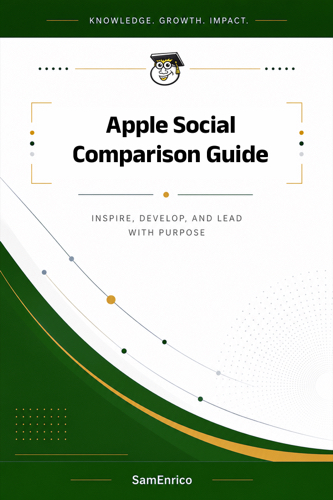
Non-FictionSelf-Help / Consumerism
Apple Social Comparison Guide eBook
undefined
by Kim Vincent
undefined
Formats
Free sample
Chapter 1: The Blue Tax--I want you to try something before you read another word.Open your Messages app. Find a conversation with someone you love—a partner, a sibling, a best friend. Now scroll up. Not to the funny exchange from last week, but further. Go back six months.
A year. Find the moment when you first noticed their bubble color.What color was it?If you’re like the vast majority of i Phone users, you don’t actually remember. Because here’s the uncomfortable truth that this entire chapter will unpack: you’ve been making decisions—social, emotional, even financial—based on a color you can’t even recall seeing for the first time. That’s not a memory problem. That’s a design feature.The blue bubble didn’t appear one day with a fanfare.
It snuck into your life like a silent partner in a bad relationship. At first, you didn’t notice it. Then you noticed it without thinking about it. Then you started to prefer it. Then you started to feel a tiny, almost invisible flicker of disappointment when you didn’t see it.
Then you started to wonder about people who didn’t have it. Then you started to judge them—just a little. Just enough to matter.And somewhere along the way, you started paying the Blue Tax.The Blue Tax is the sum total of all the small psychological withdrawals you make every time you interact with Apple’s messaging ecosystem. It’s the cost of caring about bubble color. It’s the interest you pay on a loan you never asked for—a loan that convinced you that a shade of digital blue is a proxy for social belonging, romantic potential, and personal worth.This chapter is about naming that tax, tracing its origins, and handing you the tools to stop paying it.The Moment It Became Personal Let me tell you about a woman named Sarah.
(Her name has been changed, but her story is real, and it’s drawn from interviews conducted for this book.)Sarah is thirty-two years old, a marketing manager in Chicago, and until eighteen months ago, she was an Android user. Not a militant Android user—just someone who bought a Samsung Galaxy in 2019 because it was on sale and she liked the camera. She didn’t think much about it. Her phone made calls. It sent texts.
It worked.Then she started dating someone new.“His name was Mark,” Sarah told me. “We met on Hinge. Good conversation. Good first date. Second date, we’re texting afterward, and he sends me a message that says, ‘Hey, just realized you’re green.
No judgment, just curious.’”Sarah didn’t know what “green” meant. Mark explained: i Message users have blue bubbles. Non-i Message users have green bubbles. He said it didn’t matter to him. He said he was just curious.But over the next few weeks, Sarah noticed small things.
Mark’s friends would start group chats, and Sarah would join, but her photos came through blurry. She couldn’t react to messages with a thumbs-up or a heart. When someone sent a video, it looked like it had been recorded on a flip phone from 2006. And Mark started texting her less—not because he liked her less, but because the friction of the green bubble made the conversation less effortless.“He never said it,” Sarah told me. “But I could feel it.
The group chat would be popping off with inside jokes, and I’d be the one person who couldn’t keep up. Not because I wasn’t funny. Because my phone was green.”Three months into dating, Sarah bought an i Phone. She told herself it was for the camera. She told herself it was for the battery life.
But when she texted Mark for the first time from her new phone and saw that blue bubble appear, she felt a wave of relief so strong it scared her.“I literally exhaled,” she said. “And then I thought, ‘What the hell is wrong with me? I just spent nine hundred dollars to change the color of a text bubble.’”Sarah’s story is not unusual. It’s not even extreme. It is, in fact, so common that Apple has built a trillion-dollar company on the back of this exact psychological mechanism.
The Blue Tax is not a bug. It is the entire business model.The Architecture of the Blue Tax To understand how the Blue Tax works, you have to understand what i Message actually is—not technologically, but psychologically.i Message launched in 2011 as a simple upgrade to SMS. It allowed i Phone users to send messages over Wi-Fi instead of cellular networks. It added read receipts, typing indicators, and higher-quality photos. From a technical standpoint, it was a modest improvement.But something unexpected happened.
Because i Messages were blue and SMS messages were green, users began to associate the color blue with a superior experience. The blue bubble meant your message would be delivered instantly. It meant you could see when someone was typing. It meant you could send a photo without it turning into pixelated garbage. The green bubble meant the opposite.This is where the psychology gets interesting—and a little dark.Humans are pattern-recognition machines.
We are constantly, unconsciously sorting information into categories: safe versus dangerous, familiar versus unfamiliar, us versus them. The blue-green distinction in Messages created a new category boundary almost overnight. Blue-bubble people became “us”—people who had the same devices, the same features, the same seamless experience. Green-bubble people became “them”—people outside the circle, people who made group chats worse, people who were, in some small but meaningful way, less convenient to communicate with.You didn’t decide to feel this way. No one sat you down and said, “Green bubbles are bad and blue bubbles are good.” Your brain made that association automatically, because your brain is designed to prefer what is easy and familiar and to avoid what is difficult and unfamiliar.
Green bubbles are difficult. Blue bubbles are easy. Therefore, blue bubbles are good.This is the foundation of the Blue Tax. You pay it every time you feel a flicker of annoyance at a green bubble. You pay it every time you hesitate to add someone to a group chat because you’re not sure if they have an i Phone.
You pay it every time you judge someone—even slightly, even unconsciously—for the color of their text bubble.And here’s the kicker: you didn’t choose to pay it. The tax was imposed on you by the design of the product itself.The Features That Charge You Interest The Blue Tax isn’t a flat fee. It compounds over time, with interest added by every i OS feature that deepens the divide between blue and green.Let me walk you through the specific mechanisms that turn a simple messaging app into a psychological extraction machine.The Typing Indicator This is the three little dots that appear when someone is composing a message. For blue-bubble users, the typing indicator is a source of connection—you know the other person is there, thinking about you…
This is the end of the free sample. Get the eBook to keep going. Buy now
About this book
Details
- Author
- Kim Vincent
- Publisher
- SamEnrico
- Language
- English
- Genre
- Non-Fiction, Self-Help / Consumerism
- Released
- 2026-06-09
- Pages (approx.)
- 140
- Available as
- eBook, Audiobook

Read better in the ZLOADR app
Your eBooks on your phone or tablet. Sign in with your SamEnrico account and start reading.
More by Kim Vincent
 Ideation Techniques For SolutionsKim Vincent$11.99
 Alcohol Relapse Letter GuideKim Vincent$11.99
 ABC Method for Fitness TrainersKim Vincent$11.99
 Daily Mindfulness Habit GuideKim Vincent$11.99
 The Priority Matrix for CreativesKim Vincent$11.99
 Iyanla Vanzant GuideKim Vincent$11.99
 Autism Childhood Self WorthKim Vincent$11.99
 The Hollow King's Last Ride: Camelot's Forgotten KnightKim Vincent$11.99
 The Dutch Fire and the Deep: How the Golden Age Tamed the Volcanoes of TradeKim Vincent$11.99
 How to Produce Handheld Metal Shears and NibblersKim Vincent$11.99
 How to Produce a Sugarcane HarvesterKim Vincent$11.99
 A Collector's Handbook to the Ferrari 400 SuperamericaKim Vincent$11.99
You may also like
 Hong Kong Handover 1997Dunn Johnnie$11.99
 Zumba For Postnatal Recovery CourseNeal Christian$11.99
 Zumba for BeginnersLadner Nikia$11.99
 YouTube Comment Mining GuideHumes Pandora$12.99
 Worry Box MeditationCarlin Rudy$11.99
 Workplace Stress MeditationNguyen Lynn$11.99
 Workplace Stress and Sleep RepairHawley Ivory$11.99
 Workplace Perfectionism CureDelaney Jeffry$11.99
 Workplace Injustice Anger GuideWallen Isabelle$11.99
 Work Addiction and Burnout LinkGreenwood Ester$11.99
 Women in Yoga and WellnessBeattie Galina$11.99
 Women in Stand Up ComedyChun Evangeline$11.99