
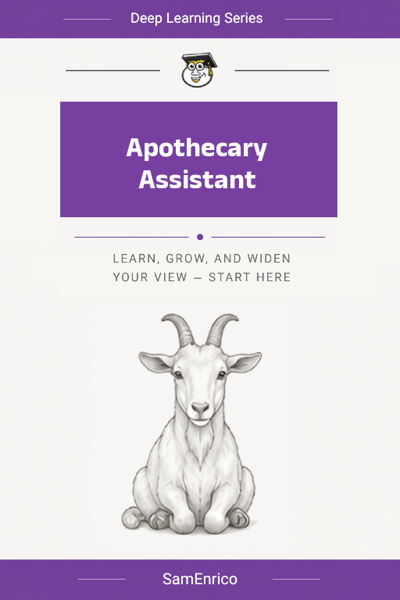
Non-FictionInformativeEducational
Apothecary Assistant eBook
A Coursebook on Apothecary Assistant
A Coursebook on Apothecary Assistant
Formats
Free sample
Chapter 1: The Mortar’s Legacy...–- The old apothecary jar sat on a high shelf in the back of the pharmacy, dusty and forgotten. Its glass was clouded with age, the faded label reading Tincture of Benzoin – 1734 barely legible. The jar had traveled from a small shop in Edinburgh to a wagon train crossing the American frontier, then to a brick-and-mortar drugstore in a growing industrial town, and finally to this modern chain pharmacy as a decorative relic. No one had opened it in fifty years. No one remembered what it contained or why it mattered.
But the jar, like the profession itself, carried a silent lesson: the work of preparing medicines has always been sacred, precise, and handed down from one pair of hands to the next.This chapter is not about that jar. It is about you, the hands that will now take up that legacy. The title “Apothecary Assistant” might sound old-fashioned, even romantic, with its images of mortar and pestle, dried herbs hanging from rafters, and leather-aproned craftsmen whispering over bubbling concoctions. But the reality of your future profession is both more demanding and more rewarding than any historical fantasy. You are not entering a relic of the past.
You are stepping into a role that has evolved continuously for three thousand years, from the temple priests of ancient Egypt who ground myrrh and frankincense, to the monastic infirmarers of medieval Europe, to the certified pharmacy technician of today who navigates complex software, calculates pediatric doses, and prepares intravenous medications that sustain the most fragile patients in the hospital.Why should you care about history? Because every safety protocol, every legal regulation, every ethical duty you will learn in this book was written in blood, error, and hard-won wisdom. The apothecary who mistakenly dispensed foxglove instead of plantain killed a patient, and from that death came the first crude formulary. The technician who failed to check an expiration date on a crash cart contributed to a code that could not be resuscitated, and from that failure came the daily cart inspection. You stand on a foundation built by those who came before—some brilliant, some careless, all human.
Your job is to honor their lessons by mastering the craft.The Apothecary Then: A Portrait of the Handcrafted Trade Before there were pharmacies, there were apothecaries. The word comes from the Latin apotheca, meaning a storehouse or warehouse. In ancient Rome, an apothecary was simply a person who stored and sold goods—wine, spices, perfumes, and yes, medicinal herbs. But by the Middle Ages, the apothecary had become a distinct profession, separate from the grocer and the physician. The apothecary did not merely sell remedies; he made them.
He grew or gathered the raw ingredients, dried them, ground them, infused them in alcohol or oil, pressed them into pills, or incorporated them into ointments. He was part botanist, part chemist, part merchant, and part counselor.Walk with me into a typical apothecary shop in London, circa 1650. The front room is narrow and dark, lit by a single window with small diamond-shaped panes. The air is thick with competing smells: lavender and rosemary from hanging bundles, the sharp tang of vinegar used in many preparations, the earthy odor of roots stored in wooden bins, and the sweetness of honey used as a preservative and binding agent. The apothecary himself stands behind a long counter, dressed in a dark woolen coat, his hands stained with the pigments of his trade.
He does not have a degree. He learned through apprenticeship, starting at age fourteen, spending seven years grinding powders, cleaning jars, and watching his master prepare compounds before he was trusted to make anything alone.The apothecary’s assistant—yes, the title existed even then—was the lowest but most essential member of the shop. The assistant did the heavy lifting: carrying sacks of dried herbs, scrubbing mortars until they shone, labeling jars with careful script, and running errands to the docks for imported spices like cloves and nutmeg, which were also used as medicines. Over time, the assistant learned. He learned that foxglove could strengthen a failing heart but could stop it entirely if the dose was wrong.
He learned that Peruvian bark (the source of quinine) could break a malarial fever but caused ringing in the ears if given too liberally. He learned to be precise in an age without standardized measurements, using words like “a scruple” (about 1.3 grams) and “a dram” (about 3.9 grams) and “a handful” (whatever his hand could hold).The apothecary’s shop was also a social hub. Patients came not with written prescriptions—most could not read—but with descriptions of their ailments: “Master, my wife has a terrible cough that keeps her awake,” or “My son has a wound from a rusty nail.” The apothecary would question them, sometimes examine them, and then retreat to his back room to compound something. He kept his formulas secret, written in code or in a personal “receipt book” that he guarded as fiercely as a goldsmith guarded his dies. There was no standard of care, no regulatory body, no legal requirement to report errors.
If a patient died, the apothecary might face a lawsuit or mob violence, but more often, death was simply accepted as the way of things.This lack of standardization was the apothecary’s greatest weakness and the reason the profession eventually had to change. Without shared knowledge, without error reporting, without quality control, every apothecary was a law unto himself. Some were brilliant healers. Others were charlatans who sold sawdust mixed with turpentine and called it a cure-all. The patient had no way to know the difference.The Modern Pharmacy: From Craft to Clinical Science The transformation from apothecary to pharmacy began in the nineteenth century with two revolutions: the industrial revolution, which allowed mass production of standardized drugs, and the scientific revolution, which isolated active ingredients from their plant or mineral sources.
In 1804, a young German pharmacist named Friedrich Sertürner isolated morphine from opium, proving that a single compound, not the whole plant, was responsible for the pain-relieving effect. In 1820, French chemists Pierre Joseph Pelletier and Joseph Bienaimé Caventou isolated quinine from cinchona bark. Suddenly, medicines could be standardized. A milligram of morphine was a milligram of morphine, whether prepared in Paris, London, or Philadelphia.This shift had profound consequences for the apothecary. If drugs could be manufactured in factories and sold pre-made, what was the point of the hand-compounder?
The role of the pharmacist began to change from manufacturer to dispenser, from creator to distributor and counselor. The pharmacist’s new value was not in grinding powders but in knowing which powder to dispense, how to dose it, what side effects to warn about, and which drugs should never be taken together. The assistant’s role changed too. No longer merely a laborer, the assistant became a technician: someone who could read a prescription accurately, select the correct pre-made product, label it correctly, and maintain the inventory.The twentieth century accelerated this evolution. The Pure Food and Drug Act of 1906 in the United States required that drugs meet standards of purity and strength.
The Food, Drug, and Cosmetic Act of 1938 required proof of safety before a drug could be marketed. The Durham-Humphrey…
This is the end of the free sample. Get the eBook to keep going. Buy now
About this book
Details
- Author
- Mcnamara Dorene
- Publisher
- SamEnrico
- Language
- English
- Genre
- Non-Fiction, Informative, Educational
- Released
- 2026-05-09
- Pages (approx.)
- 160
- Available as
- eBook, Audiobook

Read better in the ZLOADR app
Your eBooks on your phone or tablet. Sign in with your SamEnrico account and start reading.
More by Mcnamara Dorene
 Color Dream Symbolism HandbookMcnamara Dorene$11.99
 Germ Phobia CBT GuideMcnamara Dorene$11.99
 Tavus Personalization GuideMcnamara Dorene$11.99
 The High Functioning Alcoholic Recovery PlanMcnamara Dorene$11.99
 Meth Identity Reconstruction WorkbookMcnamara Dorene$11.99
 The Line in the Sand: How a Fishing Dispute Nearly Started a WarMcnamara Dorene$11.99
 How to Become a Mud BossMcnamara Dorene$11.99
 Ecommerce Regional Spending GuideMcnamara Dorene$12.99
 Academic Proofreading Side HustleMcnamara Dorene$12.99
 Understanding Indomethacin Antenatal InfectionMcnamara Dorene$17.99
You may also like
 Hong Kong Handover 1997Dunn Johnnie$11.99
 Zumba For Postnatal Recovery CourseNeal Christian$11.99
 Zumba for BeginnersLadner Nikia$11.99
 YouTube Comment Mining GuideHumes Pandora$12.99
 Worry Box MeditationCarlin Rudy$11.99
 Workplace Stress MeditationNguyen Lynn$11.99
 Workplace Stress and Sleep RepairHawley Ivory$11.99
 Workplace Perfectionism CureDelaney Jeffry$11.99
 Workplace Injustice Anger GuideWallen Isabelle$11.99
 Work Addiction and Burnout LinkGreenwood Ester$11.99
 Women in Yoga and WellnessBeattie Galina$11.99
 Women in Stand Up ComedyChun Evangeline$11.99