
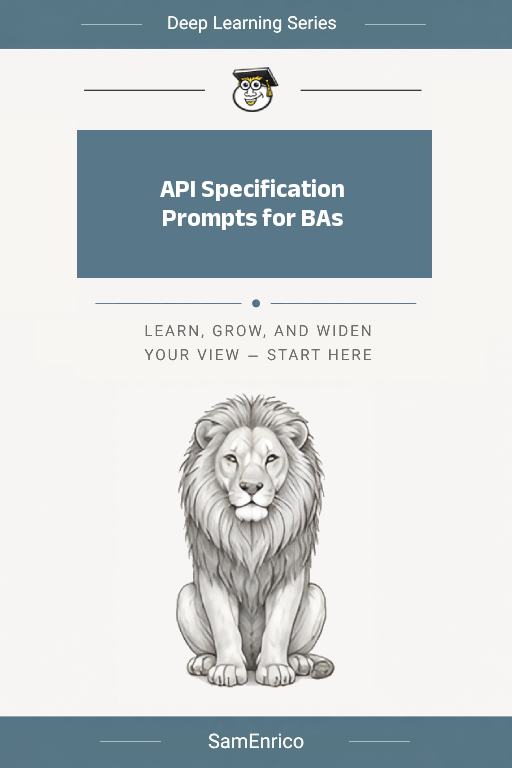
API Specification Prompts for BAs eBook
Generate OpenAPI specifications or API documentati
by Wang Gerald
Generate OpenAPI specifications or API documentation from business requirements using prompts that structure endpoint definitions and data contracts.
Formats
Free sample
Chapter 1: The 50-Page Lie--You have written a fifty-page Business Requirement Document. You followed the template. You interviewed seven stakeholders. You added diagrams, tables, and a glossary. You sent it to the development team. They nodded politely. Three weeks later, they delivered an API that has the wrong fields, no error handling, pagination that breaks after one hundred records, and a response time that makes the CEO ask, "Is it supposed to feel this slow?"You are not the problem. The document is.The fifty-page BRD is a lie we have told ourselves for decades. It pretends that software requirements can be captured in prose, handed off, and built correctly the first time. But prose is ambiguous. Prose cannot be executed. Prose cannot be tested. And prose certainly cannot be fed to an AI that expects structure, constraints, and machine-readable precision.This book exists because that lie is finally dying.Welcome to a different way of working. You are about to learn how to stop writing requirements that developers ignore and start prompting specifications that deploy. You will not abandon your business analysis skills. You will amplify them with a tool that understands structure better than any human ever could. You will become the person who sits with a stakeholder for twenty minutes, writes a single page of prompts, and generates an Open API specification that developers trust, testers love, and operations teams can deploy without panic.But first, you need to understand why everything you were taught about requirements gathering is backward.The Handoff That Never Works Every software project has a moment I have come to call the Handoff of Despair. A business analyst finishes a document. A developer opens it. The developer reads a sentence like "The system shall allow users to search for books by author, title, or ISBN, returning relevant results in a timely manner."What does that sentence actually mean? Does "search" mean exact match or fuzzy match? Is "timely manner" two hundred milliseconds or two seconds? What happens when there are no relevant results? What does a "book" even look like — does it include the publisher, the publication date, the number of pages, the cover image URL? None of these questions are answered. Yet the developer must write code anyway.So the developer guesses. They guess that search means case-insensitive substring matching. They guess that two seconds is fine. They guess that an empty array is the right response for no results. They guess that a book has a title, an author, and nothing else. Then they ship their guesses. And when the stakeholder sees the result, they say, "That is not what I meant."The BA blames the developer. The developer blames the BA. The project manager schedules another meeting. The cycle repeats.Here is the truth: nobody is to blame. The process is to blame. You have been using a communication medium — prose in a document — that is fundamentally unsuited for the task of defining machine behavior. Machines do not understand English. Machines understand YAML, JSON, and HTTP status codes. If you hand a machine a Word document, it will do nothing. If you hand a human a Word document, they will reinterpret it. Both outcomes produce the same result: the wrong software.The Handoff Test I want you to learn a single test that will change how you write every requirement from this moment forward. I call it the Handoff Test.Ask yourself: can a developer run a command to validate that my requirement has been met?If the answer is no, you have not written a requirement. You have written a suggestion. Suggestions are optional. Requirements are not.Here is an example. Most BAs write something like this: "The API must paginate results to improve performance." That is a suggestion. How would a developer test that? They would have to guess what "improve performance" means. They would have to guess the page size. They would have to guess whether offset or cursor pagination is expected.Now consider an executable requirement expressed through an Open API specification. The spec says: the GET endpoint accepts an offset query parameter that must be a multiple of twenty, and a limit query parameter between one and one hundred. The response includes a total_count field and a next_offset link. A developer can run a command to validate that the implementation matches this spec. A test can be written. A mock can be generated. The requirement is not a suggestion. It is a contract.The Handoff Test will feel uncomfortable at first. Your current BRD will fail it spectacularly. That is fine. That is the point. You are about to learn a new way of working that passes the Handoff Test on every single requirement.The Living Specification The second lie we have been told is that requirements are static. We write them once, at the beginning of a project, and then we build to them. But software changes. Stakeholders change their minds. Users discover new needs. Integration partners reveal unexpected constraints. A BRD written in January is a historical artifact by March.The solution is not to write better static documents. The solution is to abandon static documents entirely.An Open API specification is not a document. It is a machine-readable contract that lives alongside your API. When the API changes, the specification changes with it. When the specification changes, the API changes with it. They are two views of the same reality. This is what I mean by a living specification.Here is how this changes your work as a BA. You no longer write a BRD, hand it off, and disappear. Instead, you maintain a specification that evolves through the entire lifecycle. You start with a prompt that generates a draft spec based on initial stakeholder conversations. You review that spec with developers. They point out missing error responses, ambiguous data types, and unrealistic performance assumptions. You update the prompts, regenerate the spec, and review again. By the time development begins, the spec is not a wishlist. It is a contract that everyone has agreed upon.And here is the magic: that same spec works for testing, documentation, and client SDK generation. You are not writing one artifact that becomes outdated. You are maintaining one artifact that powers everything.The BA's New Role If a machine can generate an Open API specification from a prompt, what is the point of a business analyst?This is the question that terrifies BAs who first encounter AI. It is also the wrong question. The right question is: what can a BA do that a machine cannot?A machine cannot sit with a stakeholder and extract the unspoken assumption behind "We need fast search." A machine cannot recognize that "fast" means something different to a retail checkout API than it does to a nightly reporting API. A machine cannot negotiate between conflicting stakeholder needs — sales wants more fields, engineering wants fewer, and the BA finds the compromise that serves both.The machine handles syntax. You handle meaning.The machine generates YAML. You provide the business logic that fills that YAML with purpose.The machine never gets tired of generating pagination schemas. You never get tired of asking, "But what happens when there are no results?"Your value shifts from formatting documents to understanding domains. That is a promotion, not a…
This is the end of the free sample. Get the eBook to keep going. Buy now
About this book
Details
- Author
- Wang Gerald
- Publisher
- SamEnrico
- Language
- English
- Genre
- Non-Fiction, AI Operator
- Released
- 2026-06-01
- Pages (approx.)
- 142
- Available as
- eBook, Audiobook

Read better in the ZLOADR app
Your eBooks on your phone or tablet. Sign in with your SamEnrico account and start reading.
More by Wang Gerald
 Profile Language SettingWang Gerald$11.99
 Chronotype Discovery GuideWang Gerald$11.99
 Cannabis Use Disorder and Immune FunctionWang Gerald$11.99
 Bhagwan Car Collection AuctionWang Gerald$11.99
 Female Sky Scraper Window WashersWang Gerald$11.99
 Tax Preparation BehaviorWang Gerald$11.99
 Dubai Student NetworkingWang Gerald$11.99
 Caregiver Pet TherapyWang Gerald$11.99
 The Clown Killer of Milan: A Family's 30-Year Fight for JusticeWang Gerald$11.99
 Scholarship Alumni Network LeverageWang Gerald$12.99
 How to Produce Gardening TotesWang Gerald$11.99
 A Collector's Handbook to the Chrysler (USA) Chrysler CzWang Gerald$11.99
You may also like
 AI Presentation WorkbookSommers Tonda$11.99
 PowerPoint Copilot MasteryConway Lanita$11.99
 Branded AI DecksWindham Loni$11.99
 AI Presentation CourseGrooms Olin$11.99
 AI Presentation CertificationBlank Dolly$11.99
 AI Deck Version ControlMedley Lorina$11.99
 AI Deck Update AutomationFraser Tresa$11.99
 AI Deck Myths DebunkedCrittenden Romelia$11.99
 AI Deck Customization GuideDove Hannelore$11.99
 AI Bullet to Slide ConverterKohn Eloisa$11.99
 AI Deck Notes CreatorBarela Sunday$11.99
 AI Deck Outline GeneratorAshmore Morgan$11.99