
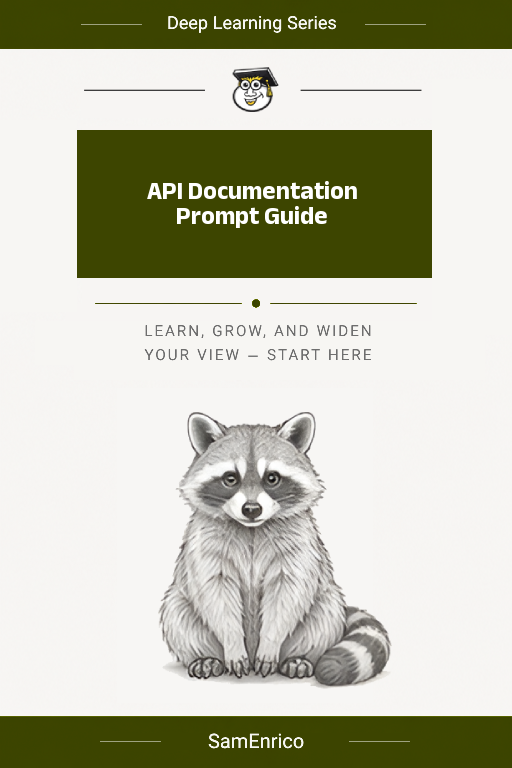
API Documentation Prompt Guide eBook
Generate endpoint descriptions, parameter tables,
by Person Jeane
Generate endpoint descriptions, parameter tables, and code examples by feeding AI your OpenAPI spec with targeted prompts that enforce consistent voice.
Formats
Free sample
Chapter 1: The 4PM Panic--–- It was 4:07 PM on a Wednesday when Maya’s Slack notifications exploded. Her CTO wanted to know why the new Payments API wasn’t documented yet. A developer from a prospective enterprise customer had just asked for “something better than the Postman collection.” And her only other technical writer had given notice two hours ago. Maya stared at her Open API spec—2,347 lines of YAML that had grown organically over eighteen months. Some endpoints had beautiful descriptions.
Most had none. A few had notes like “TODO: document this” that had been there since before she joined. The API launch was scheduled for Friday. In forty-eight hours, sixty-seven endpoints needed to be production-ready. Not just coded—documented.
Maya did what any sensible technical writer would do. She opened Chat GPT, pasted her spec, and typed: “Write documentation for this API.”The result was, to put it generously, a disaster.The descriptions were repetitive. The parameter tables missed half the constraints. The code examples used “foo” and “bar” as if her customers were writing prototypes instead of processing real payments. One example hardcoded an API key—the sandbox key, thankfully, but still.
Maya closed the tab and thought: This is why AI won’t replace us. It’s too dumb.But here’s what she didn’t know yet. The problem wasn’t the AI. The problem was her prompt. And her spec.
And her workflow. Everything she was about to learn over the next four weeks would turn that 4PM panic into a system that documented all sixty-seven endpoints in two days—with consistent voice, complete parameter tables, and code examples that actually ran.This chapter is the story of why that transformation matters. Not just for Maya. For every technical writer, API developer, and documentation manager who has ever felt the 4PM panic. And it’s the foundation for everything else in this book: the specific prompting techniques, the voice enforcement systems, and the validation workflows that turn AI from a liability into the most powerful tool you’ve ever used.The Three Lies You Believe About API Documentation Before we can fix the problem, we have to name it.
Based on conversations with hundreds of technical writers and API developers across companies ranging from two-person startups to Fortune 500 enterprises, three persistent lies keep people stuck in the manual-documentation trap.Lie #1: “AI documentation is low quality.”This is the lie Maya believed when she closed that Chat GPT tab. And she was right—the output she got was low quality. But here’s what she missed: the quality of AI output is almost entirely determined by the quality of your input. Garbage prompts produce garbage documentation. Thoughtful prompts, fed by well-structured Open API specs, produce documentation that often exceeds what a human would write—because AI never forgets constraints, never skips a parameter, and never gets tired of formatting tables.The problem isn’t AI.
The problem is that most people don’t know how to talk to it. A prompt like “write documentation for this endpoint” is the equivalent of handing a carpenter a pile of wood and saying “build a house.” You’ll get something that resembles a house from a distance, but up close, it’s unusable.Lie #2: “Cleaning up my spec first takes too long.”This is the lie that keeps teams in documentation debt forever. Maya’s spec had grown like kudzu—every developer added what they needed, nobody removed what was obsolete, and the description fields ranged from “Returns a customer’s orders” to “This endpoint does stuff” to nothing at all. Fixing it felt like a project she didn’t have time for.But here’s the truth that Maya learned the hard way: AI can’t infer what you didn’t write. If your spec is missing descriptions, AI will guess—and its guesses will be wrong.
If your parameter constraints are incomplete, AI will omit them—and developers will send invalid requests. If your examples use placeholder data, AI will generate placeholder examples—and your customers will waste hours debugging.The thirty minutes you spend cleaning up a spec saves you three hours of fixing AI output. The math is simple. Most people just do it in the wrong order.Lie #3: “I have to write everything myself to be accurate.”This is the deepest lie, and the most painful one. It’s the lie that keeps technical writers working nights and weekends.
It’s the lie that makes API developers hate documentation. It’s the lie that says your value comes from keystrokes rather than judgment.Maya believed this lie completely. She had written every word of documentation at Pay Flow for two years. Her name was on every page. And she was exhausted.
The idea of letting AI write anything felt like surrender—like admitting that her craft didn’t matter.What she discovered over the next month changed her career. AI didn’t replace her judgment. It amplified it. She stopped writing parameter tables and started designing them—deciding which columns mattered, which constraints to highlight, which examples to prioritize. She stopped typing descriptions and started curating them—catching the one sentence that was wrong, fixing the voice mismatch that the AI couldn’t detect.
Her job shifted from production to quality control. And for the first time in two years, she went home at 5 PM.The Three Problems That Plague Traditional API Documentation If you’ve ever used an API—any API—you’ve encountered these problems. They’re so common that most technical writers have stopped noticing them. But once you see them, you can’t unsee them. And once you fix them with AI, you’ll never go back.Problem #1: Terminological Inconsistency Look across any API’s documentation.
You’ll find one endpoint that says “retrieves a customer,” another that says “get customer info,” a third that says “fetch customer details.” To the developer reading these docs, they feel like different APIs—even though they’re all doing the same thing.This isn’t a small problem. Inconsistency increases cognitive load. Developers have to learn your vocabulary for every endpoint instead of learning it once and applying it everywhere. Every variation creates a moment of friction: “Is ‘get’ the same as ‘retrieve’? Does ‘fetch’ mean something different?”At Pay Flow, Maya found seven different verbs across forty read-only endpoints.
Seven. Her developers weren’t confused—they were exhausted.Problem #2: Incomplete Parameter Documentation Parameter tables are where documentation goes to die. A well-documented parameter table answers three questions: What values can I send? What happens if I don’t send anything? What does this parameter actually do?Most parameter tables answer none of these.
They list the parameter name, maybe the type, and a description that says “The customer ID” as if that’s helpful. What’s missing: Is it required? What’s the format? Are there valid values? What happens if I send an invalid one?
What’s the default if I omit it?Maya’s support tickets told a clear story. Sixty percent of her documentation-related tickets were about parameters. “What does this field do?” “What format should I use for dates?” “Is…
This is the end of the free sample. Get the eBook to keep going. Buy now
About this book
Details
- Author
- Person Jeane
- Publisher
- SamEnrico
- Language
- English
- Genre
- Non-Fiction, AI Operator, API Documentation
- Released
- 2026-05-30
- Pages (approx.)
- 142
- Available as
- eBook, Audiobook

Read better in the ZLOADR app
Your eBooks on your phone or tablet. Sign in with your SamEnrico account and start reading.
More by Person Jeane
 Meth Voice Recovery GuidePerson Jeane$11.99
 Imposter Syndrome for Sales ProfessionalsPerson Jeane$11.99
 Weekend Catch Up MemoryPerson Jeane$11.99
 Four Way Stop Etiquette GuidePerson Jeane$11.99
 Retirement Estate Planning GuidePerson Jeane$11.99
 Fourth Quarter Comeback CodePerson Jeane$11.99
 Cold Bath RLS ReliefPerson Jeane$11.99
 Bokassa Central AfricanPerson Jeane$11.99
 The Queen Who Outplayed the Crown: The Untold Story of Queen Anne’s Political MasteryPerson Jeane$11.99
 Huldra’s Hollow: The Enchantress of the Nordic WoodsPerson Jeane$11.99
 Longwang's Lost Pearl: The Dragon King's Last GambitPerson Jeane$11.99
 How to Become a ArrowsmithPerson Jeane$11.99