
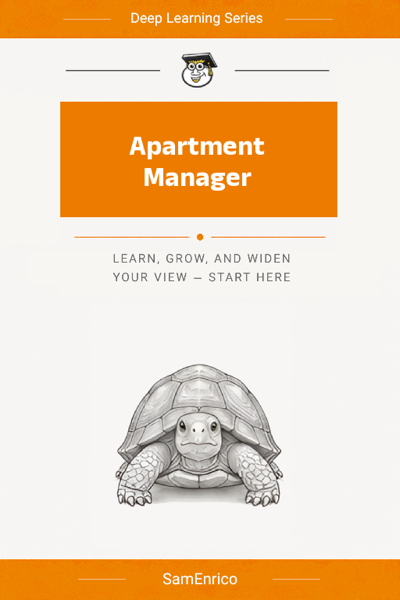
Non-FictionInformativeEducational
Apartment Manager eBook
A Coursebook on Apartment Manager
by Doan Kathlyn
A Coursebook on Apartment Manager
Formats
Free sample
Chapter 1: Beyond Rent Collection--The property smelled of burnt coffee and desperation. It was 7:45 on a Tuesday morning, and the new apartment manager, fresh from a two-day certification course, was about to learn the difference between theory and reality. An elderly woman in a bathrobe was screaming about a leaking toilet on the fourth floor. A man in work boots was demanding to know why his security deposit hadn't been returned—he'd moved out three years ago. And the owner, who never called before 10 AM, was already on line two, wanting to know why expenses were up 12% over last year.This is not a job about collecting rent.
This is a job about managing chaos, money, laws, emotions, and physical structures—often all before lunch. And yet, most people enter apartment management thinking it is exactly that: collecting rent and calling a plumber.The Great Misconception Ask a stranger what an apartment manager does, and they will say, "Collects rent and fixes things." Ask a new manager on their first day, and they might give a similar answer. Ask a seasoned professional who has survived five budget cycles, two evictions, and one fire alarm that turned out to be a tenant burning toast at 2 AM, and you will get a very different response.The modern apartment manager is not a rent collector. Rent collection is a byproduct of a much more complex role. The modern manager is an asset manager, a risk mitigator, a marketer, a counselor, a construction supervisor, a financial analyst, a diplomat, and occasionally, an amateur detective trying to figure out who left a couch in the recycling bin.This chapter exists to shatter the misconception before it takes root.
Because if you start this career thinking you are a rent collector, you will fail. You will be overwhelmed, underappreciated, and ultimately replaced by someone who understands the real job. If you start this career understanding that you are a micro-entrepreneur responsible for maximizing return on investment while serving as a community leader, you will not only survive but thrive.The Historical Evolution: From Janitor to Executive To understand where apartment management is going, you must understand where it has been. The role did not always look like it does today. In fact, the transformation over the past fifty years is so dramatic that a manager from 1975 would barely recognize the job in 2025.The 1950s to 1970s: The Janitor-Collector Era In the post-war boom, apartment buildings were simpler.
A building had a superintendent who lived on-site—often in a reduced-rent unit—and that superintendent was responsible for cleaning common areas, changing light bulbs, collecting rent in a ledger book, and calling the owner if something major broke. These superintendents were rarely trained in finance, law, or marketing. They were janitors who happened to hold a rent ledger.The owner was typically a local investor who knew every tenant by name. There was no professional property management industry to speak of. If you wanted to manage apartments, you learned by watching someone else do it, usually your father or uncle.The 1980s to 1990s: The Professionalization Era Two things changed the industry forever in the 1980s.
First, institutional investors discovered apartment buildings. Pension funds, insurance companies, and real estate investment trusts began buying apartment portfolios worth hundreds of millions of dollars. These investors did not want janitors managing their assets. They wanted professionals with budgets, reports, and accountability.Second, the Institute of Real Estate Management (IREM) and the National Apartment Association (NAA) expanded their certification programs. The Certified Property Manager (CPM) and Certified Apartment Manager (CAM) designations created a career path.
Suddenly, apartment management was a profession, not a side job for a building superintendent.During this era, managers learned to read financial statements, create operating budgets, and comply with the relatively new Fair Housing Act of 1968 and its amendments. The job expanded from maintenance and rent collection to include marketing, leasing, and basic financial management.The 2000s to 2020: The Technology and Customer Service Era The internet changed everything. Prospective tenants no longer walked down the street looking for "For Rent" signs. They went online to Apartments.com, Zillow, and a dozen other Internet Listing Services (ILS). If your property did not have professional photos, a website, and an online application process, you were invisible.Customer service became a competitive weapon.
The rise of online reviews—Google, Yelp, Apartments.com—meant that every interaction with a resident was public. A rude leasing agent could cost the property millions in lost rent over time. Resident retention became a financial imperative, not a nice-to-have.Technology also introduced property management software like Yardi, Real Page, and App Folio. Managers could now track maintenance requests, process rent payments online, and generate financial reports at the click of a button. The janitor-collector was gone.
The data-driven manager had arrived.2020 to Present: The Asset Manager Era Today, the best apartment managers are not just operators—they are asset managers. They understand that every decision they make affects the property's Net Operating Income (NOI) and, ultimately, its sale price. They know that reducing expenses by 10,000adds10,000 adds 10,000adds100,000 to $200,000 in property value, depending on the capitalization rate.They use revenue management software—dynamic pricing tools that adjust rents daily based on market demand, similar to how airlines and hotels price their inventory. They analyze turnover costs, calculate resident lifetime value, and optimize concession strategies. They are micro-entrepreneurs, and the property is their business.The manager who does not understand NOI, cap rates, or revenue management will be replaced by someone who does.
This is not speculation. This is the current reality of the industry.The Micro-Entrepreneur Mindset What separates a great apartment manager from a mediocre one? It is not technical knowledge alone, though that matters. It is not years of experience, though that helps. It is a mindset: the micro-entrepreneur mindset.A micro-entrepreneur thinks like a business owner, even though they are an employee.
They ask different questions. Instead of "How do I fix this leak?", they ask "What is the most cost-effective way to fix this leak that also prevents future leaks?" Instead of "Should I raise rents?", they ask "What is the optimal rent price that maximizes occupancy and revenue simultaneously?" Instead of "The owner wants lower expenses," they ask "Which expenses actually add value, and which are waste?"The Fiduciary Duty At the heart of the micro-entrepreneur mindset is the concept of fiduciary duty. A fiduciary is someone who is legally and ethically obligated to act in the best interest of another party. For an apartment manager, that other party is the property owner.Fiduciary duty means you cannot make decisions that benefit yourself at the owner's expense. You cannot accept kickbacks from vendors.
You cannot hire your cousin's landscaping company if it charges above-market rates. You cannot ignore a maintenance problem because fixing it is hard and you would rather do something easier.But fiduciary duty is not just about avoiding bad behavior. It is also about proactive value creation. You have a duty to seek out opportunities to increase NOI, reduce risk, and preserve the physical asset. If you see a way to save the owner $20,000 per year on utilities…
This is the end of the free sample. Get the eBook to keep going. Buy now
About this book
Details
- Author
- Doan Kathlyn
- Publisher
- SamEnrico
- Language
- English
- Genre
- Non-Fiction, Informative, Educational
- Released
- 2026-05-06
- Pages (approx.)
- 145
- Available as
- eBook, Audiobook

Read better in the ZLOADR app
Your eBooks on your phone or tablet. Sign in with your SamEnrico account and start reading.
More by Doan Kathlyn
 The Group Project AnxietyDoan Kathlyn$11.99
 Medical Relapse Prevention After OverdoseDoan Kathlyn$11.99
 Ranked Ladder Gaming AddictionDoan Kathlyn$11.99
 Hydration Brain Function GuideDoan Kathlyn$11.99
 Circadian Rhythm And Bipolar DisorderDoan Kathlyn$11.99
 Caregiver Sleep Recovery GuideDoan Kathlyn$11.99
 Chaotic Home Survival SkillsDoan Kathlyn$11.99
 Resentment After ScamDoan Kathlyn$11.99
 Japanese Type 10 and Type 97 TanksDoan Kathlyn$11.99
 The Serpent’s Crown: How a Forgotten Queen Outwitted an EmpireDoan Kathlyn$11.99
 The Frozen Cartographer: Ibn Majid and the Uncharted Southern SeasDoan Kathlyn$11.99
 Silicon Throne: The Untold Rise and Fall of a Tech DynastyDoan Kathlyn$11.99
You may also like
 Hong Kong Handover 1997Dunn Johnnie$11.99
 Zumba For Postnatal Recovery CourseNeal Christian$11.99
 Zumba for BeginnersLadner Nikia$11.99
 YouTube Comment Mining GuideHumes Pandora$12.99
 Worry Box MeditationCarlin Rudy$11.99
 Workplace Stress MeditationNguyen Lynn$11.99
 Workplace Stress and Sleep RepairHawley Ivory$11.99
 Workplace Perfectionism CureDelaney Jeffry$11.99
 Workplace Injustice Anger GuideWallen Isabelle$11.99
 Work Addiction and Burnout LinkGreenwood Ester$11.99
 Women in Yoga and WellnessBeattie Galina$11.99
 Women in Stand Up ComedyChun Evangeline$11.99