
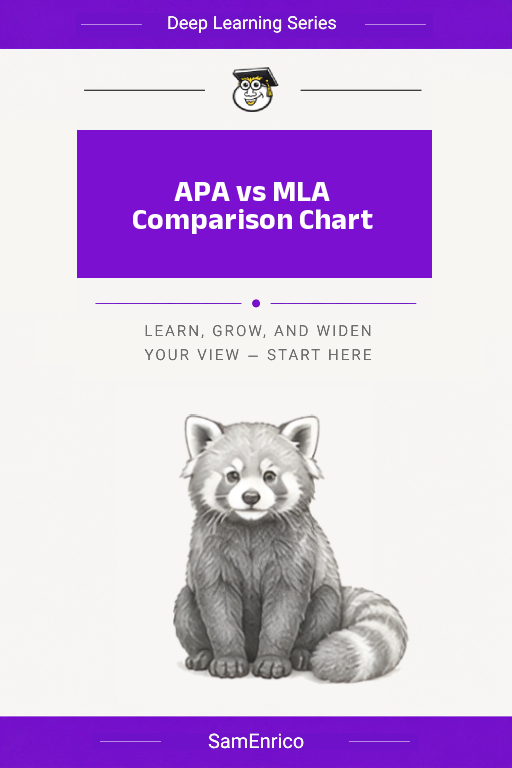
Non-FictionStudent's ShortcutComparison
APA vs MLA Comparison Chart eBook
Compare in-text citations, reference lists, and fo
Compare in-text citations, reference lists, and formatting rules side by side for quick switching.
Formats
Free sample
Chapter 1: The Two-Language Trap--You have just finished a twelve-page research paper. The arguments are sound. The evidence is irrefutable. The conclusion is devastatingly logical. You hit submit at 11:58 PM, two minutes before the deadline, and fall into bed feeling victorious.The next morning, your professor’s email arrives.
The subject line is three words that will haunt you for the rest of the semester: “See me please.”You walk to her office convinced she wants to discuss your brilliant thesis. Instead, she slides your paper across the desk. The margins are perfect. The citations are consistent. The formatting is immaculate.
There is only one problem.“This is in MLA,” she says. “The syllabus clearly requires APA.”Your heart stops. You open the syllabus on your phone. There it is, buried in paragraph seven of the course policies: “All written assignments must follow APA 7th edition formatting guidelines.” You missed it. Or maybe you read it and forgot.
Or maybe you assumed MLA would be fine because your last professor preferred it. The reason does not matter. What matters is that you have forty-eight hours to convert an entire paper into a citation style you have never used before.This book is for you.The Hidden Cost of Being Bilingual in Citation Every year, millions of students face this exact nightmare. They write a brilliant paper in one style, only to discover at the last moment that their professor expects the other. The problem is not that students are lazy or inattentive.
The problem is that universities treat citation styles as if they are interchangeable, when in fact they are fundamentally different languages with different grammar, different priorities, and different philosophies about what makes knowledge trustworthy.Think of it this way. English and Spanish both use the Latin alphabet. Both have nouns, verbs, and adjectives. Both can express the same ideas. But you would never write an essay in English and then run it through Google Translate to submit it for a Spanish class.
The grammar is different. The sentence structure is different. The very rhythm of the language is different.The same is true of APA and MLA. Both styles use parenthetical citations. Both require a list of sources at the end.
Both demand double-spacing and readable fonts. But these surface similarities are a trap. Beneath the surface, APA and MLA operate on completely different assumptions about what readers need to know and when they need to know it.APA, the style of the American Psychological Association, was designed for the social sciences. Psychology, sociology, nursing, education, and business all use APA. These fields care about one thing above all others: currency.
When a psychologist reads a study about the effectiveness of a new antidepressant, the first question is not who wrote it. The first question is when it was written. A study from 1995 might still be historically interesting, but it cannot inform current medical practice. The world has changed. The drug has been reformulated.
The patient population has shifted. The date tells the reader whether this knowledge is still alive or already dead.MLA, the style of the Modern Language Association, was designed for the humanities. Literature, philosophy, film studies, and rhetoric all use MLA. These fields care about one thing above all others: precision. When a literary scholar reads an analysis of a line from Shakespeare, the first question is not when it was written.
The first question is where exactly in the text that line appears. A claim about Act 2, Scene 1, line 42 cannot be evaluated without knowing exactly which words the scholar is interpreting. The page number tells the reader where to look to verify the evidence.These different priorities produce different citation formats. APA puts the date immediately after the author’s name, even before the title of the work. MLA puts the page number inside the parenthetical citation, even when paraphrasing.
These are not arbitrary rules designed to torture students. These are logical consequences of two different answers to the question: “What does a reader need to know first?”The problem is that students are rarely taught this philosophy. They are handed a style guide or a link to Purdue OWL and told to “follow the rules.” When they switch from one style to the other, they try to translate rule-by-rule: “MLA says to put the date at the end, so I will move the date from after the author’s name to after the publisher.” This works for simple cases. It fails catastrophically for complex ones.Consider what happens when you try to translate a citation for a journal article with three authors, accessed through a database, with a DOI, missing a publication date. In MLA, you omit the date entirely.
In APA, you write (n.d.). A rule-by-rule translator will look at the MLA citation, see no date, and produce an APA citation with no date and no (n.d.) placeholder. That is wrong. The translator did not understand that APA requires a placeholder for missing information while MLA requires silence. The translator was playing chess without knowing that the two games have different rules for what counts as a legal move.This book exists to teach you the deep structure of both citation languages so that you never have to translate rule-by-rule again.
Instead, you will learn to think in APA and think in MLA, switching between them the way a bilingual speaker switches between English and Spanish without mentally conjugating every verb.The Anatomy of a Citation: Three Questions Every Citation Answers Before we dive into the specific differences between APA and MLA, we need to understand what every citation does, regardless of style. Every citation in every academic discipline answers three fundamental questions. The styles simply disagree about the order in which to present the answers and which answers require special formatting.The three questions are:Who created this knowledge?When was this knowledge created?Where can I find this knowledge?In APA, the answers appear in this order: Who, When, Where. The author’s name comes first because the credibility of research depends on who performed it. The date comes second because the relevance of research depends on when it was performed.
The title and source information come last because the reader only needs to locate the work after deciding it is credible and current.In MLA, the answers appear in a different order: Who, Where, When. The author’s name still comes first, but for a different reason. In the humanities, the author’s authority comes from their interpretation, not their methodology. The title and source information come second because the reader needs to locate the exact text being analyzed. The date comes last because a Shakespeare interpretation from 1950 is not necessarily less valid than one from 2020.
Older scholarship in the humanities is often still foundational.This difference in ordering explains almost every formatting difference between the two styles. Once you understand that APA treats the date as the second most important element and MLA treats it as the least important, the rules stop feeling arbitrary and start feeling logical.Let us test this insight on a real example. Consider the following book citation in APA:Bruner, J. (1996). The culture…
This is the end of the free sample. Get the eBook to keep going. Buy now
About this book
Details
- Author
- Minnick Elfriede
- Publisher
- SamEnrico
- Language
- English
- Genre
- Non-Fiction, Student's Shortcut, Comparison
- Released
- 2026-05-30
- Pages (approx.)
- 142
- Available as
- eBook, Audiobook

Read better in the ZLOADR app
Your eBooks on your phone or tablet. Sign in with your SamEnrico account and start reading.
More by Minnick Elfriede
 Sobriety Affirmation Audio GuideMinnick Elfriede$11.99
 Gambling Addiction For StudentsMinnick Elfriede$11.99
 Emotion Regulation For VeteransMinnick Elfriede$11.99
 The Urgency Addiction FixMinnick Elfriede$11.99
 Gladness Breath MeditationMinnick Elfriede$11.99
 Joseph Campbell PowerMinnick Elfriede$11.99
 Antwerp Heist PodcastsMinnick Elfriede$11.99
 Mammogram ScreeningMinnick Elfriede$11.99
 The Golden Age of Axum: Africa's First Global EmpireMinnick Elfriede$11.99
 The Djinn of the Northern Wastes: A Norse-Meets-Arabian SagaMinnick Elfriede$11.99
 Mastering The Art of Jogo Do PauMinnick Elfriede$11.99
 How to Become a Roll GrinderMinnick Elfriede$11.99
You may also like
 Hong Kong Handover 1997Dunn Johnnie$11.99
 Zumba For Postnatal Recovery CourseNeal Christian$11.99
 Zumba for BeginnersLadner Nikia$11.99
 YouTube Comment Mining GuideHumes Pandora$12.99
 Worry Box MeditationCarlin Rudy$11.99
 Workplace Stress MeditationNguyen Lynn$11.99
 Workplace Stress and Sleep RepairHawley Ivory$11.99
 Workplace Perfectionism CureDelaney Jeffry$11.99
 Workplace Injustice Anger GuideWallen Isabelle$11.99
 Work Addiction and Burnout LinkGreenwood Ester$11.99
 Women in Yoga and WellnessBeattie Galina$11.99
 Women in Stand Up ComedyChun Evangeline$11.99