
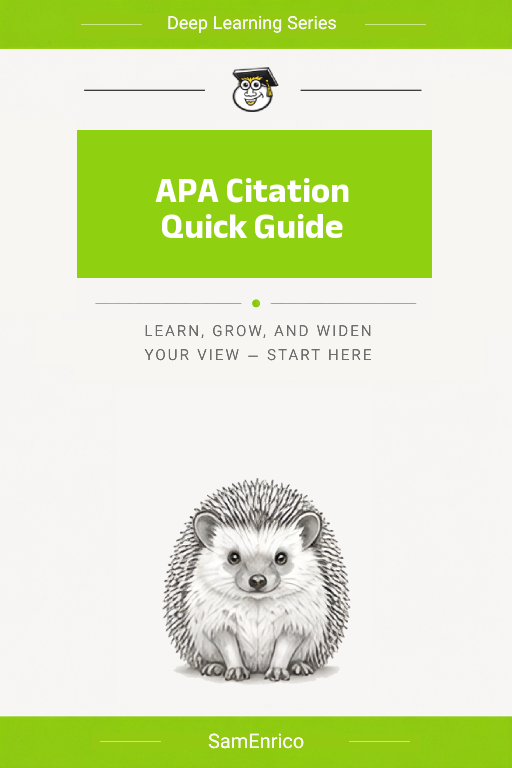
Non-FictionStudent's ShortcutAPA Style
APA Citation Quick Guide eBook
Learn APA 7th edition citations for psychology edu
Learn APA 7th edition citations for psychology education and social sciences. Master author date format and reference list entries fast.
Formats
Free sample
Chapter 1: The Citation Address...--You are staring at a blank page. Or worse, you are staring at a reference list that your professor has marked up with so much red ink it looks like a crime scene. You have a sinking feeling that APA 7th edition is a secret language designed to keep outsiders out of the academic club. You have tried watching You Tube tutorials, but they move too fast. You have tried asking your classmates, but they are just as confused as you are.
You have even tried reading the official APA manual, but at 427 pages, it feels less like a guide and more like a weapon you could use to defend yourself from citations altogether.Stop right there. Take a breath. This chapter is going to change everything you think you know about citations.Here is the secret that no one has told you: APA citations are not complicated. They are just specific. There is a massive difference between something being complicated (requiring advanced intelligence to understand) and something being specific (requiring attention to detail).
You do not need to be a genius to master APA 7th edition. You just need a system.This chapter gives you that system. By the time you finish reading these pages, you will understand the single most important concept in APA Style, a concept that makes every citation you will ever write feel like filling in a simple form. You will learn why citations exist, what they are made of, and how to stop being afraid of them. Most importantly, you will learn that you already know 90 percent of what you need.
You just need someone to show you the pattern.Let us start with a confession from someone who has taught APA Style to thousands of students. Every single semester, a student comes to office hours with a reference list that is completely wrong. The student is ashamed. The student apologizes. And every single time, after fifteen minutes of explanation, that same student says the same thing: "Wait, that is it?
That is all it is?"Yes. That is all it is. Let me prove it to you.The One Sentence That Explains Every Citation You Will Ever Write Here is the entire universe of APA 7th edition citations, compressed into a single sentence that you can memorize right now:Someone said something at some time, and you can find it in this specific place.That is it. That is the whole game. Every citation you will ever write, whether it is for a journal article, a book, a You Tube video, a tweet, or a government report, answers four questions:Who said it?
(The author)When did they say it? (The date)What is the name of the thing they said? (The title)Where can I find it? (The source information)The difference between a perfect APA citation and a failing one has nothing to do with intelligence. It has everything to do with whether you put those four pieces of information in the correct order, with the correct punctuation, and with the correct formatting applied to each piece.Think of it like a mad lib.
Remember those? You fill in the blanks with nouns and verbs and adjectives, and at the end you have a silly story. APA citations are exactly the same, except the story is not silly and the blanks are always the same. Here is the mad lib for a journal article:Last name, First initial. (Year).
Title of the article in sentence case. Title of the Journal in Title Case and Italics, volume number(issue number), page range. https://doi.org/xxxxx Every journal article you will ever cite follows that exact pattern. Every single one. The only thing that changes is the information you put into the blanks.Once you understand that a citation is just a fill-in-the-blank form, the fear starts to dissolve.
You are not solving a puzzle. You are not decoding a mystery. You are just moving information from the source you are looking at into a template that never changes.Why Citations Exist (It Is Not to Torture You)Before we go any further, let us talk about why anyone invented this system in the first place. Understanding the purpose of citations will help you remember the rules, because the rules are not arbitrary. They serve a function.The American Psychological Association created its style guide for one reason: to make research easier to follow.
Imagine you are reading a psychology paper that claims that sleep deprivation reduces working memory capacity. You want to check the original study that made that claim, because you are writing your own paper on the same topic. How do you find it?The citation tells you. It gives you an address.This is the most important analogy you will learn. Citations are addresses.
An in-text citation is like saying "See 123 Main Street." A reference list entry is like writing out the full address: "123 Main Street, Apartment 4B, Anytown, State, ZIP Code." The in-text citation tells your reader that there is a source somewhere. The reference list entry tells them exactly how to walk to its front door.If your citation is wrong, your reader cannot find the source. And if your reader cannot find the source, your paper loses credibility. That is why professors deduct points for citation errors. It is not because they enjoy watching you suffer.
It is because inaccurate citations undermine the entire enterprise of academic research.Think about it this way: if you gave someone directions to your apartment and you told them the wrong street number, they would end up at the wrong building. If you told them the wrong city, they would end up hours away. Every piece of information in a citation matters because every piece of information is part of the address.This is also why APA updates its style guide every few years. The way we find sources changes. When almost everything was print, citations looked one way.
Now that almost everything is digital, citations look another way. APA 7th edition reflects the reality of research in the 2020s: DOIs, URLs, and digital archives have replaced physical libraries for most searches.So when you feel frustrated by a citation rule, ask yourself: does this rule help someone find the source? Almost always, the answer is yes. And that answer makes the rule easier to remember.The Two Halves of Every Citation Every citation in APA Style has two halves. You cannot have one without the other.
If you try, your paper will be incomplete and your professor will deduct points.Half One: The In-Text Citation The in-text citation lives inside your paper, right next to the information you are borrowing. It is brief. It is parenthetical. It looks like this: (Smith, 2020). That is all.
Three pieces of information: the author's last name, a comma, and the year.When your reader sees (Smith, 2020), they know two things. First, they know that the sentence they just read came from a source written by someone named Smith. Second, they know that if they look at your reference list, they will find a full entry for Smith from…
This is the end of the free sample. Get the eBook to keep going. Buy now
About this book
Details
- Author
- Coffman Randee
- Publisher
- SamEnrico
- Language
- English
- Genre
- Non-Fiction, Student's Shortcut, APA Style
- Released
- 2026-06-01
- Pages (approx.)
- 139
- Available as
- eBook, Audiobook

Read better in the ZLOADR app
Your eBooks on your phone or tablet. Sign in with your SamEnrico account and start reading.
More by Coffman Randee
 Memory Palace Studying GuideCoffman Randee$11.99
 Career Transition After RelocationCoffman Randee$11.99
 Citation Rules Spaced Repetition CourseCoffman Randee$11.99
 Laci Peterson Home VideosCoffman Randee$11.99
 Upwork Job Search AutomationCoffman Randee$11.99
 Boundaries For High AchieversCoffman Randee$11.99
 Carnegie Gospel WealthCoffman Randee$11.99
 Relationship App ToolkitCoffman Randee$11.99
 GST Registration for Service Providers HandbookCoffman Randee$11.99
 The Silent Code: When Language Died in the Black DeathCoffman Randee$11.99
 The Last Broadcast: The Day Radio Saved the WorldCoffman Randee$11.99
 The Forgotten Surgeon: Dr. Frances Hesselbein and the Battlefield Nurses of WWIICoffman Randee$11.99
You may also like
 Hong Kong Handover 1997Dunn Johnnie$11.99
 Zumba For Postnatal Recovery CourseNeal Christian$11.99
 Zumba for BeginnersLadner Nikia$11.99
 YouTube Comment Mining GuideHumes Pandora$12.99
 Worry Box MeditationCarlin Rudy$11.99
 Workplace Stress MeditationNguyen Lynn$11.99
 Workplace Stress and Sleep RepairHawley Ivory$11.99
 Workplace Perfectionism CureDelaney Jeffry$11.99
 Workplace Injustice Anger GuideWallen Isabelle$11.99
 Work Addiction and Burnout LinkGreenwood Ester$11.99
 Women in Yoga and WellnessBeattie Galina$11.99
 Women in Stand Up ComedyChun Evangeline$11.99