
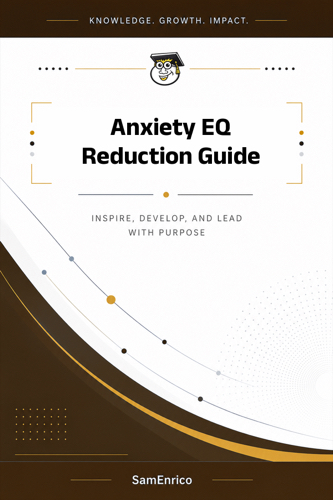
Anxiety EQ Reduction Guide eBook
Applies EQ skills to identify and calm anxious tho
by Pina Danille
Applies EQ skills to identify and calm anxious thoughts.
Formats
Free sample
Chapter 1: The 3:17 AM Question--–- You are lying in bed. The clock says 3:17 AM. Your chest feels like a fist is pressing from the inside. Your mind is not thinking one thing—it is thinking everything. Every email you sent yesterday.
Every word you said at dinner. Every possible disaster that tomorrow might bring. The meeting where you might be asked a question you cannot answer. The text you sent that received only a thumbs-up instead of the usual enthusiasm. The thing you said three years ago that still surfaces at 3:17 AM like clockwork.You tell yourself: "I am just anxious."And you are right.
But you are also wrong.Because "anxious" is almost never the real emotion.It is the mask. It is the smoke alarm. It is the sound the house makes when something is burning somewhere else, but you cannot yet see the fire. And if you only try to silence the alarm—by distracting yourself, by numbing with your phone or a glass of wine, by forcing yourself to "think positive"—the fire keeps burning. The alarm keeps screaming.
And 3:17 AM keeps arriving.This book is not about silencing the alarm. It is about reading it.This book is about asking the question that changes everything: Under the anxiety, what is actually there?The Great Mask: What Anxiety Hides Most people believe that anxiety is a primary emotion. They think that "feeling anxious" is the baseline—that the anxiety itself is the problem. But decades of clinical research and emotional intelligence science point to a different conclusion. Anxiety is almost always a secondary emotion.
It is what you feel when you will not feel what you are actually feeling.Think of it this way. Sadness is vulnerable. It requires admitting loss or disappointment, and no one likes to admit those. Anger is dangerous. It requires acknowledging that someone or something has wronged you, which might lead to conflict or confrontation.
Fear is embarrassing. It requires admitting that you are not in control, that you are smaller than the situation. Shame is unbearable. It requires looking at the parts of yourself you would rather hide.Anxiety, by contrast, is socially acceptable. You can tell your boss you are "feeling anxious about the deadline" and they will nod sympathetically.
You can tell your partner you are "stressed" and they will offer you tea. But if you said, "I am feeling humiliated because I think you have lost respect for me," or "I am angry that you ignored me today," or "I am ashamed of how I acted at the party"—those conversations are harder. They require vulnerability. They require risk.So your brain takes the easier path. It takes the raw, vulnerable, specific emotion and translates it into the vague, general, acceptable feeling we call anxiety.But translation loses information.
Every translation is a betrayal of the original. When you say "I am anxious," you are speaking in a language that is too broad to be useful. It is like telling a mechanic that your car "sounds weird." That is true, but it is not actionable. The mechanic needs to know: is it a grinding sound? A squeal?
A knock? Each sound points to a different problem.Your emotions work the same way.The Cost of Vague Language Psychologists call the ability to label emotions with precision emotional granularity. People with high emotional granularity do not just say they feel "bad" or "stressed" or "anxious." They say they feel "disappointed" or "lonely" or "humiliated" or "envious" or "weary" or "hollow." And here is what the research shows: the more specific your emotional vocabulary, the faster your brain can regulate whatever you are feeling.This makes sense when you think about it. A vague alarm is terrifying because you do not know what to do. A specific alarm—"the smoke detector in the kitchen is going off because the toast is burning"—is manageable.
You know exactly what to do. You do not panic. You simply walk to the toaster and press the button.Anxiety is the sound of a smoke detector when you do not know where the fire is. The purpose of this chapter—and this book—is to teach you how to locate the fire.Let me give you an example.Two people receive the same text message from a friend: "We need to talk."Person A says: "I am anxious." That is all. They spiral for hours.
They imagine every terrible possibility. Their heart races. They cannot focus. They are stuck in the vague fog of anxiety.Person B says: "I am feeling a combination of fear and shame. The fear is about being rejected.
The shame is about something I said last week that I am still worried was inappropriate." Person B still feels uncomfortable. But they have located the fire. They know exactly what they are afraid of (rejection) and what they are ashamed of (last week's comment). Now they have options. They can text their friend and apologize for last week.
They can remind themselves that one awkward comment rarely ends a friendship. They can accept the fear without being consumed by it.Person A is stuck. Person B is moving.The difference is emotional granularity. And it is a skill you can learn.The Four Ways We Fail at Feelings Before we teach you how to process emotions, we need to name the four ways most people fail at them. As you read these, you will likely recognize yourself in at least one—probably more.Response One: Reacting This is the impulse response.
Someone says something that stings, and three seconds later you have said something you regret. Your boss criticizes your work, and you immediately defend yourself or cry or shut down. Your partner forgets to do something they promised, and you are already ten sentences into an accusation before you realize you are not even sure what you are angry about.Reacting feels like action. It feels like you are doing something. But reacting is not action—it is the absence of choice.
It is your nervous system hijacking your behavior before your thinking brain has a chance to weigh in. Every reactive moment is a moment you handed the steering wheel to your anxiety.Response Two: Resisting This is the suppression response. You feel something unpleasant—sadness, anger, fear—and you immediately try to push it down. You tell yourself you should not feel this way. You grit your teeth.
You smile through it. You say "I am fine" when you are clearly not fine.Resisting an emotion is like trying to hold a beach ball underwater. It takes constant energy. And eventually, your arms get tired. The beach ball explodes upward, usually at the worst possible moment—in the middle of a meeting, at 3:17 AM, during an argument with someone you love.
What you resist does not disappear. It waits.Response Three: Avoiding This is the numbing response. You do not try to push the emotion down. Instead, you try to run away from it. You scroll social media for two hours.
You pour a drink. You binge a television show you do not even like. You work late for the fourth…
This is the end of the free sample. Get the eBook to keep going. Buy now
About this book
Details
- Author
- Pina Danille
- Publisher
- SamEnrico
- Language
- English
- Genre
- Non-Fiction, Self-Help, Anxiety
- Released
- 2026-06-08
- Pages (approx.)
- 123
- Available as
- eBook, Audiobook

Read better in the ZLOADR app
Your eBooks on your phone or tablet. Sign in with your SamEnrico account and start reading.
More by Pina Danille
 Stress Eating and Partner SupportPina Danille$11.99
 The Sleep Sanctuary MethodPina Danille$11.99
 Self Worth And CodependencyPina Danille$11.99
 The Nursing Student BurnoutPina Danille$11.99
 Peg System for Pi DigitsPina Danille$11.99
 Memory Palace QuizPina Danille$11.99
 Medical Trauma DreamsPina Danille$11.99
 Metta For RegretPina Danille$11.99
 The Celestial Weaver and the Storm God: A Love Forged in Silk and ThunderPina Danille$11.99
 The Duke and the Dancer: A Royal ScandalPina Danille$11.99
 Tezcatlipoca’s Shadow War: The Jaguar’s GambitPina Danille$11.99
 Growing EhretiaPina Danille$11.99
You may also like
 Hong Kong Handover 1997Dunn Johnnie$11.99
 Zumba For Postnatal Recovery CourseNeal Christian$11.99
 Zumba for BeginnersLadner Nikia$11.99
 YouTube Comment Mining GuideHumes Pandora$12.99
 Worry Box MeditationCarlin Rudy$11.99
 Workplace Stress MeditationNguyen Lynn$11.99
 Workplace Stress and Sleep RepairHawley Ivory$11.99
 Workplace Perfectionism CureDelaney Jeffry$11.99
 Workplace Injustice Anger GuideWallen Isabelle$11.99
 Work Addiction and Burnout LinkGreenwood Ester$11.99
 Women in Yoga and WellnessBeattie Galina$11.99
 Women in Stand Up ComedyChun Evangeline$11.99